
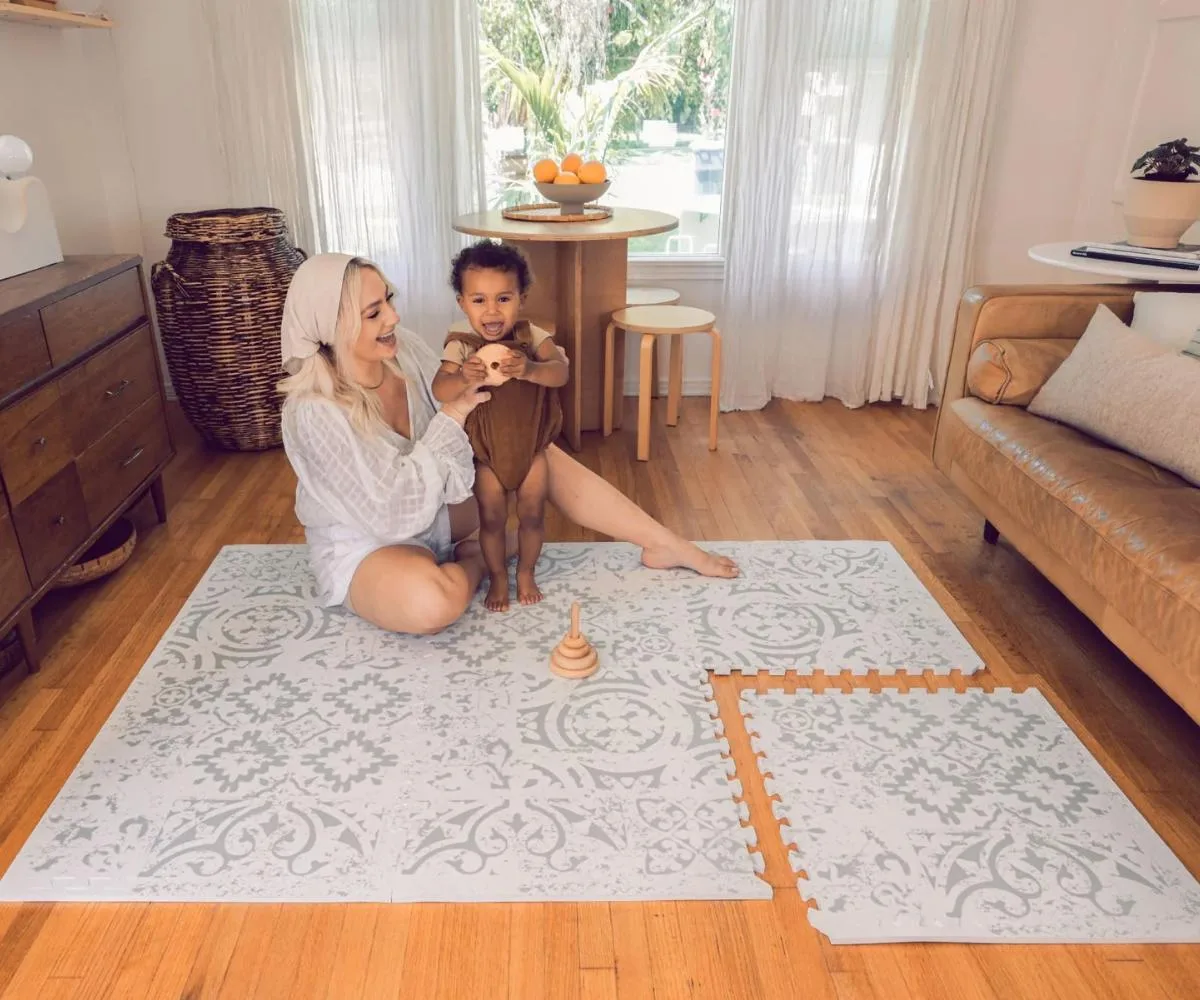
You see EVA foam puzzle mats everywhere: in nurseries, playrooms, home gyms, classrooms and trade show booths. They look simple, but two mats that seem identical in a product photo can differ a lot in foam quality, chemical safety, print durability and fit. This guide explains what an EVA foam puzzle mat is, which styles exist, what to check for safety, which sizes and thicknesses suit which rooms, and how to install and care for the mats. If you are a brand or importer planning your own line, the last sections cover what to ask a manufacturer.
What Is EVA Foam?
Ethylene vinyl acetate (EVA) is a copolymer of ethylene and vinyl acetate. When the resin is compounded and expanded, it becomes a closed-cell foam that is soft, flexible and light. Because the cells are closed, the foam does not soak up water, which is why EVA shows up in shoe soles, sports gear, packaging, marine products and toys. For flooring, that combination of cushioning, low weight and water resistance makes it a practical choice for floors that need to be soft underfoot and easy to wipe down.
Not all EVA foam is the same, though. Density, the additives used during foaming and the chemical residue left after production all affect how a mat feels, how long it lasts and whether it is suitable for babies. We cover the safety side in detail below.
What Is an EVA Foam Puzzle Mat?
An EVA foam puzzle mat is a modular floor covering made of interlocking EVA tiles. Each tile has puzzle-shaped edges, so tiles click together into one continuous surface that you can expand, reshape or take apart. Most tiles have a textured, anti-slip surface. Many come with removable border strips that give the outer edge a straight, finished look.
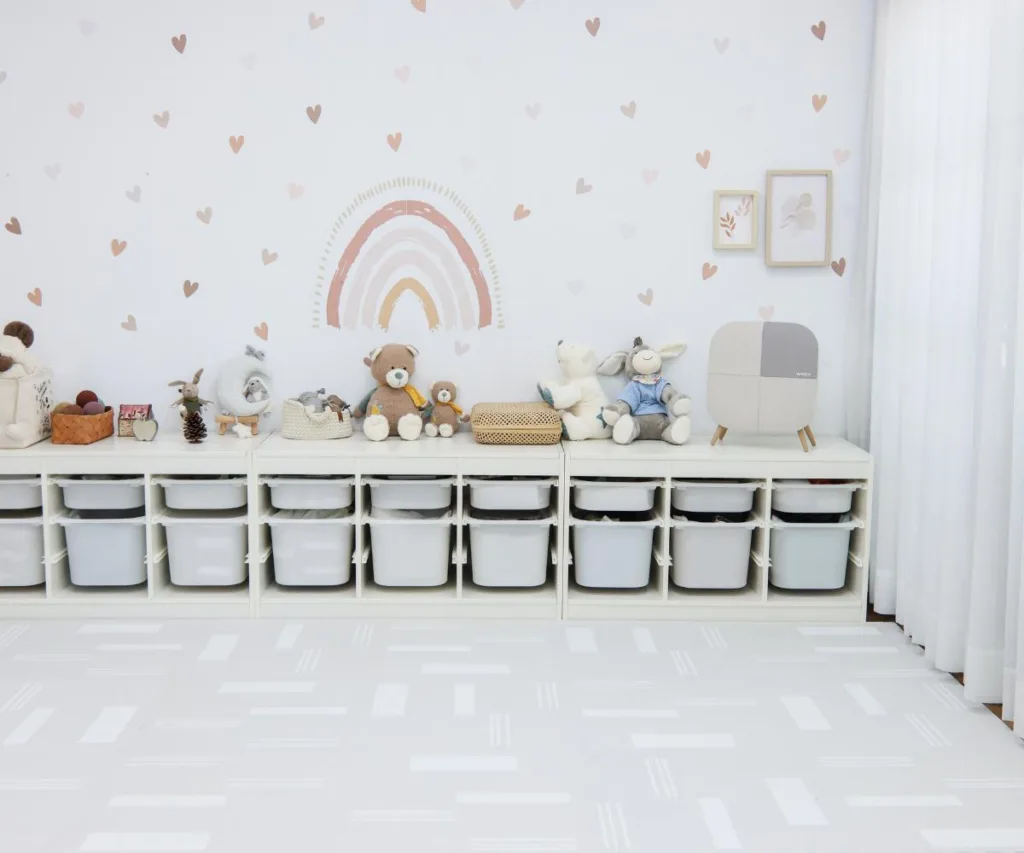
Because the tiles are lightweight and modular, one set can cover a small tummy-time corner today and a full playroom later. That flexibility is a big reason parents, schools and gyms choose interlocking foam over a single large rug.
Types of EVA Foam Puzzle Mats
Puzzle mats now range from basic solid-color tiles to printed designs that look like area rugs. Here are the main styles you will find.
1. Rug-style printed puzzle mats
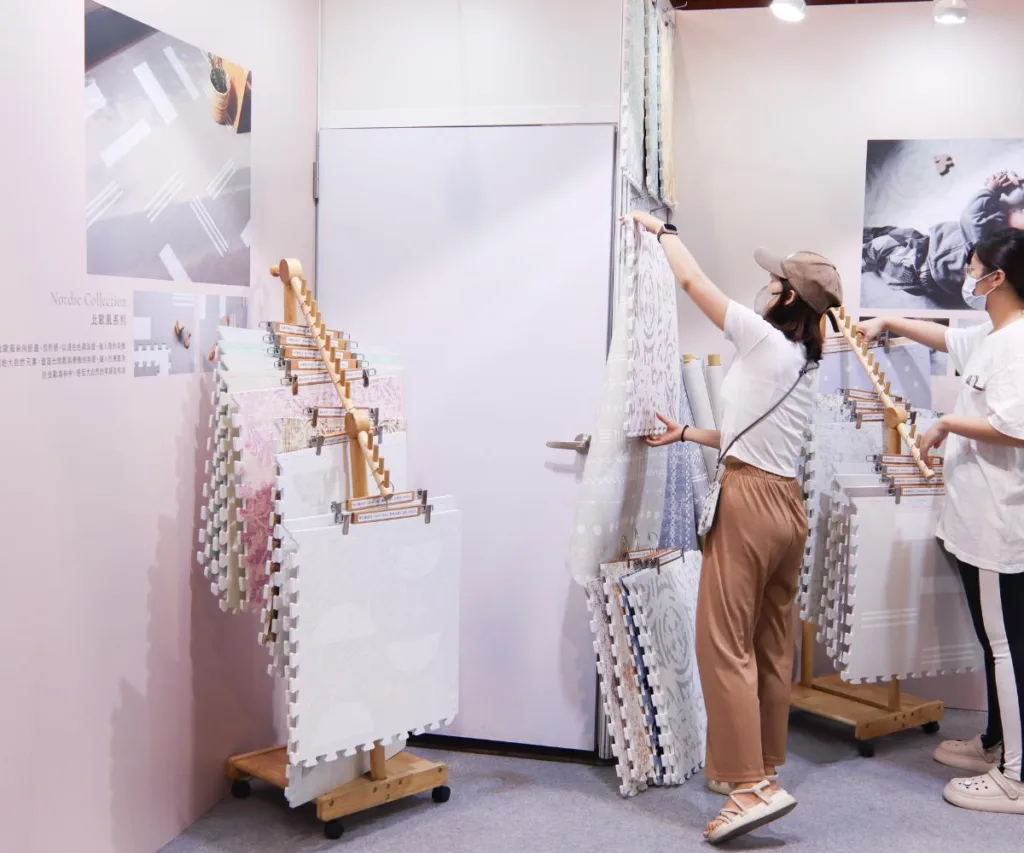
Komat started developing printed, rug-pattern EVA foam mats in 2015. Instead of bright primary colors, these mats carry full designs, such as Moroccan, Persian, vintage, Nordic, Scandinavian and terrazzo patterns, in neutral tones from warm beige to soft gray. The tiles still interlock like any puzzle mat, but the pattern lines up across the seams, so the finished floor reads as one rug. Besides squares, printed mats can be made as rectangles and other shapes.
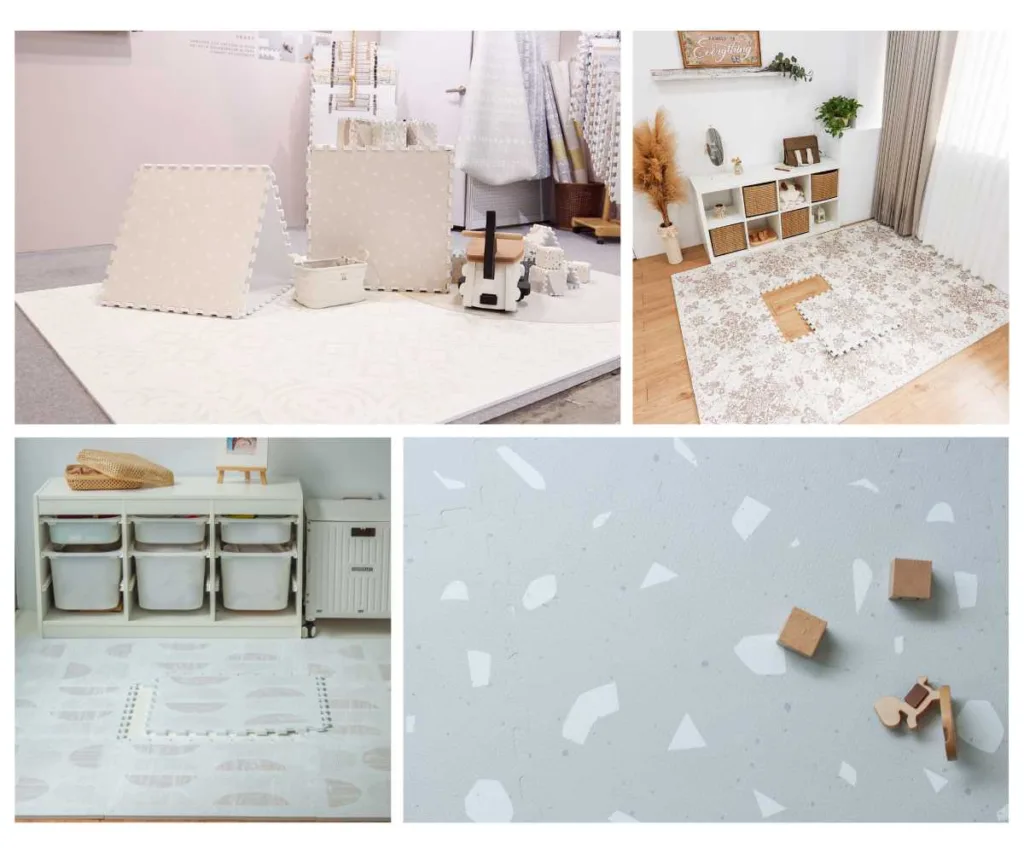
The weak point of many printed mats is the top film. If the printed layer is laminated as one continuous sheet, it can lift and peel at the tile edges after repeated use. Komat uses a patented non-continuous print lamination process so the film stays bonded and does not peel. You can read how it works on our printing and lamination page, and browse ready designs in our private label design library.
A printed baby mat typically uses a 1/2-inch (about 1.2 cm) tile, which is soft enough for tummy time and crawling and grows with the child into a toddler play area. Tiles can be rearranged or added as the space changes.
2. Solid-color puzzle mats
The classic foam puzzle mat comes in solid colors, such as red, yellow, blue, green and pink, or in calmer neutrals. These mats are common in basements, playrooms and home gyms. For private label lines, colors can be matched to Pantone references.
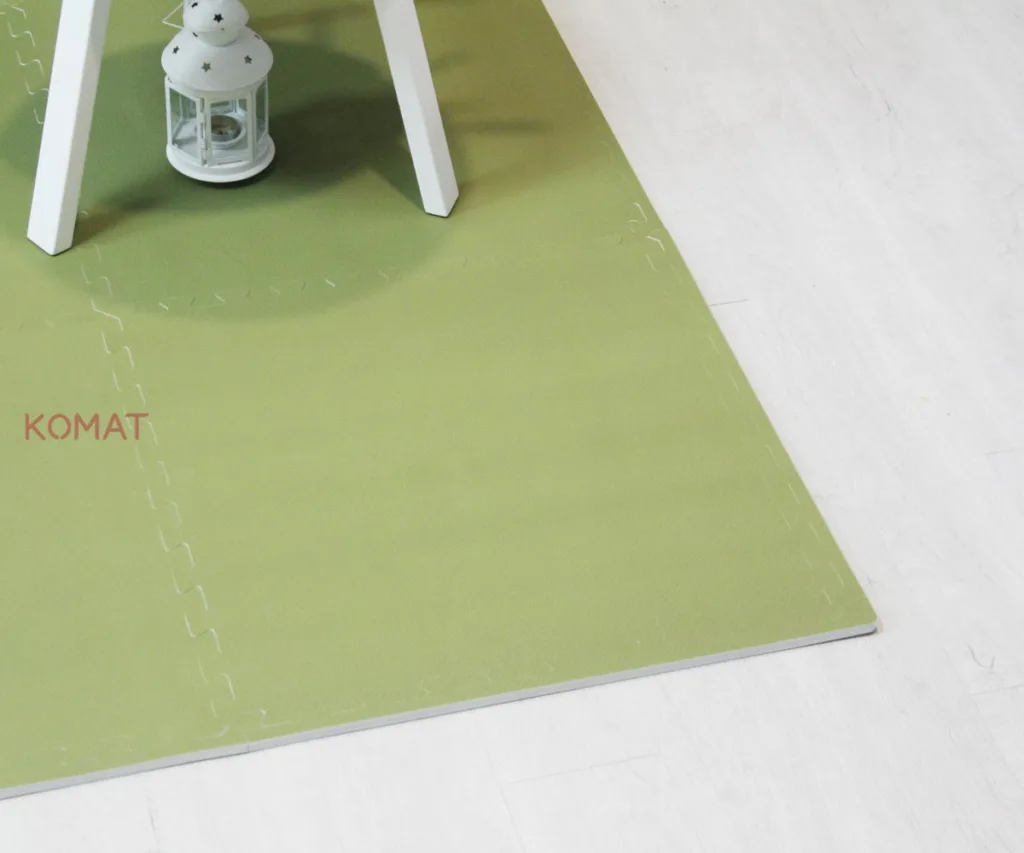
Common thicknesses are 10 mm, 12 mm and 20 mm, and tile sizes usually range from 30 x 30 cm to 60 x 60 cm. Thicker tiles give more cushioning. A 10 mm tile is generally enough for a child’s playroom, while heavier use calls for more thickness.
3. Tatami-style foam mats
Tatami-textured puzzle mats are built for exercise and martial arts. They are typically 100 x 100 cm and come in thicknesses of 20, 25, 30 and 40 mm. A 20 mm mat suits controlled, low-impact training, while 40 mm offers more protection for disciplines with throws and falls. Many tatami mats are reversible, with a different color on each side and an anti-slip texture on both faces.
4. Kids’ learning mats
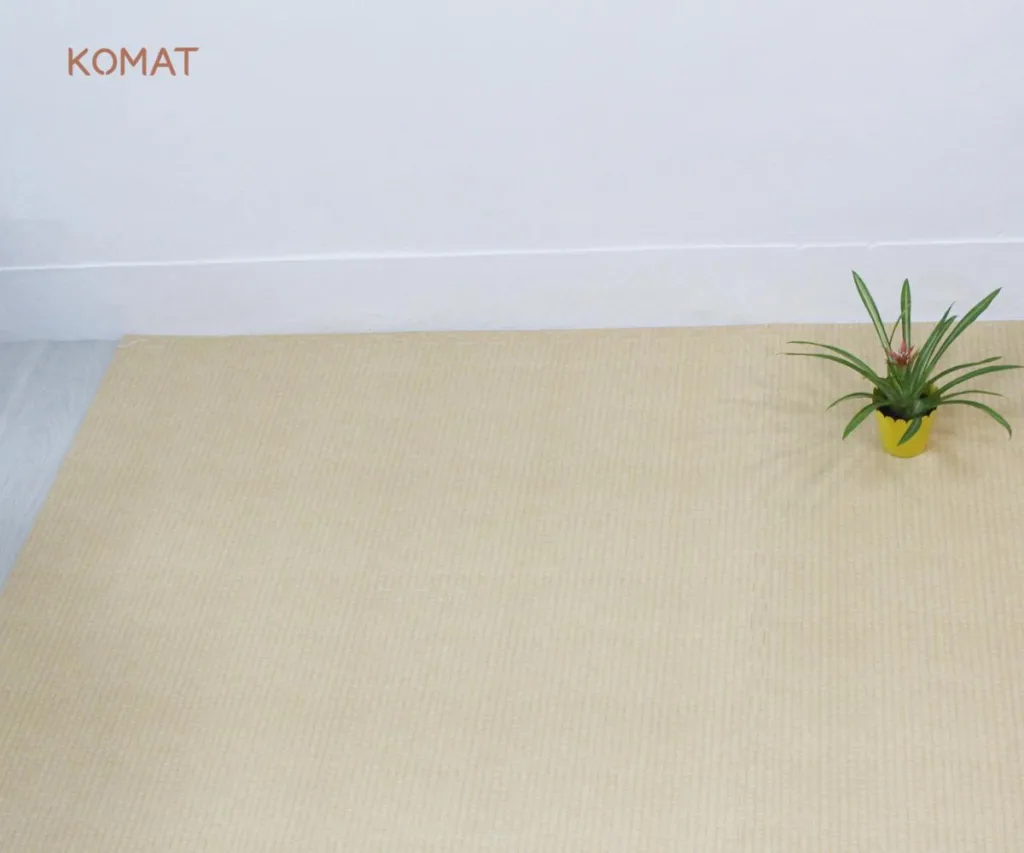
Learning mats combine play and early education. Tiles feature numbers, letters, animals or shapes, and the cut-out pieces can be popped out and used as toys. These are usually 30 x 30 cm tiles around 10 mm thick, with removable border strips. Custom artwork is also possible for brands that want their own theme, such as the bold black-and-white pattern below.

5. Wood-grain foam mats
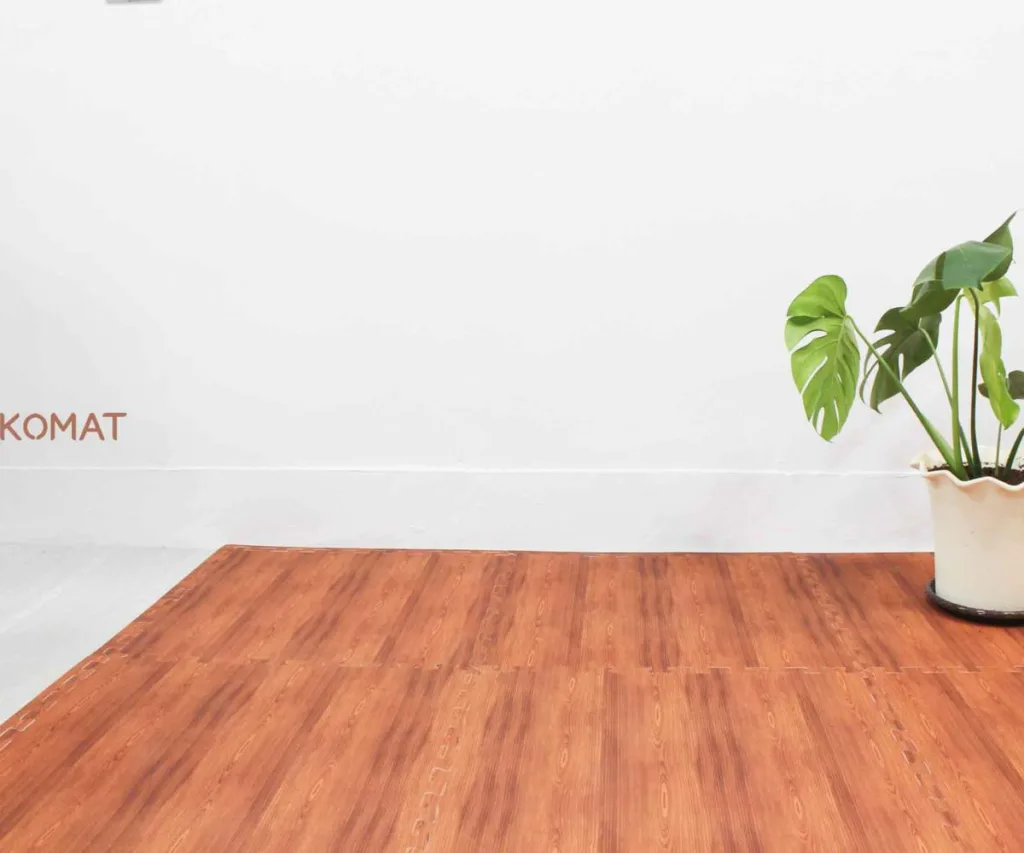
Wood-grain mats have a laminated top layer with a textured wood pattern, so they look like a wooden floor while staying soft and quiet. They are popular in living areas and trade show booths, typically in 60 x 60 cm tiles, and they are an affordable way to get a warm wood look with better cushioning and less noise than hard flooring.
Quick Comparison: Which Puzzle Mat Fits Which Space?
| Mat type | Typical tile size | Typical thickness | Best for |
|---|---|---|---|
| Rug-style printed | Squares, rectangles and custom shapes | 1/2 in (about 12 mm) | Nurseries, living rooms, baby play areas |
| Solid color | 30 x 30 cm to 60 x 60 cm | 10, 12 or 20 mm | Playrooms, basements, home gyms |
| Tatami | 100 x 100 cm | 20 to 40 mm | Martial arts, exercise rooms |
| Kids’ learning | 30 x 30 cm | About 10 mm | Classrooms, daycares, playrooms |
| Wood grain | 60 x 60 cm | Varies by line | Living areas, trade show booths |
Where Interlocking Foam Mats Are Used
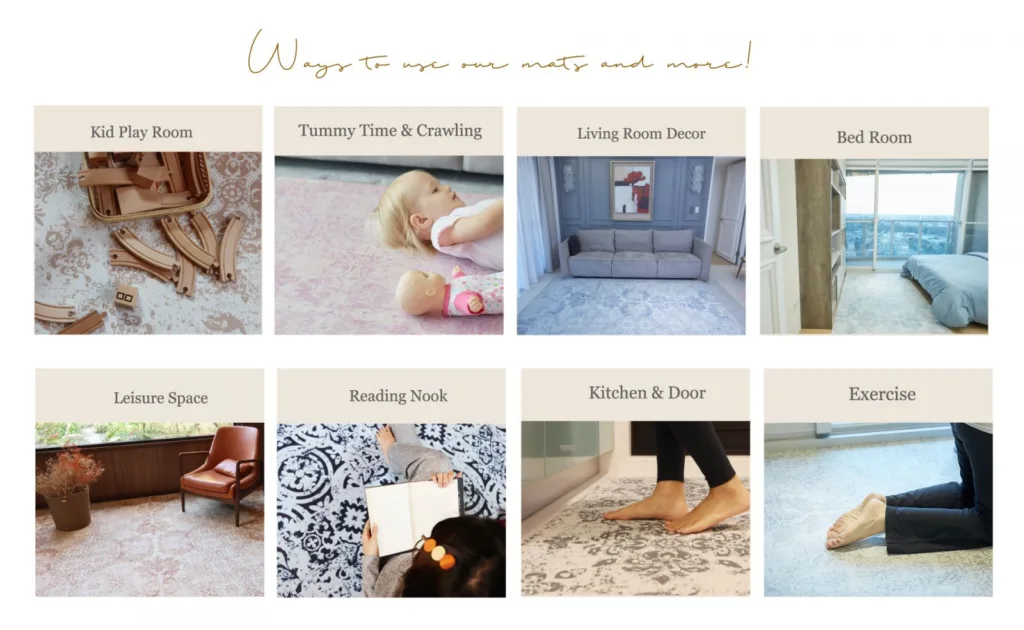
Because they are modular, light and water resistant, interlocking foam mats work in many settings:
- Baby and kids’ playrooms: a soft, anti-slip surface for crawling, tumbles and floor play.
- Living rooms and bedrooms: rug-style mats replace a carpet with something softer and easier to clean.
- Home gyms: cushioning for floor exercises and protection for the floor beneath equipment.
- Classrooms and daycares: a soft, insulated surface for sitting, playing and learning.
- Martial arts and dance studios: shock absorption for falls, jumps and footwork.
- Basements, workshops and garages: warmth underfoot and protection from dropped tools and spills.
- Trade show booths and events: comfortable, attractive flooring that installs and packs down quickly.
- Craft corners: a forgiving, wipeable work surface that protects the floor.
Why People Choose EVA Foam Mats
- Comfort: the foam cushions knees, elbows and little tumbles.
- Anti-slip surface: a textured finish reduces slipping for kids and adults.
- Water resistance: closed-cell foam does not absorb spills, so liquids stay on the surface and wipe off.
- Floor protection: mats shield hard floors from scratches, dents and dropped objects.
- Noise reduction: foam dampens footsteps and impact sound, useful in apartments and playrooms.
- Insulation: mats add a warmer layer over cold tile or concrete.
- Easy installation and portability: tiles click together without tools and are light enough to move or reconfigure.
- Design choice: colors, patterns and thicknesses can match both the style and the use of a room.
- Value: foam mats are usually more affordable than permanent flooring.
Is EVA Foam Safe for Babies?
This is the question that matters most for baby play mats. Some EVA foam can contain formamide, a chemical that may be left behind by certain foaming agents. The EU has set limits for formamide in toy foam, and parents increasingly ask about it. When you compare mats, look for a clear statement on formamide content and for independent test reports.
Komat’s play mats use a non-toxic EVA formulation with formamide under 2 ppm. Our mats are tested to ASTM F963, CPSIA, California Proposition 65, EN 71 and REACH, and reports are available on request. For brands that want more, we also offer Bio EVA with 20 to 30 percent bio-based content and GraphEVA, a graphene-enhanced antibacterial EVA. Learn more on our materials and functions page and in our EVA puzzle play mat collection.
Safety is not only about chemistry. Check that tiles fit tightly with no wide gaps, that edges are cleanly cut, and that any removable pieces, such as letters or border strips, are large enough not to be a choking hazard for the age group using the mat. At Komat, every production station runs 100 percent in-process quality control (IPQC). You can read about the process on our quality control page.
How to Install a Foam Puzzle Mat
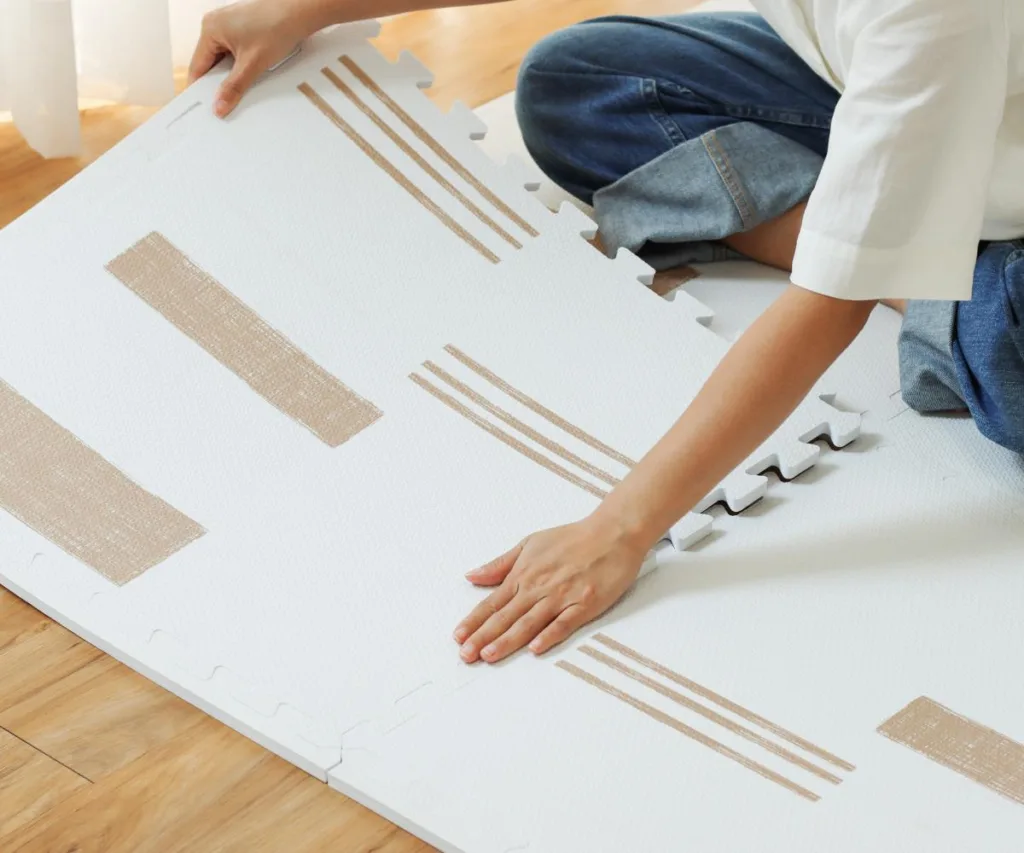
You will need: the mats, a clear open floor, a utility knife, a ruler or straight edge, and a cutting surface such as a cutting mat or piece of cardboard.
- Prepare the floor. Make sure the area is clean, dry and free of debris so the mat lies flat.
- Lay out the tiles. Unpack the tiles and arrange them in your planned layout, following the pattern direction on printed mats.
- Start in a corner. Work outward from one corner, aligning the puzzle edges and pressing each joint down firmly.
- Trim if needed. Measure carefully and cut along a straight edge with a utility knife to fit walls or furniture.
- Add border strips. Attach the border strips to the outer edges for a clean, finished look.
- Check the joints. Walk across the mat, look for gaps or raised seams, and press down any joint that is not fully locked.
Tips: on concrete, a thin underlay adds comfort and stability. Be gentle with the tabs when connecting tiles so they do not tear. Check the mat regularly and replace any damaged tile on its own instead of the whole set.
Buying Checklist for EVA Foam Puzzle Mats
| What to check | Why it matters | What to look for |
|---|---|---|
| Intended use | Drives thickness, size and design choice | Baby play, fitness, decor or commercial use |
| Foam quality | Affects cushioning and how long the mat lasts | Even density, clean cut edges, tight joints |
| Chemical safety | Babies spend hours on the surface | Formamide content stated, test reports to ASTM F963, CPSIA, EN 71 |
| Thickness | More thickness means more cushioning | About 1/2 in for play areas, more for impact sports |
| Anti-slip surface | Reduces slips, especially near spills | Textured top and bottom |
| Coverage | Prevents gaps and mismatched sets | Measure the room, include border strips |
| Print durability | Printed films can peel at the edges | Lamination that does not lift at seams |
| Customization | Important for brands and specific spaces | Custom colors, patterns, sizes and packaging |
Caring for Your Foam Mat
- Clean regularly: wipe with a damp cloth and mild soap, then dry. Avoid soaking the joints.
- Keep sharp objects away: knives, toys with sharp edges and pet claws can puncture foam.
- Inspect for wear: replace individual tiles that show tears or compressed areas.
- Store flat: stack tiles flat in a cool, dry place so they keep their shape.
- Check small parts: in children’s areas, make sure removable pieces are secure or age-appropriate.
For Brands: Choosing an EVA Foam Puzzle Mat Manufacturer
If you are developing your own play mat line, the supplier decision shapes everything from safety compliance to reviews. Ask potential manufacturers to show:
- Formulation details, including formamide levels, and recent test reports for your target market.
- How printed films are laminated, and how the print holds up at tile edges over time.
- Design support, including whether patterns can be matched across tiles and whether ready designs are available for private label.
- How quality is controlled during production, not only at final inspection, and what happens if defective units arrive.
- Material options beyond standard EVA, such as bio-based or antibacterial foam.
Komat has made EVA foam play mats in Changhua, Taiwan, since 2011. We offer 50+ ready private label designs, patented borderless puzzle and print lamination technology, 100 percent IPQC with a 99.7 percent or higher shipping yield, and 1:1 replacement of any defective units on delivery.
FAQ
What thickness should a baby foam play mat be?
About 1/2 inch (roughly 1.2 cm) is a common standard for baby and toddler play areas. It cushions crawling and small falls while staying light and easy to clean. Thicker mats are better suited to impact sports.
Are EVA foam puzzle mats waterproof?
The foam itself is closed-cell, so it does not absorb water, and spills stay on the surface. Liquid can still seep through the joints, so wipe spills promptly and lift the tiles occasionally to dry the floor underneath.
How do I clean an EVA foam puzzle mat?
Wipe it with a damp cloth and a mild soap solution, then let it air dry. For a deeper clean, take the tiles apart and wipe the edges. Avoid harsh solvents, which can damage printed films.
What is formamide, and why does it matter?
Formamide is a chemical that can remain in some foam after production. Because babies spend a lot of time on play mats, many buyers look for low-formamide foam with test reports. Komat’s EVA formulation keeps formamide under 2 ppm.
Can I get custom designs or sizes?
Yes. Brands can choose from ready designs or develop their own patterns, colors, tile shapes and packaging. Tell us about your project and we will suggest options.
Planning an EVA foam puzzle mat line for your brand or store? Contact Komat to discuss designs, materials and testing for your market, or browse our private label designs to get started.