

Formamide is a small industrial chemical that European authorities found in some foam puzzle mats in 2010, prompting French market withdrawals and, later, an EU emission limit for foam toy materials. For brands, the practical answer is simple: specify a low-formamide EVA formulation, test content and, where needed, emissions, and keep the reports on file for retailers and regulators.
Key Takeaways
- Formamide (CAS 75-12-7) is classified in the EU as toxic for reproduction, category 1B, according to the French agency ANSES.
- In 2010, several EU Member States found formamide in foam toys such as puzzle mats; France suspended sales of affected mats at the end of that year.
- Since May 24, 2017, EU toy law limits formamide emissions from foam toy materials to 20 µg/m³ after up to 28 days, where content exceeds 200 mg/kg.
- EN 71-15:2025 provides a content test method that checks whether foam toy materials are below the 200 mg/kg cut-off.
- Komat’s standard EVA formulation is specified at under 2 ppm formamide, which is far below the EU content cut-off.
What Is Formamide?
Formamide is the simplest amide, a colorless liquid derived from formic acid and used as an industrial solvent and chemical intermediate. ANSES notes that it is used mainly in the chemical, pharmaceutical, and plastics and polymers industries, including as a solvent, a plasticizer, or an adjuvant for blowing agents in foam production. The EU classifies it as toxic for reproduction in category 1B.
Formamide matters for foam mats because it is volatile enough to be released into indoor air from a product, and because young children spend long periods close to the floor. That combination, rather than skin contact, is what drew regulators’ attention.

Why Was Formamide Found in EVA Foam Mats?
The honest answer is that regulators did not pin down a single cause. In its 2011 assessment, ANSES said it could not determine the origin or the reason for formamide in the puzzle mats it reviewed. It proposed investigating whether formamide was used as a plasticizer or was linked to the blowing agent azodicarbonamide, and it noted that other EVA foam products might also contain it. That is a hypothesis, not a confirmed mechanism, so be wary of articles that state the cause as settled fact.
What the episode made clear is that foam chemistry depends on formulation and process choices: which blowing agents and additives are used, in what amounts, and how the foam is cured and aged. That is why formamide control is a specification and testing topic, not something a brand can judge by smell or appearance. Our foaming process page explains how EVA sheets are formed and controlled on our production line.
The 2010 Foam Mat Story in Europe
The modern history of formamide in foam mats starts in late 2010. According to ANSES, France’s consumer protection authority (DGCCRF) suspended the marketing of foam puzzle mats found to contain formamide at the end of 2010 and asked ANSES for an expert assessment. News reports from the time also said Belgium ordered foam puzzle mats off shelves on December 10, 2010, citing formamide emissions. The EU later recorded that, in 2010, several Member States identified formamide in a range of foam toys, such as puzzle mats.
ANSES published its opinion in July 2011. Its main findings:
- Exposure was mainly by inhalation. Emissions were strongest in the first days after unpacking, then fell to 50 to 200 µg/m³ in the first week and 20 to 30 µg/m³ after the first month in the conditions studied.
- Animal studies pointed to effects on the blood-forming and reproductive systems; no studies of direct effects in humans were found.
- ANSES judged the probability of blood-related effects in infants to be low (less than 5%) and found no likely health risk for adults, including pregnant women.
- It recommended that formamide emissions from puzzle mats not exceed 20 µg/m³, measured after 28 days in a test chamber, and that parents air new mats for several days in a room the child does not use.
What Are the Formamide Limits for Foam Mats?
The EU turned that recommendation into law through Commission Directive (EU) 2015/2115, which added formamide to the chemical limits in the Toy Safety Directive for toys intended for children under 36 months and toys intended to be placed in the mouth. The limit and related rules are summarized below.
| Jurisdiction or source | Requirement | Status as of 2026 |
|---|---|---|
| EU Directive 2015/2115 (Toy Safety Directive, Appendix C) | 20 µg/m³ emission limit after a maximum of 28 days from the start of emission testing, for foam toy materials containing more than 200 mg/kg formamide (content cut-off) | Applies since May 24, 2017, to toys for under-36-month-olds and mouthing toys |
| EU Toy Safety Regulation (EU) 2025/2509 | Replaces the Directive; testing labs report that formamide restrictions previously limited to toys for under-3s are extended to toys of all ages | Published December 12, 2025; Directive repealed August 1, 2030. Confirm transition dates with your lab |
| EN 71-15:2025 | Test method to determine whether total formamide content in foam toy materials is below the 200 mg/kg cut-off | Published 2025 |
| United States (federal) | CPSIA’s chemical limits focus on lead and specified phthalates; formamide is not one of them | Many brands apply the EU benchmark voluntarily or to meet retailer requirements |
The structure of the EU rule is worth understanding. A cut-off limit is a content threshold below which further testing is not needed: if a foam material contains 200 mg/kg of formamide or less, emission testing is not required. Above that, the material must meet the emission limit. Note that 1 ppm by weight equals 1 mg/kg, so a content specification of under 2 ppm is about one-hundredth of the cut-off.
How Do Brands Test for Formamide in Foam Mats?
There are two kinds of test, and they answer different questions.
| Test type | What it measures | When it is used | Practical notes |
|---|---|---|---|
| Content test (for example EN 71-15:2025) | Total formamide in the foam material, in mg/kg | Screening every foam material against the 200 mg/kg cut-off | Faster and simpler; test each foam color or formula that is used |
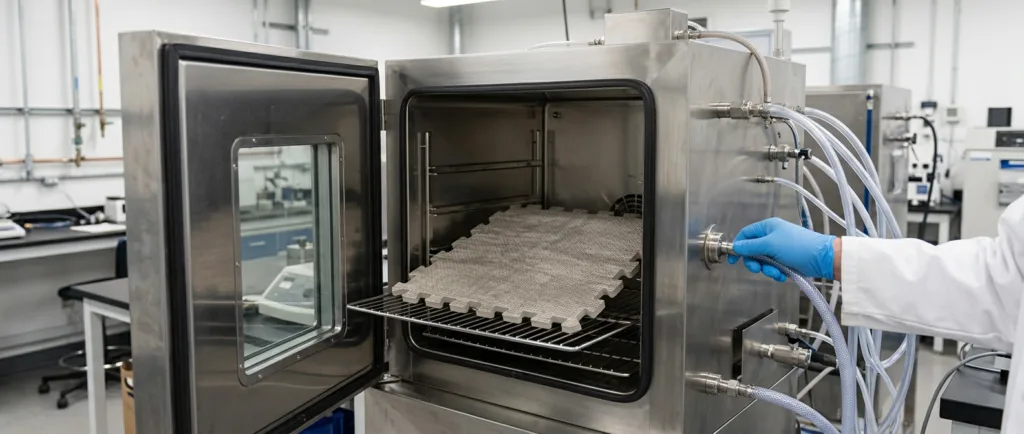
| Emission (chamber) test | Formamide concentration in chamber air, in µg/m³, over up to 28 days | When content is above the cut-off, or when a buyer requests it | Takes weeks; reflects real release into air |
A sensible program for a foam mat brand looks like this:
- Put a formamide limit in the specification. State a maximum content in the purchase specification and approved material list, not just “non-toxic.”
- Test every foam formulation. Different colors, Bio EVA blends or densities can use different compounds. Test each one used in the product.
- Test at a qualified lab. Use a lab accredited for the method and ask the report to cite the method and detection limit.
- Repeat with changes and periodically. Retest when the formula, raw material supplier or process changes, and on a regular schedule for continuous production.
- Keep reports ready. Retailers and marketplace compliance teams often ask for formamide data on foam mats sold for babies.
What Does a Low-Formamide Formulation Mean?
A low-formamide formulation is an EVA compound and process designed so that the finished foam contains formamide far below regulatory thresholds, with test data to prove it. It is a measured result, not a marketing adjective. When you compare suppliers, ask three questions: what is the specified maximum content, what method and lab produced the data, and how often is it retested?
It also helps to keep formamide in proportion. It is one parameter in a chemical specification, alongside heavy elements, phthalates and other restricted substances, and a mat that passes on formamide still needs the rest of its testing. Conversely, a strong overall chemical profile does not replace formamide data for foam sold in Europe. Asking for both, in one organized report set per material, is the simplest way to avoid gaps.
At Komat, our standard EVA formulation is specified at under 2 ppm formamide. Our materials are also tested to ASTM F963, CPSIA, CA Prop 65, EN 71 and REACH, with reports available on request. The same discipline applies across our material range, including Bio EVA play mats with 20 to 30% bio-based content, described on our materials and functions page.

Questions to Ask a Foam Mat Supplier About Formamide
A supplier’s answer to “is your foam safe?” is less useful than its answers to specific questions. Before you approve a material, ask:
- What is your formamide specification? Look for a stated maximum content in mg/kg or ppm, not a general claim.
- Which method and which lab? The report should name the test method, the laboratory and the detection limit, and describe the sample clearly enough to match your product.
- Which materials were tested? A report for one foam color or density does not automatically cover another. Ask for data on every formulation in your design, including border strips.
- How recent is the data? Ask when the material was last tested and how often it is retested for continuous production.
- What triggers retesting? Changes in blowing agent, additives, raw material supplier or curing conditions should trigger new tests.
- How do you control lots? Lot traceability lets you connect a test report to the foam actually used in a shipment.
The same questions apply when you compare material options such as standard EVA, Bio EVA or GraphEVA. Each is a distinct compound, so each needs its own data. Treat formamide as one line in a broader chemical specification that also covers lead, heavy elements and phthalates for the U.S., and the EN 71 and REACH requirements for Europe.
What Should You Tell Parents?
Consumers who search for “formamide foam mat” are usually worried parents. Clear, factual product pages help: state that the foam is tested for formamide, give the specification or the standard it is tested to, and offer reports to retailers on request. ANSES’s practical advice, airing new mats for a few days before use, is reasonable for any new foam product and costs nothing to include in instructions. Avoid health claims beyond what your data supports. For broader material questions, our guides on whether EVA foam is toxic and what makes a play mat non-toxic cover the wider picture.
Frequently Asked Questions
Is formamide still found in foam play mats?
It can be, depending on formulation and process, which is why testing matters. Since the 2010 findings in Europe, EU toy law has set a formamide emission limit for foam toy materials, and many brands specify low-formamide EVA. The only reliable way to know for a specific product is a test report for its foam materials.
What is the formamide limit in the EU?
Under Directive 2015/2115, foam toy materials in toys for children under 36 months and mouthing toys must not emit more than 20 µg/m³ of formamide after up to 28 days of emission testing, if their formamide content exceeds 200 mg/kg. The newer Toy Safety Regulation (EU) 2025/2509 replaces the Directive by August 1, 2030.
How is formamide content tested?
A content test, such as the method in EN 71-15:2025, measures total formamide in the foam material and compares it with the 200 mg/kg cut-off. If content is above the cut-off, an emission chamber test measures formamide in the air over up to 28 days and compares it with the 20 µg/m³ limit.
Does the U.S. regulate formamide in play mats?
CPSIA’s specific chemical limits for children’s products cover lead and listed phthalates; formamide is not one of them. Brands selling in the U.S. often test to the EU benchmark anyway, because retailers and parents ask about it. Check with your lab for any state or retailer requirements that apply to your product.
Should new foam mats be aired out?
ANSES recommended unpacking new puzzle mats and leaving them for several days in a room the child does not use before young children play on them. It is simple advice that brands can include in product instructions, alongside test data showing low formamide content.
If you are building a foam mat line and want low-formamide EVA with documentation your retailers will accept, explore our private-label designs or contact Komat to discuss materials and test reports.
Sources
- ANSES: Formamide and Puzzle Mats, Minimising Exposure for Young Children
- EUR-Lex: Commission Directive (EU) 2015/2115 (Formamide Limit Values in Toys)
- Commission Directive (EU) 2015/2115, Full Text (legislation.gov.uk)
- BSI: EN 71-15:2025 Safety of Toys, Formamide in Foam Toy Materials (Content)
- SGS: EU Toy Safety Regulation (EU) 2025/2509 Published
- Deccan Herald: Report on Foam Mat Withdrawals in Belgium (2010)