

AQL sampling is a statistical way to decide whether to accept a production lot by inspecting a random selection of units instead of every piece. Using tables from ISO 2859-1 or ANSI/ASQ Z1.4, the lot size and chosen inspection level set how many units to check, and the acceptance quality limit (AQL) sets how many defects are allowed before the lot fails.
Key Takeaways
- AQL stands for acceptance quality limit: the worst process average quality a sampling plan is designed to treat as tolerable over a series of lots.
- ISO 2859-1 and ANSI/ASQ Z1.4 share the same basic sampling tables, which descend from the US military standard MIL-STD-105.
- ISO 2859-1 was revised in January 2026 (third edition), adding a procedure for skip-lot sampling and moving OC curve methods to an annex.
- Buyers classify defects as critical, major or minor and set a separate acceptance limit for each class, usually with zero tolerance for critical defects.
- Final AQL inspection checks outgoing quality; it works best when the supplier also runs in-process inspection at each production stage.
What Is AQL Sampling?
Acceptance sampling is a method in which a random sample is taken from a lot and the results are used to accept or reject the entire lot. The NIST/SEMATECH Engineering Statistics Handbook describes it as sitting in the middle ground between no inspection and 100 percent inspection, and stresses that its purpose is to decide whether a lot is likely to be acceptable, not to estimate the lot’s exact quality.
AQL sampling is acceptance sampling indexed by an acceptable or acceptance quality limit. You choose the AQL for each defect class, look up the sampling plan in the standard’s tables, inspect the specified number of units, and compare the defects found with the plan’s acceptance and rejection numbers. If defects are at or below the acceptance number, the lot passes; at or above the rejection number, it fails.
A common shorthand describes AQL as the maximum percentage of defective items considered acceptable in a lot. That is a useful starting point, but the more precise idea is about process average: the standard is designed to encourage the producer to keep its process average at least as good as the AQL, while limiting the buyer’s risk of accepting an occasional poor lot. The NIST handbook calls the AQL “the base line requirement for the quality of the producer’s product.” A lot that passes is not guaranteed to be below the AQL; it is simply consistent with a process running at that level.

ISO 2859-1 and ANSI/ASQ Z1.4: Where AQL Tables Come From
The tables most inspectors use trace back to MIL-STD-105, first issued as Mil. Std. 105A in 1950. According to the NIST handbook, ANSI adopted it as Z1.4 in 1971 and ISO adopted it as ISO 2859 in 1974; the last military revision, MIL-STD-105E, was issued in 1989. ASTM notes that the US Department of Defense later canceled MIL-STD-105E in favor of ANSI/ASQ Z1.4, and that the basic sampling tables remain the same in ANSI/ASQ Z1.4 and ISO 2859 as in MIL-STD-105D and E.
The current international version is ISO 2859-1:2026, “Sampling procedures for inspection by attributes, Part 1: Sampling schemes indexed by acceptance quality limit (AQL) for lot-by-lot inspection.” ISO lists it as the third edition, published in January 2026, replacing the 1999 edition and its amendment. The foreword describes the main changes: a new procedure for switching from normal or reduced inspection to skip-lot sampling, guidance on producer and product qualification for skip-lot inspection, and the removal of operating characteristic curves from the body of the standard, with methods for constructing them moved to an annex. If your purchase agreements cite ISO 2859-1, state which edition applies.
How to Read an AQL Chart
An “AQL chart” is usually two tables used together. NIST summarizes the steps for picking a plan as follows: decide the AQL, decide the inspection level, determine the lot size, find the sample size code letter, choose single, double or multiple sampling, find the plan in the appropriate table, and start with normal inspection, applying switching rules as needed.
- Code letter table. Find the row for your lot size and the column for your inspection level. The cell gives a sample size code letter, not a sample size.
- Master table. Find the row for that code letter to read the sample size, then the column for your AQL to read the acceptance number (Ac) and rejection number (Re).
- Repeat for each defect class. Critical, major and minor defects usually have different AQLs, so each class gets its own Ac and Re from the same sample.
Arrows in the master table send you to a different plan when the combination of sample size and AQL is not workable; follow the arrow and use the sample size from the row it points to. Inspection firms and quality software do this automatically, but understanding the logic helps you check that the plan in an inspection report matches the one you agreed.
What Are AQL Inspection Levels?
An inspection level sets the relationship between lot size and sample size. The standard offers three general levels and four special levels. The general levels, commonly labeled I, II and III, scale the sample size from smaller to larger for the same lot. The special levels, S-1 to S-4, use much smaller samples and are typically reserved for tests that are costly or destructive.
| Inspection level | Relative sample size | Typical use |
|---|---|---|
| General I | Smaller | Stable supplier with good history; lower-risk product features |
| General II | Standard | The usual default for routine final inspection of consumer goods |
| General III | Larger | New supplier, new design, or a history of problems |
| Special S-1 to S-4 | Much smaller | Time-consuming or destructive checks, such as dimensional or functional tests on a few units |
The standards also define normal, tightened and reduced inspection. You begin with normal inspection, switch to tightened inspection when there is evidence the producer is not meeting the agreed AQL, and may switch to reduced inspection after a sustained run of good results. The 2026 edition of ISO 2859-1 adds a defined path from normal or reduced inspection to skip-lot sampling for qualified producers and products.
Critical, Major and Minor Defects for Foam Play Mats
A defect classification is the agreed list of what counts as a nonconformity and how serious each one is. It is the most important document in any AQL program, because the sampling plan is meaningless if inspector and supplier disagree about what a defect is.
- Critical defect: a nonconformity likely to create a hazard for the user or to breach a mandatory requirement. Buyers usually allow zero critical defects.
- Major defect: a nonconformity likely to cause the product to fail in use or to be unsaleable, such as tiles that do not lock together.
- Minor defect: a departure from specification that does not affect use or safety, such as a small cosmetic mark visible only on close inspection.
The table below shows a starting defect list for EVA foam puzzle play mats. Adjust the classes and tolerances to your specification and agree them in writing before production.
| Check | How it is inspected | Typical classification |
|---|---|---|
| Foreign material embedded in foam, or small loose pieces | Visual and tactile check of surfaces and puzzle edges | Critical |
| Missing or incorrect required labeling, warnings or tracking information | Compare packaging and inserts with approved artwork | Critical or major, per your compliance requirements |
| Thickness out of tolerance | Measure with a caliper or thickness gauge at agreed points | Major |
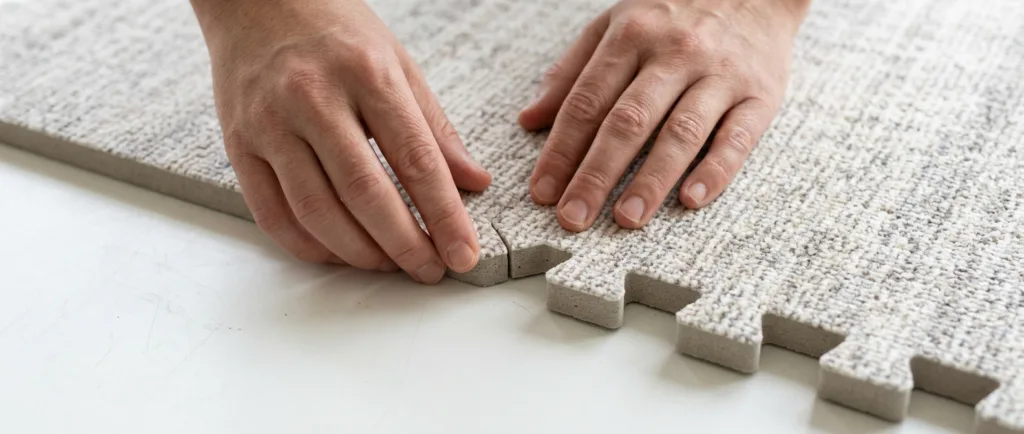
| Edge fit too loose or too tight | Assemble tiles; check for gaps, lifting edges or forced fit | Major |
| Print registration off, or pattern not matching across tiles | Assemble a section; compare with approved reference | Major (obvious) or minor (slight) |
| Print film lifting or delamination | Flex tile edges and corners; inspect surface | Major |
| Strong or unusual odor | Odor check on opening the package | Major |
| Color difference from approved standard | Compare under consistent light with the approved reference | Major or minor, by degree |
| Small surface marks, slight edge burrs | Visual check at a set distance | Minor |
| Carton marks wrong or illegible; damaged cartons | Check outer cartons against packing list and marking instructions | Major |
Odor and chemical questions deserve a note. An odor check is a sensory screen, not a chemical test. Chemical limits, such as formamide, are verified through laboratory testing of the material; Komat’s EVA formulation keeps formamide under 2 ppm. Our article on formamide in foam mats explains how brands test for it.
How to Run an AQL Inspection on a Play Mat Order
- Agree the plan in the purchase agreement. Name the standard and edition, inspection level, AQL for each defect class, and the defect list.
- Schedule the inspection while goods are still in the supplier’s control. Usually that means when production is complete and most goods are packed, before delivery under your Incoterm. Our guide to FOB vs EXW explains why timing relative to delivery matters.
- Draw units at random. Open cartons from across the lot, including different pallets and positions.
- Inspect against the approved reference. Use the pre-production approval unit and approved artwork, not memory.
- Count and classify defects. Record each by class with photos.
- Decide and document. Compare counts with Ac/Re for each class, then accept, reject or agree on rework and re-inspection.
How AQL Pairs With In-Process Inspection
Final AQL inspection is a filter at the end of the process. It tells you whether a lot is acceptable, but it cannot fix problems built into thousands of units. In-process quality control (IPQC), which is inspection at each production stage, prevents those problems from multiplying.
For foam play mats, the stages that matter most are foaming (density and formulation), cutting and forming (thickness and edge geometry), printing and lamination (registration and bonding), and packing (counts, labeling and carton marks). Catching a cutting die issue on the first sheets protects a whole run; catching it at final inspection means rework or rejection.
At Komat, every station runs 100 percent IPQC, our shipping yield is 99.7 percent or higher, and defective units found on delivery are replaced 1:1. Our patented non-continuous print lamination is designed so the printed film does not peel, which removes one of the common major defects at the source. You can read more on our quality control and printing and lamination pages. We still recommend that buyers run their own final inspection: the two layers check different things, and together they give you better confidence than either alone.

Frequently Asked Questions
What does AQL mean in quality control?
AQL stands for acceptance quality limit (older texts say acceptable quality level). It is the quality level, expressed as percent nonconforming or nonconformities per hundred units, that a sampling plan treats as the worst tolerable process average. Buyers set an AQL for each defect class, and the standard’s tables translate it into a sample size and acceptance and rejection numbers.
Which AQL inspection level should I use?
General inspection level II is the usual default for routine final inspection of consumer goods. Level III takes a larger sample and suits new suppliers, new designs or problem histories. Level I takes a smaller sample for stable, proven programs. Special levels S-1 to S-4 are for costly or destructive tests where only a few units can be checked.
Is ANSI/ASQ Z1.4 the same as ISO 2859-1?
They share the same basic sampling tables, both descending from MIL-STD-105, so a plan chosen from one generally matches the other. The documents differ in wording and in some procedures; ISO 2859-1’s 2026 edition, for example, added skip-lot sampling guidance. Name the standard and edition you want in your purchase agreement so inspector and supplier work from the same rules.
What AQL should I use for critical defects?
Most buyers allow zero critical defects, meaning any critical defect found in the sample fails the lot. For major and minor defects, buyers choose separate AQLs, with a tighter limit for major defects than minor ones. The right values depend on your product, market and risk tolerance, so set them deliberately and record them in the purchase agreement.
Can AQL inspection replace in-process quality control?
No. AQL inspection is a statistical check on finished lots; it can accept or reject but cannot prevent defects. In-process quality control catches problems at each production stage before they spread across a run. The strongest programs combine both: the supplier controls the process, and the buyer verifies outgoing quality with an agreed AQL plan.
Setting up quality requirements for a new play mat program? Komat can share how our in-process inspection works and align with your AQL plan and defect list. Contact our team, or read our guide on how to find a manufacturer for the wider vetting process.
Sources
- ISO 2859-1:2026, Sampling procedures for inspection by attributes, Part 1
- ANSI Webstore: ISO 2859-1:2026 preview (foreword and contents)
- ANSI Blog: ISO 2859-1:2026, AQL sampling
- NIST/SEMATECH e-Handbook: Choosing a sampling plan, MIL Standard 105
- NIST/SEMATECH e-Handbook: What is acceptance sampling?
- ASTM: Preservation of the military standards for acceptance sampling