

If you are working out how to find a manufacturer for a play mat or baby product line, start with a written specification, search through trade shows, B2B directories and industry referrals, then shortlist suppliers that specialize in your category. Vet each one on test reports, in-process quality control, IP protection and communication before you approve a pre-production unit and place an order.
Key Takeaways
- A clear product specification (materials, dimensions, print, packaging and target standards) is the single best tool for getting comparable quotations.
- Trade shows, B2B platforms and referrals from testing labs, freight forwarders and customs brokers are the most productive places to find a product manufacturer.
- For children’s products sold in the US, the importer must certify compliance based on testing by a CPSC-accepted third-party lab, so a manufacturer’s test documentation is a core vetting point.
- Patents and trademarks are territorial, so protect your brand and designs in the countries where you sell and produce before sharing artwork.
- Red flags include vague answers on testing, no defined in-process inspection, reluctance to put terms in writing, and claims that cannot be documented.
Step 1: Define What You Need Before You Search
A product specification is a written description of exactly what you want made, detailed enough that two different suppliers would quote the same thing. Without one, quotations are not comparable, and the cheapest quote is often for a different product than the one you had in mind.
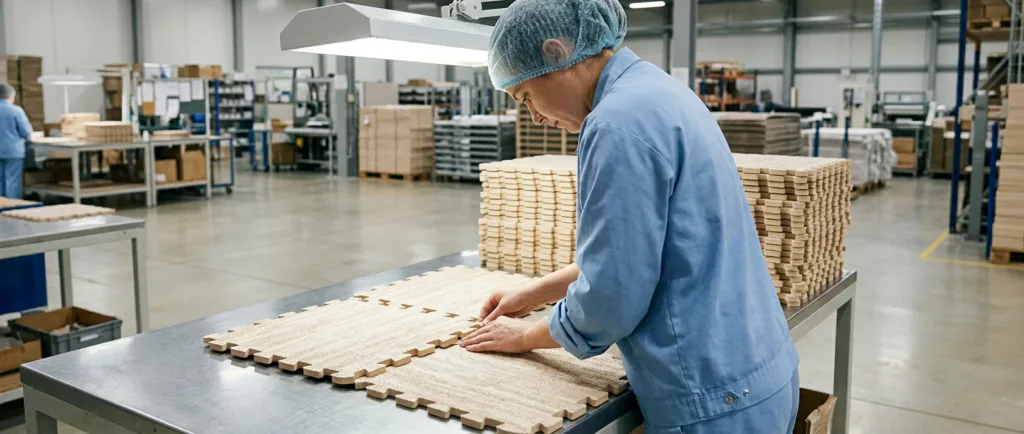
For an EVA foam play mat line, a useful specification covers:
- Material: standard EVA, Bio EVA, GraphEVA or another foam, plus any chemical limits you require (for example, a formamide limit).
- Dimensions: tile size, tile count per set, thickness and tolerance, and edge style (puzzle edges or borderless).
- Surface and print: plain, textured or printed; pattern artwork; whether the pattern must match across tiles.
- Packaging: retail box or bag, insert card, carton size and carton marks.
- Target market and standards: for the US, typically ASTM F963 and CPSIA requirements; for the EU, EN 71 and REACH; plus California Proposition 65 if you sell into California.
- Business model: whether you want your own artwork (OEM) or a ready design under your brand (ODM).
Writing this down also helps you decide what kind of supplier you need. A company that makes a broad range of foam goods may be fine for a basic product, while a printed, pattern-matched play mat benefits from a specialist with dedicated printing and lamination capability.

Step 2: How to Find a Manufacturer Through the Right Channels
There is no single directory of good suppliers. Most importers combine several channels and cross-check what they find. Each has strengths and blind spots.
| Channel | Strengths | Limitations | Best for |
|---|---|---|---|
| Industry trade shows | See and handle products, meet technical staff, compare many suppliers in a few days | Travel time and cost; booths show best-case products | Building a serious shortlist |
| B2B sourcing platforms | Broad reach, easy first contact, searchable by category | Mix of manufacturers and trading companies; claims are self-reported | Mapping the market quickly |
| Referrals (labs, forwarders, brokers, peers) | Pre-filtered by people who see real shipments and test results | Smaller pool; depends on your network | Finding experienced exporters |
| Manufacturer websites and search | Shows specialization, process detail, certifications and history | Quality of information varies widely | Checking depth and focus |
| Trade associations and export agencies | Member directories and trade missions | Coverage varies by country and category | Targeted searches by region |
Trade shows
Trade shows remain one of the most efficient ways to meet an overseas manufacturer in person. For floor products and play mats, relevant events include flooring, sporting goods and general merchandise shows. Komat, for example, has exhibited at The International Surface Event in Las Vegas, ISPO Munich and ASD Market Week 2024 (booth C31243); our global presence page lists where we show. At a booth, ask to speak with someone from production or quality, not only sales, and bring your specification.
B2B platforms and search
Online platforms are useful for mapping who makes what, but treat listings as a starting point. Check whether a listing belongs to a manufacturer or a trading company. Both can be legitimate, but they offer different levels of control over production. Follow up by reviewing the company’s own website for process detail: a supplier that explains its foaming, cutting, printing and inspection steps usually understands them.
Referrals
Testing laboratories, freight forwarders and customs brokers see many suppliers’ goods and paperwork. They will rarely endorse a company formally, but they can often tell you which suppliers ship consistently and document well. Peers in non-competing categories are another good source.
Step 3: Build a Shortlist
Once you have a long list, narrow it to three to five candidates using criteria that predict a smooth program, not just a low first quote:
- Category specialization: do they make your product type every day, or only occasionally?
- Export experience: have they shipped to your market and supported the paperwork it requires?
- Documentation: can they share current test reports for the standards you need?
- Process control: is inspection built into each production stage or only done at the end?
- Capacity: can they handle your volumes and growth? (For reference, Komat’s production capacity is 25 to 30 containers per month.)
- Communication: are answers specific, prompt and in writing?
Step 4: Vet Each Candidate With the Right Questions
Vetting is where you separate capable partners from good salespeople. Focus on four areas.
Testing and compliance
For the US market, CPSC requires domestic manufacturers and importers of children’s products to issue a Children’s Product Certificate based on test results from a third-party, CPSC-accepted laboratory. CPSC also notes that importers must electronically file certificate data with US Customs and Border Protection starting July 8, 2026. Ask each supplier which standards the product has been tested to, which lab performed the tests, and how recent the reports are. You can check whether a lab is accepted for a given rule using CPSC’s lab search. Our guide to the Children’s Product Certificate explains what you will need from the supplier.

Process control
In-process quality control (IPQC) is inspection carried out at each production stage rather than only on finished goods. Ask where inspection happens, what is checked (thickness, edge fit, print registration, odor, carton marks), and what happens to nonconforming product. At Komat, every station has 100 percent IPQC, our shipping yield is 99.7 percent or higher, and defective units found on delivery are replaced 1:1. You can see how that works on our quality control page. Whatever supplier you choose, pair their process control with your own final inspection; our article on AQL inspection explains how buyers set that up.
IP protection
Before you send artwork, protect it. The US government’s StopFakes program notes that patents and trademarks are territorial, must be applied for in each country where protection is sought, and that a US registration does not protect you elsewhere. Register your trademark where you sell, consider protection where you manufacture, and use a written agreement that states who owns artwork, print files and cutting dies.
Communication and transparency
Ask for a short written summary of how a project would run: specification review, artwork proofing, pre-production approval, production, inspection and shipping. Suppliers who can describe their process clearly tend to execute it reliably. Notice who answers your technical questions and whether answers stay consistent over time.
Step 5: Verify and Approve Before Production
With a preferred candidate, verify what you have been told. A visit or a third-party supplier audit confirms that the operation matches the description. Then approve a pre-production unit against your specification, agree on inspection criteria in writing, and settle commercial terms, including the Incoterm. If you are new to shipping terms, read our guide to FOB vs EXW before you sign, and work out your landed cost so you know what each unit really costs delivered.
The pre-production approval deserves particular care. It is the physical reference that mass production will be judged against, so check it against every line of your specification: material, thickness, tile size, edge fit, print color and registration, odor, packaging and carton marks. Record any agreed tolerances in writing and keep the approved unit (and a duplicate held by the manufacturer) as the shared standard. If something is not right, fix it now; changes are far easier before mass production starts than after goods are packed. Finally, agree how and when final inspection will happen, whether by your own staff, a third-party inspection firm or both, so there are no surprises on the day goods are ready.
Red Flags When Choosing an Overseas Manufacturer
None of these automatically disqualifies a supplier, but each deserves a direct question:
- Test reports that are old, for a different product, or from a lab that is not accepted for the relevant rule.
- Vague answers about where and how inspection happens.
- Reluctance to put ownership of artwork and tooling in writing.
- Claims that cannot be documented, such as unexplained “certified” or “medical grade” language.
- Quoted terms or promises that change significantly after you commit.
- A different contact answering technical questions every time, with inconsistent answers.
Manufacturer Vetting Checklist
Use this checklist to compare finalists on the same basis. Ask for evidence, not just answers.
| Area | What to ask | Evidence to request |
|---|---|---|
| Specialization | How much of your output is this product category? | Product range, process descriptions, references in similar categories |
| Testing | Which standards has this product been tested to, and by which lab? | Current test reports; confirm lab acceptance for the relevant rule |
| Materials | What is the formulation, and are chemical limits controlled? | Material specifications and related test results |
| Process control | Where does inspection happen during production? | Inspection points, defect criteria, records |
| Outgoing quality | What is your shipping yield and defect policy? | Written defect and replacement terms |
| IP | Who owns artwork, print files and dies? | Clauses in the supply agreement |
| Capacity | Can you support my volume and growth? | Stated capacity and production planning approach |
| Logistics | Which Incoterms do you offer and from which port? | Quotation with named Incoterm and place |
| Communication | Who is my day-to-day contact, and who handles technical issues? | Named contacts and a written project timeline |
Frequently Asked Questions
How do I find a manufacturer for my product idea?
Write a specification first, then search through trade shows in your category, B2B platforms, and referrals from testing labs, freight forwarders and customs brokers. Shortlist three to five suppliers that specialize in your product type, and compare them using the same specification, so that quotations, documentation and timelines are directly comparable.
Should I use an overseas manufacturer or a domestic one?
It depends on the product, your volumes and the skills available. Overseas manufacturers often specialize deeply in categories such as printed EVA foam mats, while domestic suppliers can offer shorter transit. Compare on total landed cost, quality control, documentation and communication, not on unit cost alone, and remember that the importer carries certification duties for children’s products.
How can I tell a manufacturer from a trading company?
Ask direct questions about the production process: which stages happen in-house, where inspection takes place, and who you would speak to about a technical problem. A visit or third-party audit gives the clearest answer. Trading companies can add value, but you should know which you are dealing with, because it affects control over production.
What documents should a play mat manufacturer provide?
At minimum, ask for current test reports for the standards your market requires (for the US, typically ASTM F963 and CPSIA-related tests), material specifications, packaging and carton specifications, and written quality and defect terms. These support the Children’s Product Certificate that you, as importer, must issue. Confirm requirements with your testing lab.
How do I protect my design when working with a manufacturer?
Register your trademark in the countries where you sell, consider design or copyright protection for key artwork, and sign a supply agreement that states who owns artwork, print files and cutting dies. Intellectual property rights are territorial, so a US registration alone does not protect you abroad. Share full artwork files only after these basics are in place.
If you are searching for a play mat partner, Komat works with importers, distributors and brand owners on OEM and ODM programs, with 50+ ready private-label designs and custom artwork options. Contact our team with your specification to start a conversation.
Sources
- CPSC: Children’s Product Certificate (CPC)
- CPSC: Testing Lab Accreditation and CPSC-Accepted Labs
- Federal Register: Certificates of Compliance (eFiling final rule)
- StopFakes.gov: How do I register my trademark, patent or copyright abroad?
- International Trade Administration: Protect Intellectual Property