

Closed cell foam is foam in which every gas bubble is sealed off from its neighbors by a thin wall of solid material. Because the cells do not connect, water, juice and crumbs stay on the surface instead of soaking into the core. That single structural difference is why EVA and polyethylene floor mats can be wiped clean, while open-cell foams behave more like a sponge.
Key Takeaways
- In closed-cell foam, each gas pocket is completely surrounded by solid material; in open-cell foam, the gas pockets connect to each other.
- Closed-cell foams are generally denser and stronger in compression than open-cell foams of the same polymer.
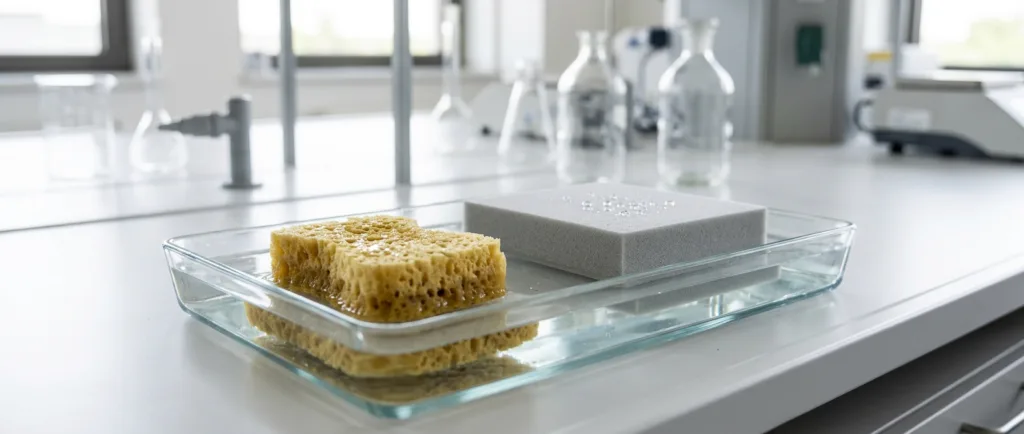
- Open-cell foams take up whatever surrounds them, including water; a bath sponge is the classic example.
- EVA and polyethylene play mats and floor tiles are closed-cell foams, which is why spills can be wiped away.
- Closed-cell structure does not make a mat waterproof at the seams; liquid can still reach the floor between tiles.
What Is Closed Cell Foam?
Closed-cell foam is a cellular material in which the gas forms discrete pockets, each fully enclosed by the solid polymer. Picture a block of tiny, sealed balloons pressed together. Because each bubble is sealed, gas cannot flow from one cell to the next, and neither can liquid.
Open-cell foam is the opposite: its cell walls are broken or incomplete, so the pockets connect into a continuous network. Air moves through it freely, and if you put it in water, water moves in and pushes the air out. That is exactly how a bath sponge works.
Most foams are not perfectly one or the other. Manufacturers talk about the closed-cell content of a foam, and production conditions such as crosslinking and blowing-agent level influence how many cells stay intact. For floor mats, the goal is a foam that is predominantly closed-cell with a smooth surface skin.
A closed cell foam mat, then, is a floor mat whose cushioning layer is made of predominantly closed-cell foam, usually EVA or crosslinked polyethylene. It may be plain foam, textured, or laminated with a printed film on top. What the buyer experiences as “easy to clean” and “springy underfoot” comes directly from that sealed-cell structure, which is why it is worth understanding before you compare products or write a specification.
Closed Cell vs Open Cell Foam: What Is the Difference?
The table below summarizes how the two structures typically compare. Exact values depend on the polymer, density and process, so treat it as a guide to the direction of each difference.
| Property | Closed-cell foam | Open-cell foam |
|---|---|---|
| Cell structure | Discrete, sealed gas pockets | Interconnected pockets forming a network |
| Water behavior | Resists water uptake; liquids stay on the surface | Absorbs water into the structure, like a sponge |
| Air flow | Very limited | Air passes through freely |
| Density | Generally higher | Generally lower |
| Compressive strength | Generally higher | Lower; soft and squishy |
| Feel | Firm-soft, springy | Very soft, slow or quick to compress depending on type |
| Cleaning | Wipe the surface | Must be rinsed and dried through; can hold moisture |
| Typical examples | EVA and PE foam mats, camping sleeping pads, flotation foams, closed-cell spray foam | Bath sponges, foam rubber, many cushion and mattress foams, open-cell spray foam |
An example from building insulation
Spray polyurethane insulation shows how much the structure matters even within one chemistry. In U.S. EPA material on spray foam product types, open-cell spray foam is described as low density, about half a pound per cubic foot, drying soft, with an R-value of around 3.5 per inch. Closed-cell spray foam is medium density at about 2 pounds, or high density at 3 pounds for roofing, dries rigid and reaches around 6.5 per inch. Same family of polymer, very different behavior, largely because of the cells.
Why Does Closed Cell Foam Matter for Floor Mats?
Floor mats at home deal with spilled milk, drool, wet bathing suits, pet water bowls and muddy shoes. A closed cell foam mat handles those in a way open-cell foam cannot.
Spills stay on top
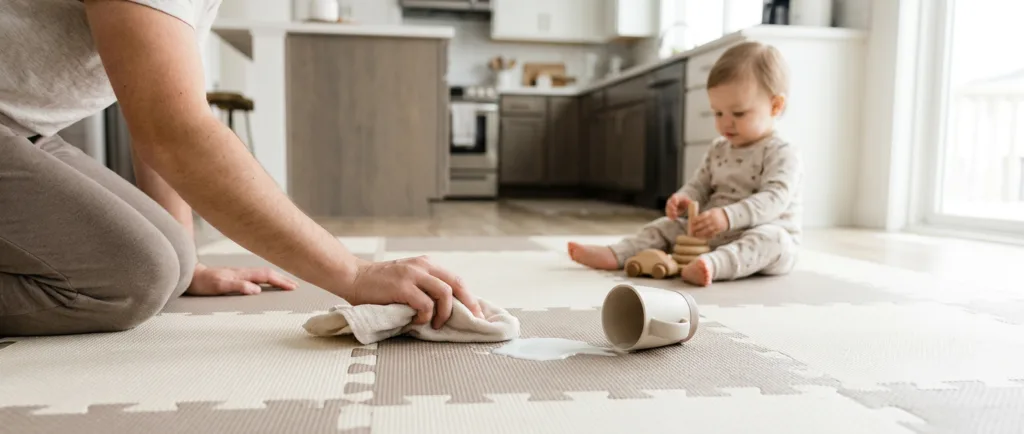
Liquid that lands on a closed-cell surface sits there until you wipe it. With open-cell foam, it wicks into the core, where it is hard to reach and slow to dry. For families, the practical outcome is a mat you can clean with a damp cloth and mild soap. We cover cleaning routines for mealtimes in our kitchen and mealtime applications.
Easier to keep clean
Because moisture and crumbs do not get trapped inside the foam, a closed-cell mat is easier to keep clean and dry with routine wiping. That is a point about cleanability, not a health claim. Regular cleaning still matters, especially at the seams between tiles.
Cushioning that recovers
Each sealed cell acts like a tiny spring: when you kneel, the gas compresses, and when you stand up, it pushes the cell walls back. That is why well-made EVA tiles feel springy rather than dead. Open-cell foams can be very soft, but much of their recovery depends on air flowing back into the cells.
What Is Compression Set and Why Should Buyers Care?
Compression set is the permanent loss of thickness a foam keeps after being squeezed for a period and then released. A foam with low compression set bounces back close to its original thickness; a foam with high compression set keeps dents from furniture legs, toy bins and knees.
For closed-cell foams, compression set depends heavily on the polymer and on crosslinking. Crosslinking links polymer chains so the cell walls hold their shape. Non-crosslinked foams tend to keep dents more easily, which is one reason quality floor mats use crosslinked EVA or crosslinked polyethylene. ASTM D3575 provides standard test methods for flexible closed-cell materials made from olefin polymers, with product requirements set out in a companion specification, ASTM D4819. When you compare suppliers, ask which test methods were used so results are comparable.
Which Common Foams Are Closed-Cell?
Here is how foams you are likely to meet in consumer and flooring products usually line up. Many can be made either way, so the table shows the typical structure in common uses.
| Foam | Typical structure | Common uses | Notes for floor products |
|---|---|---|---|
| EVA foam | Closed-cell | Puzzle play mats, floor tiles, shoe midsoles, padding | Soft, springy and printable; standard for interlocking tiles |
| Polyethylene foam (EPE) | Closed-cell, non-crosslinked | Protective packaging | Light and inexpensive; can keep dents |
| XPE / IXPE foam | Closed-cell, crosslinked | Roll-out mats, underlayment | Fine cells, smooth surface, firmer feel |
| Polyurethane foam | Usually open-cell in cushions; closed-cell versions exist | Mattresses, sofa cushions, insulation | Open-cell types absorb liquids; not suited to exposed floor use |
| Foam rubber (latex) | Open-cell | Cushions, padding | Comfortable but absorbs moisture |
| Neoprene foam | Commonly closed-cell | Wetsuits, gaskets | Water-resistant; heavier |
For a detailed comparison of the two main closed-cell options for play mats, see EVA vs polyethylene foam. For the chemistry behind EVA itself, see our explainer on EVA material.
How Is a Closed Cell Foam Mat Made?
In EVA foam production, the resin is compounded with a blowing agent and a crosslinker, then heated in a press. The blowing agent decomposes into gas while the crosslinker links the polymer chains; the result is millions of sealed cells locked in place. The expanded block is cooled, stabilized and sliced into sheets, then die-cut into tiles. Our foaming process page describes each stage on Komat’s production line.
Process control matters for the closed-cell structure. Too little crosslinking and cells can rupture or collapse; poorly balanced blowing agent levels produce uneven cells. Foaming chemistry is also where residues such as formamide can arise, which is why reputable producers test for them. Komat’s non-toxic EVA formulation keeps formamide under 2 ppm; for more context, read Is EVA Foam Toxic?

Where Else Is Closed Cell Foam Padding Used at Home?
The same properties that make closed-cell foam work in a nursery make it useful elsewhere in the house. Closed cell foam padding shows up in several floor applications that brands and retailers sell into:
- Home fitness corners. Interlocking foam floor tiles give a cushioned, wipeable surface for bodyweight workouts and stretching, and protect floors from dropped light equipment.
- Pet feeding and resting areas. Water from bowls and wet paws stays on the surface, so the area can be wiped down. Foam is not designed to resist determined chewing or digging, so supervise pets and replace damaged pieces.
- Outdoor picnics and patios. A closed-cell mat does not soak up damp ground the way fabric blankets do, although it should be brought inside after use to avoid prolonged sun exposure.
- Daycare and commercial play spaces. Large tiled areas can be cleaned quickly between groups, and damaged tiles can be swapped out individually.
In each case, the closed-cell core provides the water resistance, and the quality of the surface, edges and test reports decides whether the product holds up in real use.
Limits of Closed-Cell Foam Mats
Closed-cell structure solves a lot, but not everything:
- Seams are not sealed. On interlocking tiles, liquid can run into the joints and reach the floor. Lift tiles occasionally and dry the subfloor, especially in kitchens and pet areas.
- Cut edges expose cells. Die-cut edges show the cell structure. Quality cutting gives clean edges that do not crumble.
- Heat and sharp objects. Foam can deform near heaters and can be punctured by sharp toys or claws.
- Surface prints need good lamination. On printed mats, the film must stay bonded, or moisture can creep beneath it. Komat’s patented non-continuous print lamination is designed so the film does not peel.
Frequently Asked Questions
Is closed cell foam waterproof?
Closed-cell foam strongly resists water uptake because its cells are sealed, so liquids stay on the surface. The material is often described as waterproof. A finished mat, however, may not be: interlocking tile seams and cut edges let liquid reach the floor. Wipe spills promptly and occasionally lift tiles in wet areas to dry underneath.
Is EVA foam open or closed cell?
EVA foam used in play mats, floor tiles and footwear is closed-cell. The foam is expanded with a blowing agent and stabilized by crosslinking, which keeps the gas trapped in sealed cells. That structure gives EVA its springy cushioning and makes the surface wipeable, which is why it is the standard material for interlocking puzzle mats.
Which is better, closed cell or open cell foam?
It depends on the job. Closed-cell foam is better where water resistance, firmness and wipeability matter, such as floor mats, flotation and some insulation. Open-cell foam is better where breathability and plush softness matter, such as mattresses and sofa cushions. For exposed floor mats used by children and pets, closed-cell foam is the practical choice.
Is a closed cell foam mat good for babies?
A closed-cell EVA or polyethylene mat provides a cushioned, wipeable surface for tummy time and crawling. As with any baby product, check that the finished mat has been tested for lead and phthalates under CPSIA, look for low residues such as formamide, keep the mat clean, and always supervise babies during floor play.
How can I tell if a foam is closed cell?
A simple home check is to press a cut piece under water. Open-cell foam will release air bubbles and absorb water; closed-cell foam will mostly float and stay dry inside. For specifications, ask suppliers for density, water absorption and compression set data measured with standard methods such as ASTM D3575.
What is closed cell foam padding used for?
Closed cell foam padding is used wherever cushioning has to cope with moisture or frequent cleaning: play mats and floor tiles, camping sleeping pads, flotation aids, sports and protective padding, gaskets and some building insulation. In the home, it is most common in interlocking EVA tiles for nurseries, playrooms, home fitness corners and pet areas.
Brands and retailers who sell floor mats to parents can turn closed-cell performance into a clear, honest selling point: wipeable, cushioned and tested. Explore Komat’s rug-look private-label designs or contact our team to discuss specifications for your range.