
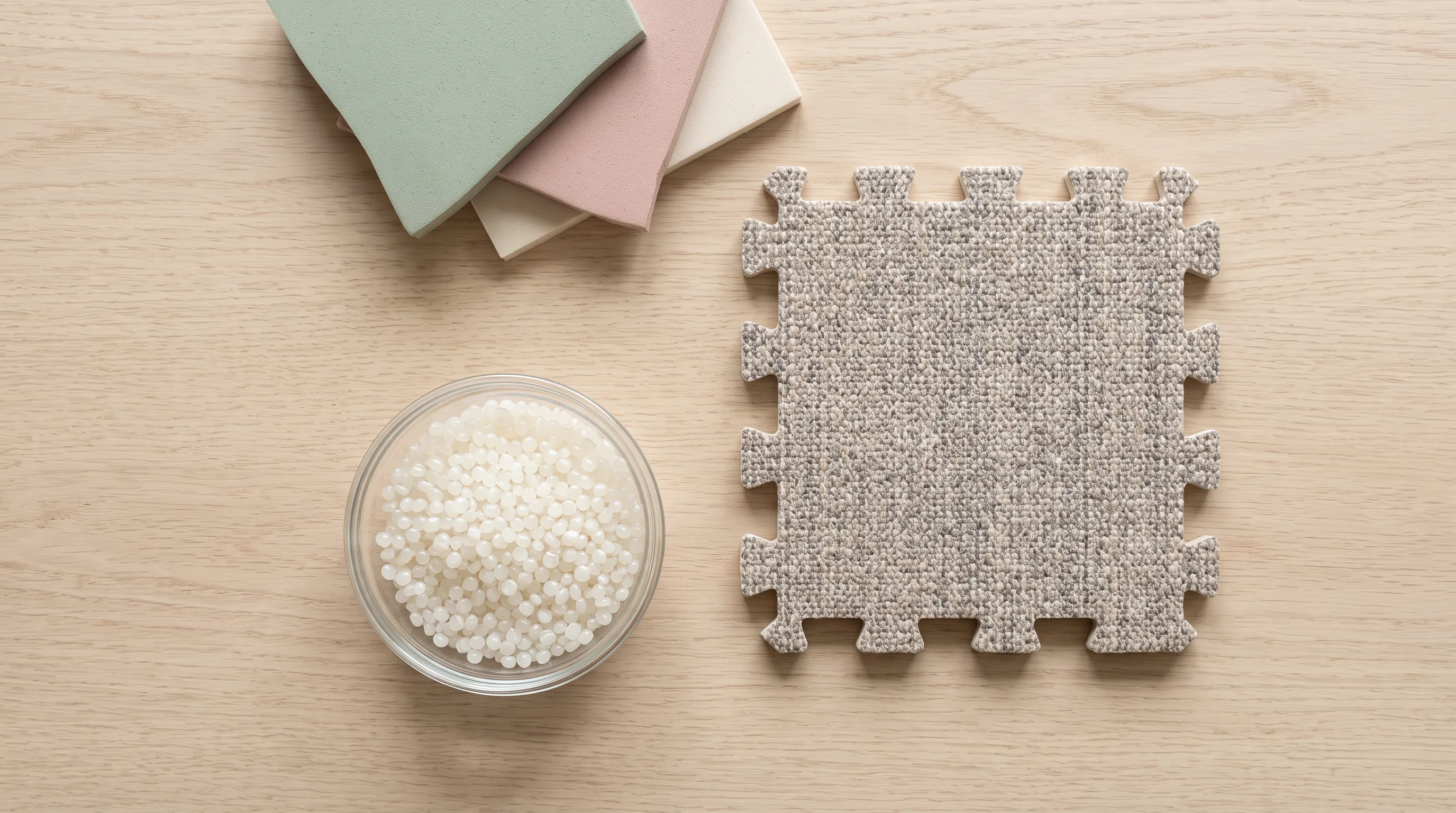
EVA material, short for ethylene vinyl acetate, is a copolymer made by joining ethylene and vinyl acetate into one polymer chain. More vinyl acetate makes it softer and more rubber-like; less makes it behave like polyethylene. Foamed and crosslinked, EVA becomes the light, cushioned, water-resistant material used in shoe soles, sports padding and interlocking floor mats.
Key Takeaways
- Ethylene vinyl acetate is a copolymer of ethylene and vinyl acetate, commonly produced under high pressure with free-radical initiators.
- Vinyl acetate (VA) content is the main dial: commercial grades range from a few percent to about 40 to 50 percent VA by weight, changing softness and flexibility.
- EVA keeps toughness at low temperatures; its glass transition temperature sits around -25 to -30 °C regardless of VA content.
- EVA foam has a closed-cell structure, which is why it cushions well and does not soak up spills.
- U.S. FDA rules (21 CFR 177.1350) permit EVA copolymers in food-contact articles, which says a lot about the base resin’s profile.
What Is Ethylene Vinyl Acetate?
Ethylene vinyl acetate is a thermoplastic copolymer in which ethylene units and vinyl acetate units are linked along the same polymer chain. It is also called poly(ethylene-vinyl acetate), PEVA or simply EVA. Ethylene alone gives polyethylene, a waxy, semi-crystalline plastic. Adding vinyl acetate interrupts that crystalline order, so the material becomes softer and more flexible.
Britannica describes EVA as being produced by copolymerizing ethylene and vinyl acetate under pressure using free-radical catalysts. On the industrial side, high-pressure bulk polymerization in tubular or autoclave reactors is widely used, with azo compounds or peroxides as initiators. Because the reaction releases heat, producers keep conversion below a set point to keep it controlled.
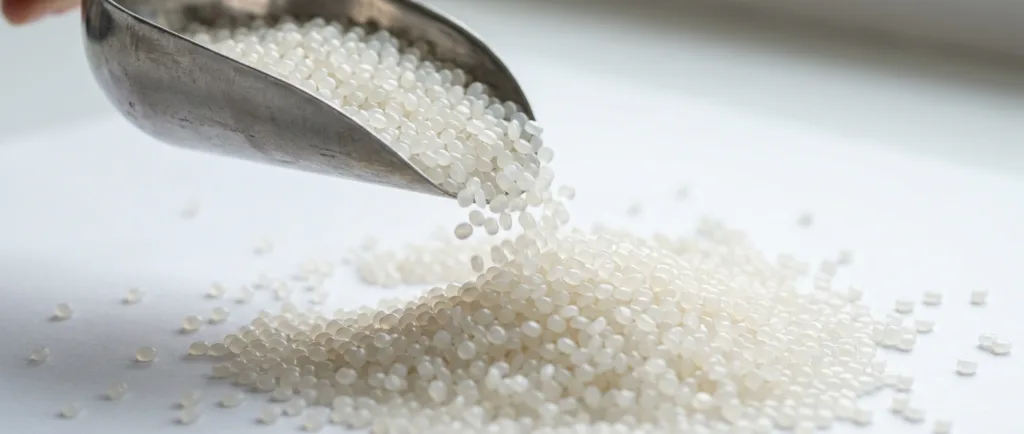
The result is sold as pellets. Those pellets are then compounded with other ingredients and processed into films, molded parts, hot-melt adhesives or, in our case, foam sheets.
Is EVA a plastic or a rubber?
Both descriptions are partly right. EVA is technically a plastic, and at low VA content it processes much like low-density polyethylene. At medium VA content it behaves as a thermoplastic elastomer: rubbery and flexible, but meltable and reprocessable without vulcanization. At very high VA content it becomes an EVA rubber. So when people say “EVA plastic” or “EVA rubber,” they are usually talking about different grades of the same family.
How Does Vinyl Acetate Content Change EVA Properties?
Vinyl acetate content is the most important number on an EVA datasheet. Britannica notes that grades are made with VA content from about 5 to 50 percent by weight, while other references describe typical commercial EVA as roughly 1 to 40 percent VA. The table below groups grades the way reference sources usually do.
| VA content (by weight) | Common name | How it behaves | Typical uses |
|---|---|---|---|
| Up to about 4% | VA-modified polyethylene | Processes like low-density polyethylene, with more gloss, softness and flexibility | Films and packaging |
| About 4% to 30% | Thermoplastic EVA | Soft, flexible, rubber-like thermoplastic elastomer; not vulcanized | Foams, footwear, hot-melt adhesives (around 11% VA grades), molded parts |
| Above about 60% | EVA rubber | Elastomeric, rubber-like grades | Specialty rubber applications |
As VA rises, EVA generally becomes softer and more flexible. Adhesive and encapsulant uses take advantage of EVA’s bonding behavior, while foam producers choose grades that balance softness with enough strength to survive cutting, interlocking and years of foot traffic.
What Are the Main EVA Properties?
Reference sources consistently describe EVA as having good clarity and gloss, low-temperature toughness, stress-crack resistance, rubber-like softness, waterproof behavior and UV resistance. It also has a mild vinegar-like odor. Here is how those properties translate when you are evaluating EVA for a product:
| EVA property | What it means in practice | Why it matters for floor mats |
|---|---|---|
| Flexibility and softness | Bends without cracking; feels rubbery rather than rigid | Comfortable for kneeling, crawling and sitting |
| Low-temperature toughness | Glass transition around -25 to -30 °C, so it stays flexible in cold rooms | Tiles do not turn brittle in winter garages or during shipping |
| Stress-crack resistance | Resists cracking under repeated stress | Interlocking edges survive being joined and separated many times |
| Water resistance | The polymer does not absorb water readily; foam can be closed-cell | Spills stay on the surface and can be wiped away |
| Lightweight when foamed | Mostly gas by volume after foaming | Easy to ship, carry and rearrange at home |
| Bondability | Adheres well to films and other layers | Allows printed or laminated decorative surfaces |
| Thermoplastic behavior | Softens with heat and can be molded or laminated | Supports compression molding and heat lamination |
What Is EVA Material Used For?
EVA material shows up in more everyday products than most people realize. Common uses include:
- Footwear: sandal and flip-flop soles, clogs and running shoe midsoles, where compression-molded EVA foam provides cushioning.
- Adhesives: hot glue sticks and packaging, textile and bookbinding adhesives.
- Solar panels: EVA film encapsulates silicon cells and bonds them to the glass.
- Medical and drug delivery: transdermal patches and other delivery systems.
- Sports and protective padding: helmets, pads, bicycle saddles and boot liners.
- Floats and handles: fishing floats, rod grips and floating eyewear.
- Floor products: play mats for babies and children and interlocking floor tiles.
- Packaging and food contact: under 21 CFR 177.1350, the FDA permits EVA copolymers in articles used to produce, pack, process, store and transport food, subject to extractives limits.
What Is EVA Foam and How Is It Different From Solid EVA?
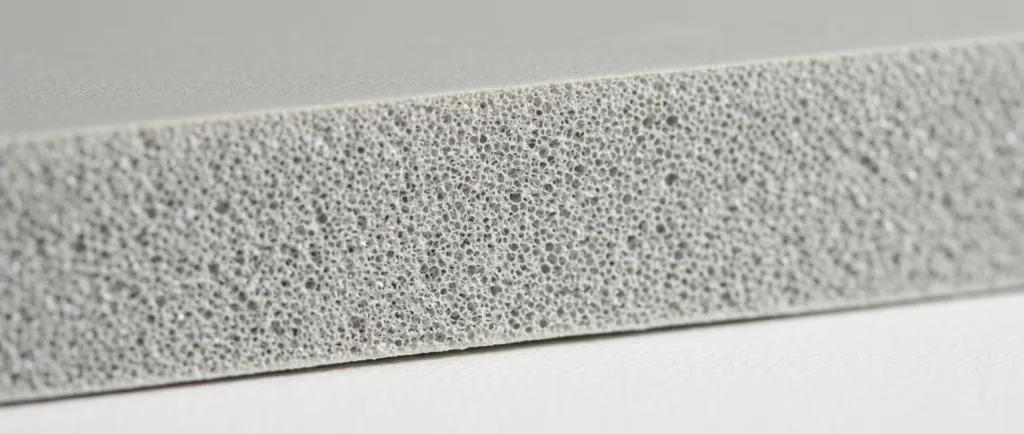
EVA foam is EVA that has been compounded with a blowing agent and a crosslinking agent, then expanded with heat so that the material fills with tiny gas cells. Solid EVA is dense and rubbery. EVA foam is mostly gas by volume, which makes it light and cushioned while keeping the toughness of the polymer around each cell.
Two things make EVA foam suitable for floors:
- Closed cells. In a closed-cell foam, each gas pocket is completely surrounded by solid material. Water and crumbs cannot travel into the core the way they do in a sponge. Our article on closed-cell foam and why it matters for floor mats explains this in more depth.
- Crosslinking. Linking polymer chains together during foaming stabilizes the cells so the foam recovers after being pressed, rather than slowly flattening.
The full production route, from pellets to compounded sheet, press foaming, slicing and cutting, is described on our foaming page.
Why Is EVA Material Popular for Play Mats and Floor Tiles?
EVA combines several properties that are hard to get in one material at a reasonable weight:
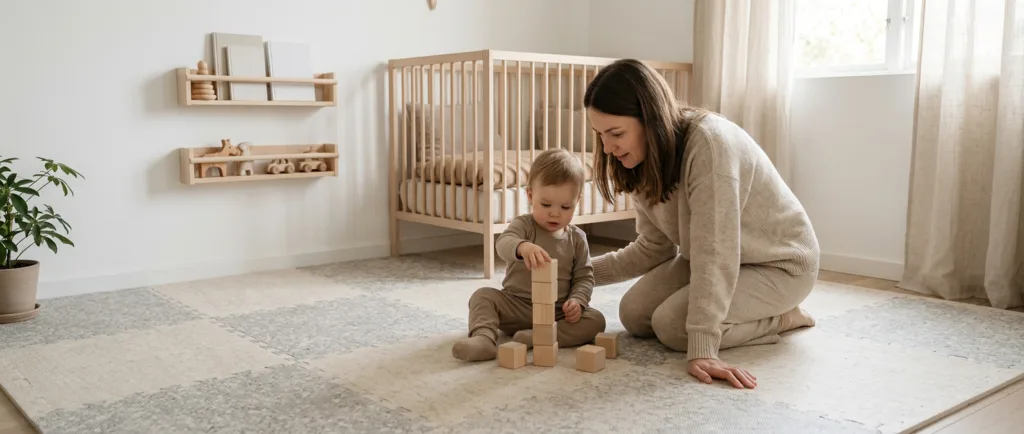
- Cushioning with recovery. The foam compresses under a knee or a fall and springs back. A 1/2 inch EVA tile, which is Komat’s standard thickness, gives noticeable cushioning on hardwood or tile floors.
- Easy cleaning. The closed-cell surface can be wiped with mild soap and water.
- Modularity. EVA cuts cleanly with steel-rule dies, so tiles can be made with precise interlocking edges and borders.
- Printability. EVA bonds well to decorative films, which allows rug-look and patterned designs instead of plain colors.
- No plasticizer needed in the foam. Unlike flexible PVC, EVA foam gets its softness from its copolymer structure, not from added plasticizers.
Those last two points are where manufacturing quality shows. Printed films can peel at the edges if the lamination is poor. Komat uses a patented non-continuous print lamination so the film does not peel, plus a borderless puzzle design that lets patterns match across tiles. For an overview of the finished product category, see our EVA foam puzzle mat buyer’s guide.
Sourcing EVA play mats?
Choose the EVA formula that fits your product
Komat develops standard EVA, Bio EVA with 20–30% bio-based content and GraphEVA for private label play mats, all with formamide under 2 ppm.
Is EVA Material Safe?
The base polymer has a good safety profile, which is one reason regulators allow EVA copolymers in food-contact applications. For children’s products, though, safety depends on the whole formulation and process: residues left by foaming chemistry, pigments, and any film or coating on the surface. U.S. children’s products must meet CPSIA limits, including the 0.1% limits on specified phthalates under 16 CFR 1307. Notably, EVA is not on the CPSC’s list of plastics determined not to exceed phthalate limits (16 CFR 1308.2), so EVA components are normally included in third-party phthalate testing.
We cover residues such as formamide, test reports and what brands should check in Is EVA Foam Toxic? What Parents and Brands Should Know.
EVA vs Other Foam Materials
EVA is not the only option for foam flooring. Polyethylene foams, including crosslinked XPE and IXPE, are common in roll-out mats; polyurethane foams are typical in cushions and mattresses, often with open cells. Each has strengths. EVA tends to win where you want a soft, resilient, printable tile that interlocks cleanly. Our EVA vs polyethylene foam comparison goes through the trade-offs for play mats.
EVA also comes in more sustainable variants. Komat’s Bio EVA contains 20 to 30 percent bio-based content while keeping the same tile format, and is available in our Bio EVA play mat range.
How Should a Brand Specify EVA Material?
If you are writing a specification for an EVA product, “EVA foam” on its own is too vague. Two mats can both be EVA and still feel, smell and wear very differently. A useful brief covers at least these points:
- Thickness and tolerance: for example 1/2 inch tiles, with how much variation you will accept across a production run.
- Hardness and feel: agree on a reference tile so softness and rebound can be checked against a physical standard.
- Surface finish: plain foam, textured, or printed film, and how the print should match across tiles.
- Material variant: standard EVA, Bio EVA or another option, decided before testing starts.
- Chemical test scope: the standards and substances you need reports for, such as CPSIA, ASTM F963 and formamide content.
- Packaging: how many tiles per set, edge pieces, and carton format for your sales channel.
Writing these down early avoids surprises when production starts, and it gives your quality team clear criteria for inspection.
For brands and importers
Turn the right EVA spec into your own product line
Tell us your market, tile size and design ideas. We will recommend a material and prepare a quote for private label or custom EVA foam mats.
Frequently Asked Questions
What is EVA material made of?
EVA is made of two monomers, ethylene and vinyl acetate, joined in a single copolymer chain. The proportion of vinyl acetate, often somewhere between a few percent and about 40 to 50 percent by weight, determines how soft and flexible the grade is. For foam, the EVA resin is also compounded with a blowing agent, a crosslinker and colorants before it is expanded.
Is EVA the same as PEVA?
Yes. PEVA stands for poly(ethylene-vinyl acetate), which is another name for the same copolymer. You often see “PEVA” on shower curtains and similar film products, and “EVA” on foam products, footwear and adhesives. The chemistry is the same family; what differs is the grade, vinyl acetate content and how the material is processed into the final product.
Is EVA plastic waterproof?
EVA does not absorb water readily, and reference sources list waterproof behavior among its properties. EVA foam used for play mats has a closed-cell structure, so water stays on the surface instead of soaking in. Seams between interlocking tiles can still let liquid through to the floor below, so wipe spills promptly and lift tiles occasionally to dry the subfloor.
Does EVA material contain phthalates or BPA?
EVA does not need plasticizers to be flexible; its softness comes from the vinyl acetate in the polymer chain. BPA is not part of the EVA copolymer. A finished product can still include other layers, such as printed films, so U.S. children’s products are tested for the eight phthalates restricted under 16 CFR 1307 on every accessible component.
How long does EVA foam last?
Lifespan depends on density, crosslinking quality, thickness and use. Well-crosslinked EVA foam recovers after compression and resists cracking at interlocking edges, but heavy furniture, sharp objects, pets and direct sunlight all shorten its life. Replace tiles that are torn, crumbling or permanently compressed, especially in areas used by babies and toddlers.
Is EVA recyclable?
EVA is a thermoplastic, but EVA foam used in mats is crosslinked, which makes it much harder to remelt and reprocess than uncrosslinked plastics. Recycling options depend on local facilities. Brands looking to reduce footprint often focus on bio-based content, durable designs and right-sized packaging instead. Check with your local program before marketing any recyclability claim.
If you are developing a play mat or floor tile line and want to choose the right EVA grade, thickness and finish, Komat can help you weigh the options. Contact our team to talk through materials, testing and design for your market.