

ASTM F963 is the U.S. Standard Consumer Safety Specification for Toy Safety, covering toys intended for children under 14. Its current edition, ASTM F963-23, has been the mandatory federal toy standard under 16 CFR Part 1250 since April 20, 2024. For play mats, it matters whenever the mat or its pieces are treated as toys, which affects testing and certification.
Key Takeaways
- ASTM F963-23 applies to toys intended for use by children under 14 years of age and addresses hazards that may not be readily recognized by the public.
- The CPSC made ASTM F963-23 mandatory for toys manufactured on or after April 20, 2024, excluding section 4.2 (flammability) and the annex.
- Only certain provisions require third-party testing; the CPSC kept the same 37 provisions subject to third-party testing as under the prior edition.
- Sections most relevant to foam mats include heavy elements in coatings and substrates, small objects, accessible edges and points, and labeling.
- Whether a play mat is a “toy” depends on its design and marketing; confirm the scope of your test plan with a CPSC-accepted lab.
What Is ASTM F963?
ASTM F963 is a consensus safety standard developed by ASTM International’s toy safety subcommittee that sets requirements and test methods for toys. ASTM states that the standard “relates to possible hazards that may not be recognized readily by the public,” and that it covers “toys intended for use by children under 14 years of age,” with some requirements using narrower age bands.
The standard is organized into requirements (section 4), labeling (section 5), instructional literature, producer markings, test methods (section 8) and annexes, including age-labeling guidance. Its hazard topics range from material quality, flammability and toxicology to small objects, accessible edges and points, projections, stuffing materials, magnets, batteries and expanding materials. Some product types are outside its scope, including bicycles, playground equipment and sporting goods that are not toy versions.
ASTM F963-23 is the current mandatory edition
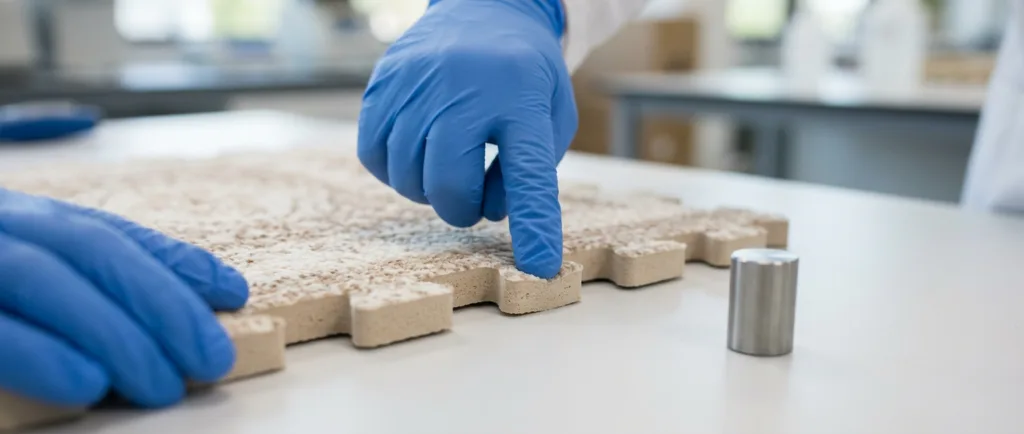
ASTM published ASTM F963-23 in 2023. In January 2024, the CPSC issued a direct final rule adopting it as the mandatory toy safety standard under 16 CFR Part 1250. The Toy Association summarized the timing this way: toys produced on or after April 20, 2024 need to comply with F963-23. As of 2026, F963-23 remains the incorporated edition, and the CPSC has continued to add product-specific requirements to Part 1250, such as the neck float rule published in December 2025 with an effective date of June 15, 2026. Check the CPSC site for any newer revision before you finalize a test plan.
What Changed in ASTM F963-23?
According to the CPSC’s 2024 Federal Register notice, the update made several safety-related changes and some editorial ones. Few of them change how a basic foam mat is tested, but they matter for activity mats and bundles.
| Area | Change in F963-23 (per CPSC notice) | Relevance to foam mats |
|---|---|---|
| Battery-operated toys | Clearer accessibility requirements, abuse testing for some older-age toys, fasteners must stay attached | Only for mats with sound or light modules |
| Expanding materials | Scope widened to more small components that can expand | Rarely relevant to EVA mats |
| Sound-producing toys | New limit for user-propelled push or pull toys | Only for musical or sound mats |
| Substrate heavy elements | Section 4.3.5.2 reorganized; paper and paperboard clarified as out of scope | Relevant: foam substrate and printed layers are assessed |
| Phthalates | Now restates CPSC’s 16 CFR Part 1307 limits | Aligns toy testing with federal phthalate rule |
| Tracking labels | Section 5.1.2 restates federal tracking label requirements | Product and packaging marking |
The CPSC also noted that it requires third-party testing for the same 37 provisions as under F963-17, and that test reports must cite “ASTM F963-23” and the specific section numbers.
Which ASTM F963 Sections Matter for Play Mats?
A foam play mat is a simple product compared with a ride-on or an electronic toy, so only part of the standard usually applies. The table lists the areas labs most commonly look at for interlocking EVA mats and related soft products. Your lab will decide the exact list based on your design and age grading.
| F963 area | What it addresses | Why it matters for foam mats |
|---|---|---|
| Toxicology, heavy elements (4.3.5) | Soluble heavy elements in paints, surface coatings and accessible substrates | Printed films, inks and the foam body are accessible to children |
| Small objects (4.6) | Small parts that could pose choking hazards for young children, including after use-and-abuse testing | Detachable border pieces, removable shapes, or foam that tears into small pieces |
| Accessible edges and points (4.7, 4.9) | Sharp edges and points | Mostly a concern for accessories, zippers on bags, or rigid trims |
| Projections (4.8) | Projections that could cause impalement | Rarely relevant to flat mats; check rigid add-ons |
| Material quality (4.1) | General requirements on the quality of materials used in toys | Consistent, clean foam and print materials |
| Labeling and age grading (5, Annex A1) | Age labeling, warnings, producer markings | Age grade affects which tests apply |
Small parts and detachable pieces
The highest practical risk for foam mats is detachment. A small part, in toy safety terms, is a piece that fits inside the standard small parts test cylinder and could be a choking hazard for children under three. Interlocking tiles are large, but removable letter or shape inserts, thin decorative layers that peel, and border strips can create small pieces. Use-and-abuse tests simulate a child’s handling and check whether anything breaks off. This is one reason rug-look designs without removable inserts have become popular, and why Komat uses a patented non-continuous print lamination designed so the film doesn’t peel; see our printing and lamination process.
Heavy elements in coatings and substrates
Section 4.3.5 limits soluble heavy elements in paints and surface coatings and in accessible substrate materials. For a printed mat, labs typically sample the printed surface and the foam separately. This works alongside the federal limits on total lead content and lead in surface coatings described in our CPSIA guide.
When Is a Play Mat Treated as a Toy?
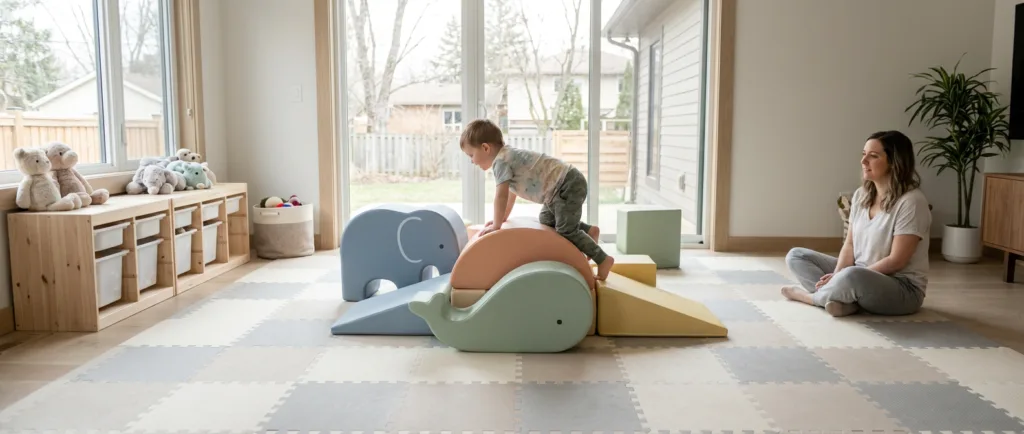
A toy, for ASTM F963 purposes, is a product intended for children under 14 to use in play. A plain floor mat designed to cushion a play area is often discussed as a children’s product rather than a toy, while an activity mat with games, removable shapes or printed play scenes is more clearly a toy. Marketing matters: describing the mat as a “puzzle” or “learning toy” pushes it toward toy treatment.
Age grading is closely tied to this question. The CPSC staff Age Determination Guidelines, referenced in the federal definition of a children’s product, look at how a product is designed and used at different developmental stages. A mat designed for tummy time and crawling will typically be graded for the youngest children, which brings in the strictest small-parts expectations for any detachable piece. Decide the intended age range early, write it into the specification, and make sure packaging, marketing and test plans all reflect the same age grade.
In practice, many brands and retailers ask for testing to the applicable F963 sections on any mat sold for babies and toddlers, because it simplifies certification and retailer approval. The legal question of whether a specific design is a toy is one to settle with your CPSC-accepted lab and, if needed, counsel. Products such as EVA foam tumbling animals in our soft play range are designed for active play and are evaluated with that use in mind.
How Does ASTM F963 Testing Work?
ASTM F963 testing follows a sequence that most labs share:
- Scope review. You provide product photos, the bill of materials, age grade, packaging and instructions. The lab confirms which sections apply.
- Sample submission. Production-representative samples are sent, ideally from the first production lot or a run built with production materials.
- Physical and mechanical tests. Use-and-abuse conditioning, small parts, edges and points, and any applicable sections.
- Chemical tests. Heavy elements in coatings and substrates, plus the separate federal lead and phthalate tests where required.
- Labeling review. Age labeling, warnings and tracking label content.
- Report and certification. The report cites ASTM F963-23 section numbers. The importer or U.S. manufacturer uses it to issue a Children’s Product Certificate.
Third-party testing is required for provisions the CPSC lists, performed by a lab the CPSC has accepted for those provisions. The CPSC notes that it has accepted more than 600 labs worldwide, but acceptance is rule-specific, so check the lab’s scope.
Build testing into the launch calendar rather than treating it as a final checkbox. If a test fails, the fix usually means changing a material, an ink or a component and then retesting, which can push back a retail launch date. Brands that agree on the material list early, send production-representative samples, and ask the lab to review packaging artwork at the same time tend to move through testing with fewer surprises.
How to Prepare a Foam Mat Program for ASTM F963 Testing
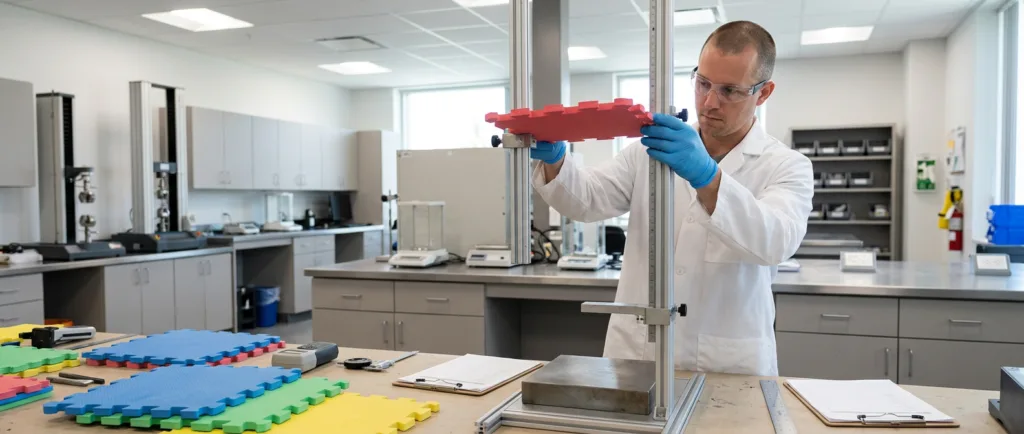
Most failed or delayed toy tests come from preparation gaps rather than unsafe products. Before you send samples, work through these points with your manufacturer:
- Fix the age grade first. The age grade drives small-parts rules and labeling, so decide it with your marketing and lab before artwork is final.
- Submit production materials. Prototype foam, a different print film or a hand-cut sample may not behave like mass production in use-and-abuse tests.
- Include every component. Border strips, carry bags, play pieces and packaging inserts each need to be evaluated if a child can reach them.
- Prepare labeling drafts. Labs review age labeling, warnings and tracking label content, so send packaging artwork with the samples.
- Agree on change control. Decide which changes (ink supplier, foam formula, thickness) will trigger retesting, and write it into your supply agreement.
Consistent production is what makes the test result meaningful for every later order. Our quality control system applies 100% in-process inspection at every station, and our shipping yield is 99.7% or higher, which helps keep each batch aligned with the tested sample.
ASTM F963 vs. Other Toy Safety Standards
ASTM F963 is the U.S. toy safety standard. Brands selling in Europe work with the EN 71 series under EU toy safety law, and other markets have their own standards. The requirements overlap in topics such as small parts, mechanical hazards and chemical limits, but test methods and limits differ, so one report does not automatically cover another market. Komat’s EVA formulations are tested to ASTM F963, CPSIA, CA Prop 65, EN 71 and REACH, with reports available on request, which helps brands plan multi-market launches from one specification.
Frequently Asked Questions
Is ASTM F963 mandatory in the United States?
Yes. The CPSC incorporated ASTM F963 into federal law as the mandatory toy safety standard under 16 CFR Part 1250. The current edition, ASTM F963-23, applies to toys manufactured on or after April 20, 2024, with section 4.2 and the annex excluded. Toys for children 12 and under need third-party testing for the listed provisions.
Does every foam play mat need ASTM F963 testing?
Not every mat is legally a toy, but mats sold for babies and toddlers are children’s products, and many brands and retailers expect testing to the applicable F963 sections. Activity mats with removable pieces or play features are more clearly toys. Ask your CPSC-accepted lab to confirm the scope for your design.
What is the latest version of ASTM F963?
As of 2026, ASTM F963-23 is the edition incorporated into the federal toy rule. ASTM revises the standard periodically, and the CPSC decides whether to adopt each revision. Before testing a new product, check the CPSC toy safety pages for the edition currently in force and any added product-specific requirements.
Which ASTM F963 sections apply to foam mats?
Common ones include heavy elements in coatings and substrates (4.3.5), small objects (4.6), accessible edges and points (4.7 and 4.9), material quality (4.1), and labeling and age grading (section 5 and Annex A1). Mats with electronics, sounds or magnets bring in additional sections.
How long is an ASTM F963 test report valid?
A report supports certification for the product and materials tested. For continuous production, children’s products need periodic testing, at least once a year under a periodic testing plan per 16 CFR 1107.21, and new testing when materials or design change in ways that could affect compliance.
Planning a play mat or soft play line for U.S. retail? Explore our ready private-label designs or contact Komat to discuss specifications and test documentation.
Sources
- ASTM International: ASTM F963-23 Standard Consumer Safety Specification for Toy Safety
- Federal Register: Safety Standard Mandating ASTM F963 for Toys (January 18, 2024)
- The Toy Association: CPSC Approves Updated Federal Toy Safety Standard
- Federal Register: Mandatory Toy Safety Standards, Requirements for Neck Floats (December 15, 2025)
- CPSC: Third Party Testing