

EVA vs PVC comes down to how a play mat is built. EVA foam tiles are thick, soft and modular; PVC mats are usually roll-out or leather-look surfaces that wipe clean easily but rely on plasticizers to stay flexible. PU leather mats sit in between, with a polyurethane coating over a fabric base. Each suits a different room, budget and cleaning routine.
Key Takeaways
- EVA foam is a closed-cell foam that gets its softness from its copolymer structure, not from added plasticizers.
- Flexible PVC needs plasticizers; the U.S. EPA notes that phthalates are used primarily as plasticizers in PVC products.
- U.S. children’s toys and child care articles may not contain more than 0.1% of eight specified phthalates in accessible plasticized components (16 CFR 1307).
- PU leather is typically a polyurethane coating on a fibrous base layer; “vegan leather” is a marketing name used for both PU and PVC materials.
- FTC guides say non-leather that looks like leather should be disclosed, for example as “imitation leather,” “vinyl” or “not leather.”
What Are EVA, PVC and PU Play Mats?
Before comparing them, it helps to define each material in one line:
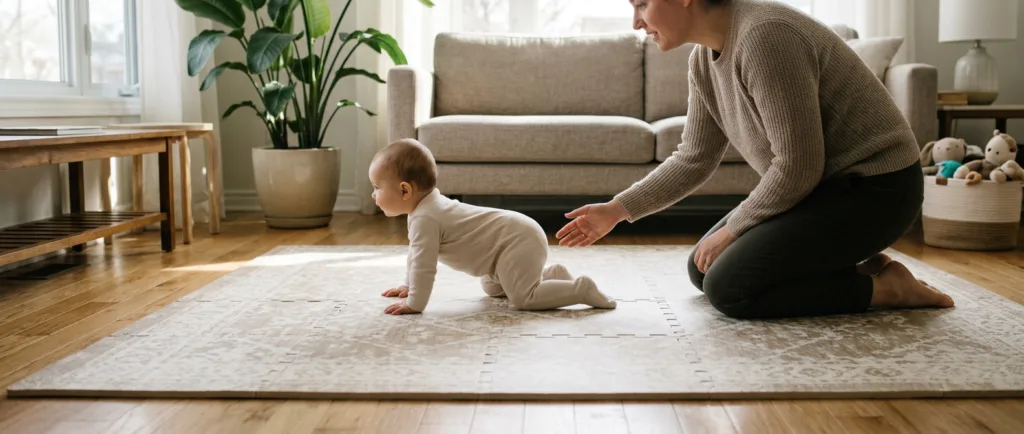
- EVA play mat: a mat made of ethylene vinyl acetate foam, usually as interlocking puzzle tiles, often with a printed or textured surface.
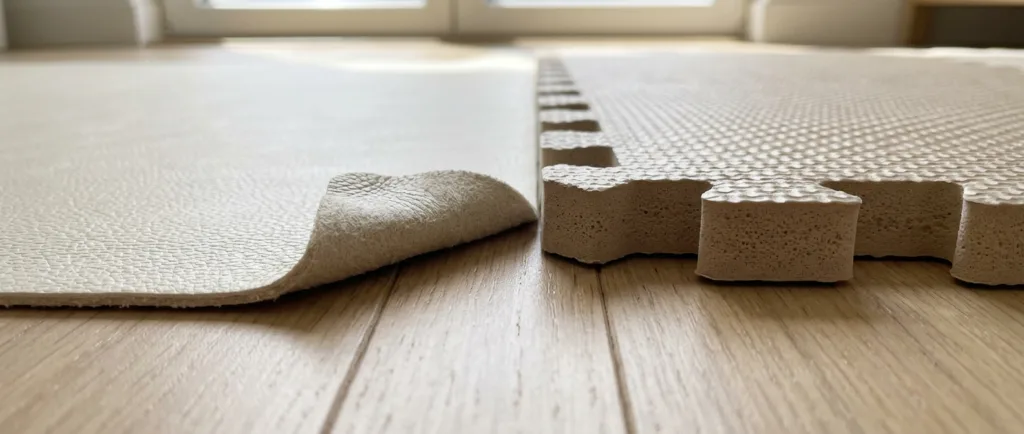
- PVC play mat: a mat with a polyvinyl chloride surface, either a thick roll-out mat with a cushioning core or a thin leather-look vinyl sheet.
- PU leather play mat: a mat with a polyurethane coating, often over a fabric backing, made to look and feel like leather.
“Vegan leather play mat” and “leather play mat” are marketing terms that can describe either PU or PVC surfaces. Real leather mats for babies are rare. Reference sources list “vegan leather,” “faux leather,” “leatherette” and “PU leather” among the many names for artificial leather.
EVA vs PVC vs PU: How Do They Compare?
The table below compares typical products in each category. Constructions vary widely, especially among PVC and PU mats, so check the actual product specification and test reports.
| Factor | EVA foam tiles | PVC mats (roll-out or vinyl leather) | PU leather mats |
|---|---|---|---|
| Construction | Closed-cell foam, interlocking tiles | PVC skin, sometimes over a foam core; or thin vinyl sheet | Polyurethane coating on a fabric or foam base |
| Softness | Soft and springy, especially at 1/2 inch | Varies: thick roll-outs are soft; thin vinyl is flat | Usually thin; soft only if it has a padded core |
| Plasticizers | Not needed for flexibility | Needed for flexible PVC; type matters | Not typically the main softening route; other additives possible |
| Cleaning | Wipe surface; seams can trap crumbs | Wipe-clean, seamless surface | Wipe-clean; follow coating care |
| Durability | Good; edges and films are the weak points | Good; can crease or cut | Surface can rub or wear with time |
| Portability | Disassemble and stack | Roll or fold | Roll or fold; very light |
| Coverage | Expandable to any room size | Fixed size | Fixed size |
| Best use | Nurseries, playrooms, larger areas | Seamless play zones, under high chairs | Under high chairs, style-led spaces |
Plasticizers: The Key Difference Between EVA and PVC
A plasticizer is an additive that makes a rigid plastic soft and flexible. Rigid PVC is used for pipes; flexible PVC, the kind in mats and vinyl leather, contains plasticizers. According to the U.S. EPA, phthalates are high production volume chemicals used primarily as plasticizers in PVC products. CPSC guidance similarly describes phthalates as most often used to make plastics softer and more pliable.
That is why phthalates are a central topic for PVC play mats. Under 16 CFR 1307.3, children’s toys and child care articles may not contain more than 0.1 percent of DEHP, DBP, BBP, DINP, DIBP, DPENP, DHEXP or DCHP, and the limits apply to plasticized component parts. For a brand, the practical step is simple: ask which plasticizer a PVC material uses, and require third-party phthalate test reports on every accessible PVC component.
EVA foam is different. Its flexibility comes from vinyl acetate units built into the polymer chain, so the foam itself does not need plasticizers. That does not exempt it from testing: EVA is not on the CPSC’s list of plastics determined not to exceed phthalate limits (16 CFR 1308.2), and printed films or coatings on an EVA mat are separate components. EVA’s own watch points are residues from foaming, such as formamide, covered in Is EVA Foam Toxic?
When Does a PVC Play Mat Make Sense?
PVC has real advantages, which is why it remains common:
- Seamless, wipeable surface. No tile joints means fewer places for crumbs and spills to collect.
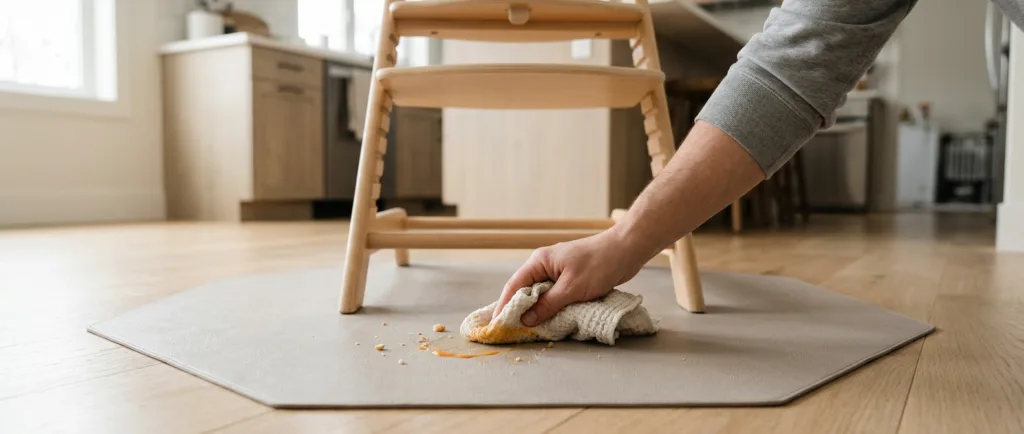
- Thin, flexible formats. Vinyl leather can be made very thin, which suits splat mats under high chairs and mats that need to lie flat without a trip edge.
- Durability. Coated vinyl resists everyday wear and does not crack or fade easily, though the surface of artificial leathers can rub with time.
The trade-offs are plasticizer chemistry, which must be controlled and tested, and less cushioning in thin formats. For mealtime use, our splat mat for high chair buyer’s guide and the comparison of what to put under a high chair explain where thin mats outperform foam.
Komat’s vegan leather option
Komat’s leather-look line uses a biodegradable PVC vegan leather for splat mats and pet mats: thin, wipe-clean and designed to lie flat. Because it is PVC-based, it goes through the same phthalate testing as any accessible plasticized component. You can see the range in our leather splat mats collection.
When Does a PU Leather Play Mat Make Sense?
PU leather is a polyurethane coating, often on a fabric base layer. It is used where brands want a soft, leather-like hand and a light, foldable product. As of 2016, reference sources report polyurethane had become more widely used than PVC in artificial leather overall.
The trade-offs are similar to PVC in format (usually thin, fixed size) with different chemistry. PU’s surface can wear with heavy use, and quality varies widely between coatings. Like any children’s product component, a PU surface should be tested for lead and phthalates under CPSIA, since additives and coatings can vary.
When Does EVA Foam Make Sense?
- Cushioning. Thick EVA tiles soften the floor for tummy time, crawling and early walking.
- Room-sized coverage. Add tiles to fit any space, then reconfigure as the child grows.
- Design. Rug-look printed films let EVA mats look like part of the decor. Komat’s patented non-continuous print lamination keeps the film from peeling, and pattern-matched designs carry across tile joints.
- Repairability. Replace one damaged tile instead of the whole mat.
The trade-off is seams. Crumbs and liquids can reach the floor between tiles, which is why many families pair an EVA play area with a thin wipe-clean mat under the high chair.
EVA also gives brands more room on the material story. Alongside standard EVA, Komat offers Bio EVA with 20 to 30 percent bio-based content, so a range can include a lower-fossil-content option without changing the tile format, thickness or print quality that shoppers already know. That makes it easier to build good, better and best tiers within one product family.
How Do Cleaning and Care Differ Between EVA, PVC and PU?
Day-to-day care is where parents notice the differences most, so it is worth spelling out for your product pages and inserts.
- EVA foam tiles: wipe the surface with a damp cloth and mild soap. Because the foam is closed-cell, spills stay on top, but liquid can run into the seams. Lift tiles every so often to wipe the edges and dry the floor underneath. Avoid harsh solvents and keep tiles away from heaters.
- PVC mats: the seamless surface is the easiest to wipe after meals. Follow the maker’s guidance on cleaners, since strong solvents can affect vinyl surfaces, and let the mat dry flat before rolling or folding it.
- PU leather mats: wipe with a soft damp cloth. Abrasive pads can wear the coating, so gentle cleaning helps the surface last.
Whatever the material, clear care instructions reduce returns and complaints. They also set honest expectations: no floor mat is indestructible, and pets, sharp toys and heavy furniture will mark any of them over time. If you are comparing foam constructions as well, our guide to EVA vs polyethylene foam explains how roll-out foam mats differ from interlocking tiles.
What Should Brands Check Before Choosing a Material?
| Check | EVA foam | PVC | PU leather |
|---|---|---|---|
| CPSIA lead limits | Yes | Yes | Yes |
| CPSIA phthalates (16 CFR 1307) | Yes; EVA not on the 1308.2 determination list | Yes; key test for plasticized PVC | Yes; check coatings and backing |
| Formamide | Commonly tested for foam | Relevant if a foam core is used | Relevant if a foam core is used |
| Labeling of leather-look surfaces | Not applicable | Disclose non-leather, e.g. “vinyl” or “imitation leather” | Disclose non-leather, e.g. “not leather” |
| Main format strength | Thick, modular cushioning | Seamless, thin or roll-out | Light, soft-touch, foldable |
On labeling: the FTC’s Guides for Select Leather and Imitation Leather Products (16 CFR 24.2) say that when a product is made of non-leather material that appears to be leather, the seller should disclose that it is not leather or the general nature of the material, with examples such as “Not leather,” “Imitation leather,” “Simulated leather,” “Vinyl” and “Plastic.” Whether “vegan leather” alone is enough is a question to settle with your counsel. For the testing side, our CPSIA guide for play mat brands covers certificates and lab selection.
Frequently Asked Questions
Is EVA safer than PVC for play mats?
Neither material is automatically safe or unsafe; testing of the finished product decides that. EVA foam does not need plasticizers for flexibility, which removes one concern associated with flexible PVC. PVC mats can comply if their plasticizers meet the 0.1% phthalate limits. Ask for CPSIA lead and phthalate reports on every accessible component, whichever material you choose.
Are PVC play mats toxic?
A PVC play mat is not toxic by definition, but its plasticizer chemistry deserves attention. Phthalates are used primarily as plasticizers in PVC products, and eight phthalates are limited to 0.1% in U.S. children’s toys and child care articles. Choose PVC mats with third-party test reports showing compliance, and confirm which plasticizer is used.
Is PU leather better than PVC leather for a play mat?
They suit similar uses, and quality varies more within each category than between them. PU leather is a polyurethane coating on a base layer; PVC leather uses plasticized vinyl. Compare the actual products on feel, wear resistance, ease of cleaning and test reports rather than choosing on the material name alone.
What does “vegan leather play mat” mean?
It means the mat has a leather-like surface made without animal hides, typically PU or PVC. The term describes what the material is not, rather than what it is. FTC guides suggest disclosing the non-leather nature of the material, so look for labels that name the actual material, such as PU or vinyl.
Can I use an EVA mat and a PVC mat together?
Yes, and many families do. A thick EVA foam play area gives cushioning for floor play, while a thin wipe-clean leather-look mat under the high chair handles mealtime mess. Using each where it performs best often works better than asking one mat to do everything.
Which play mat material is easiest to clean?
For quick mealtime cleanup, a seamless PVC or PU leather-look mat is the easiest: one wipe and it is done. EVA foam tiles also wipe clean because the foam is closed-cell, but crumbs and liquids can work into the seams, so they need an occasional lift-and-wipe. Many households use each where it fits best.
If your customers are parents choosing between foam tiles and leather-look mats, offering both formats lets you meet each need honestly. Explore Komat’s private-label designs across EVA puzzle mats and vegan leather splat mats.
Sources
- Risk Management for Phthalates (U.S. EPA)
- Phthalates Business Guidance (U.S. Consumer Product Safety Commission)
- 16 CFR 1307.3: Prohibition of children’s toys and child care articles containing specified phthalates
- 16 CFR 1308.2: Plastics determined not to contain specified phthalates
- 16 CFR 24.2: FTC Guides for Select Leather and Imitation Leather Products, deception as to composition
- Artificial leather (Wikipedia)