

Is EVA foam toxic? The EVA polymer itself is generally considered low-toxicity, and the U.S. FDA even lists ethylene-vinyl acetate copolymers for food-contact use. The real question for a play mat is what else is in the foam: residues such as formamide, heavy metals in pigments, phthalates in other layers and fresh-product odor. A well-made, properly tested EVA mat answers each of those.
Key Takeaways
- EVA (ethylene-vinyl acetate) is a copolymer of ethylene and vinyl acetate; the base resin is not where most safety concerns come from.
- Formamide, a substance associated with blowing agents, is the best-known residue issue in foam puzzle mats; the EU has limited it in foam toy materials since May 24, 2017.
- U.S. children’s products are capped at 100 ppm total lead in accessible components, and covered products may not contain more than 0.1% of eight specified phthalates.
- “Non-toxic” is not a legal term. Test reports from an accredited lab, tied to the exact material and print, are what make the claim credible.
- Brands should test the finished product, including inks, films and any lamination layer, not just the raw foam.
What Is EVA Foam?
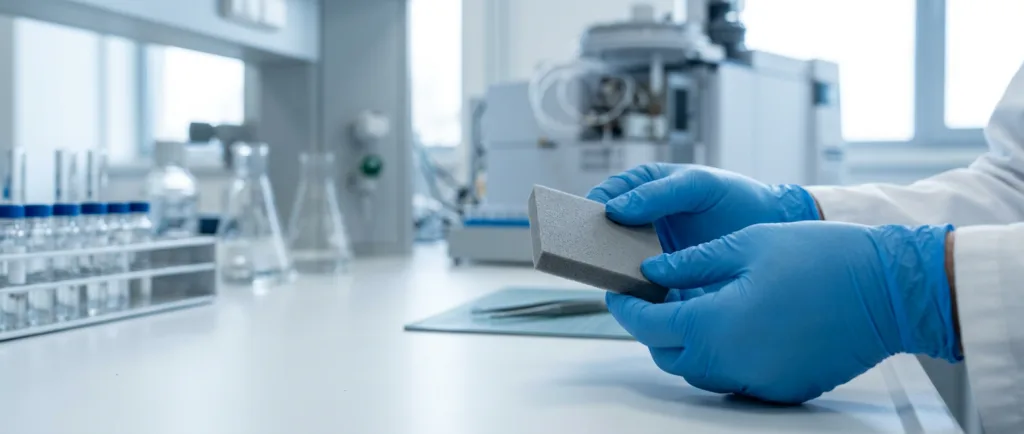
EVA foam is a closed-cell foam made from ethylene-vinyl acetate copolymer, expanded with a blowing agent and usually crosslinked so the cells hold their shape. Britannica describes EVA as a copolymer produced from ethylene and vinyl acetate under pressure with free-radical catalysts, made in grades with roughly 5 to 50 percent vinyl acetate by weight. That vinyl acetate share is what makes EVA softer and more flexible than plain polyethylene.
EVA shows up in places where people expect a material to be benign: shoe midsoles, mouthguards, hot-melt adhesives, solar-panel encapsulants and baby play mats. If you want the chemistry in more depth, our guide to EVA material and its properties covers vinyl acetate content and why it matters for flooring.
So, Is EVA Foam Toxic or Safe for Babies?
For most families, a properly manufactured and tested EVA foam mat is a reasonable choice for floor play. The polymer is the same family of material regulators already accept in food packaging: under 21 CFR 177.1350, the FDA permits ethylene-vinyl acetate copolymers in articles used for producing, packing and storing food, subject to extractives limits. That is not a toy approval, but it tells you the base resin is not considered inherently hazardous.
Where babies are concerned, the honest answer is “it depends on the mat.” Babies spend time face-down during tummy time, mouth corners of tiles and crawl across the surface for hours. So the questions that matter are about residues and surface layers, not the word “EVA.” The same polymer can go into a carefully controlled product or a cheap one with high residual chemicals, unknown pigments and a laminated film nobody has tested.
Where the risk actually comes from
Think of an EVA mat as a stack of decisions. Each one can introduce a chemical you would want to know about:
- Foaming chemistry. Blowing agents and crosslinkers create the foam structure. Their by-products can remain in the finished sheet if the process is not controlled.
- Colorants and inks. Pigments can carry heavy metals such as lead if sourcing is poor.
- Surface films and laminates. A printed film or a coated layer may be a different plastic from the foam, sometimes plasticized.
- Odor and volatiles. Fresh foam can smell. Odor is a signal worth checking, not proof of harm, but it often tracks how well the material was cured and aired.
Formamide: The Residue Everyone Asks About
Formamide is a chemical that can be present in foam materials, and it is the issue most often linked to foam puzzle mats. According to the recitals of Commission Directive (EU) 2015/2115, formamide is used in plastics and polymers as a solvent, plasticizer or “as a substance associated with a blowing agent.” In 2010 several EU member states found it in foam toys such as puzzle mats, which raised concerns about children inhaling it. Formamide is classified in the EU as toxic to reproduction, category 1B.
The EU response was a two-step limit for foam toy materials, applying from May 24, 2017. If formamide content is 200 mg/kg or less, no emission test is needed. Above that cut-off, emissions must not exceed 20 µg/m³ after a maximum of 28 days from the start of emission testing. There is no equivalent federal formamide limit for play mats in the U.S. as of 2026, which is why many brands selling into North America still choose to test for it. Our article on formamide in foam mats and how brands test for it walks through the methods in detail.
For reference, Komat’s non-toxic EVA formulation is controlled to keep formamide under 2 ppm, and the reports behind that figure are available to buyers on request.
Lead, Phthalates and Other Regulated Substances
In the U.S., EVA play mats sold as children’s products fall under the Consumer Product Safety Improvement Act (CPSIA). Two limits come up on almost every test plan:
- Total lead. CPSC states that children’s products with more than 100 ppm lead in an accessible component are banned hazardous substances.
- Phthalates. Under 16 CFR 1307.3, children’s toys and child care articles may not contain more than 0.1 percent of DEHP, DBP, BBP, DINP, DIBP, DPENP, DHEXP or DCHP, and the limit applies to plasticized component parts and other parts made of materials that may contain phthalates.
A detail many brands miss: the CPSC has determined that certain plastics, including polyethylene and polypropylene with specified additives, do not exceed the phthalate limits with a high degree of assurance (16 CFR 1308.2). EVA is not on that list as a standalone plastic. In practice, that means EVA components are normally included in third-party phthalate testing rather than exempted. Our CPSIA compliance guide for play mat brands explains how these tests feed into a Children’s Product Certificate.
| Concern | Where it can come from | Reference point (as of 2026) | What to ask for |
|---|---|---|---|
| Formamide | Residue associated with blowing agents in the foam | EU: 200 mg/kg content cut-off, 20 µg/m³ emission limit for foam toy materials | Content test result in mg/kg (ppm) on the finished foam |
| Lead | Pigments, inks, contaminated raw materials | U.S.: 100 ppm total lead in accessible components of children’s products | CPSIA lead content report covering each color and the print |
| Phthalates | Plasticized films, coatings or other layers | U.S.: 0.1% each for eight phthalates in covered products | 16 CFR 1307 test on each accessible plastic component |
| Prop 65 chemicals | Any listed chemical in the product | California: warning required for significant exposures unless exempt | Supplier statement and testing scope matched to your Prop 65 approach |
| Odor and VOCs | Incomplete curing, fresh packaging | No single U.S. play mat limit; brand-specific specs | Odor check on arrival; VOC or emission testing if you make low-odor claims |
Does EVA Foam Off-Gas?
New EVA foam often has a noticeable smell when the box is first opened. EVA itself has a faint vinegar-like odor, and freshly produced foam can release residual volatiles from processing. A smell does not automatically mean a mat is unsafe, and the absence of smell does not prove it is clean. What a smell does tell you is that it is worth asking about curing, airing and emission data.
Practical habits help regardless of the product: unpack a new mat in a ventilated room, lay the tiles flat for a day or two before baby uses them, and wipe them with mild soap and water. If an odor is strong or persists after airing, contact the seller and ask for the test reports.

What “Non-Toxic EVA Foam” Should Mean
“Non-toxic” has no single regulatory definition for play mats. California’s Proposition 65, for example, does not certify products as non-toxic at all. It requires businesses to give clear and reasonable warnings before knowingly exposing people to listed chemicals, and the list now covers over 800 chemicals known to cause cancer, birth defects or other reproductive harm. Businesses with fewer than 10 employees are exempt from the warning requirement.
Because the term is unregulated, a credible “non-toxic EVA foam” claim should rest on three things:
- A defined test scope. Name the substances and standards: for example lead and phthalates under CPSIA, formamide content, and the chemical sections of ASTM F963 or EN 71.
- Reports on the finished product. The tested item should be the actual mat with its print, film and colors, not a generic foam sheet.
- Consistency over time. One good report is a snapshot. Ongoing production control matters as much as the certificate.
Komat products are tested to ASTM F963, CPSIA, California Prop 65, EN 71 and REACH requirements, and our quality control process runs 100% in-process inspection (IPQC) at every station so that what passed the lab is what ships.
For brands and importers
See how we test every EVA mat we ship
Our EVA formula keeps formamide under 2 ppm, and our mats are tested to ASTM F963, CPSIA, California Prop 65, EN 71 and REACH. Reports are available on request.
How Should Brands Evaluate an EVA Foam Test Report?
A test report is only as useful as its match to your product. When a supplier sends a PDF, check these points before you rely on it:
| Check | What good looks like | Red flag |
|---|---|---|
| Item description | Matches your product: material, colors, print, thickness | Generic “EVA foam sheet” or a different item |
| Laboratory | Accredited lab; CPSC-accepted for CPSIA tests used in a CPC | Unknown lab or in-house screening only |
| Date | Recent and tied to the current formulation | Several years old or predating a material change |
| Test scope | Lists each standard and substance tested, with results | Only “pass” with no methods or values |
| Components covered | Foam, inks, film and any other accessible layer | Foam only, while the print layer is untested |
If you are building your own line, plan testing into the development schedule rather than treating it as a final checkbox. When Komat develops a private-label line, compliance testing is built around the specific material, print and packaging the brand chooses.
Is EVA Foam Safer Than Other Play Mat Materials?
EVA is one of several common options. Polyethylene foams are often used for roll-out mats, PVC for some printed mats and leather-look surfaces, and natural materials such as cotton or wool for rugs. Each has its own trade-offs. EVA’s advantages are softness, cushioning, light weight, water resistance from its closed-cell structure, and the absence of a need for plasticizers in the foam itself. Its main watch points are residues from foaming and the safety of any print or film on top.
Material choice also connects to sustainability goals. Komat offers standard EVA, Bio EVA with 20 to 30 percent bio-based content, and GraphEVA, and each can be specified with the same test scope so results stay comparable across a range.

What Should Brands Test Before Launching an EVA Mat?
For a U.S. launch, a sensible baseline looks like this:
- CPSIA lead and phthalates on each accessible component, by a CPSC-accepted lab, to support the Children’s Product Certificate.
- ASTM F963 sections that apply to the product, including heavy elements in surface coatings and substrates.
- Formamide content on the finished foam, even though it is not a U.S. federal requirement, because buyers and parents ask.
- Prop 65 review of the bill of materials and your warning strategy for California.
- EN 71 and REACH if you also sell into Europe, including the formamide limits for foam toy materials.
Treat this as a starting framework, not legal advice. Requirements depend on the product’s intended age group, how it is marketed and where it is sold, so confirm your final scope with your testing lab and compliance counsel. Our non-toxic play mat guide covers how to explain these results to parents.
Private label play mats
Launch a non-toxic play mat under your brand
Start from 50+ ready designs or your own artwork, made with the same tested EVA formula and checked by 100% in-process inspection.
Frequently Asked Questions
Is EVA foam toxic to touch or sit on?
The EVA polymer is generally considered low-toxicity, and regulators allow ethylene-vinyl acetate copolymers in food-contact articles under 21 CFR 177.1350. The base resin is not where most concerns come from. The more useful question is whether the finished product has been tested for residues such as formamide, lead in pigments and phthalates in any surface layer.
Is EVA foam safe for babies who chew on it?
Babies mouth everything, so the surface and edges should be treated as accessible parts. Look for a mat tested for lead and phthalates under CPSIA and for heavy elements under ASTM F963. Supervise play, and replace tiles that are torn or crumbling, because small pieces of any foam can be a choking hazard regardless of what the material is made of.
Does EVA foam contain BPA or phthalates?
EVA foam does not require plasticizers in the foam itself, and BPA is not part of the EVA polymer. However, printed films, coatings or other layers might be a different plastic. That is why U.S. rules require covered children’s products to meet the 0.1% phthalate limits on each accessible plasticized component, and why testing should cover the whole mat.
How long does EVA foam smell last?
Fresh-product odor from EVA usually fades as the material airs out. Unpacking the mat in a ventilated room and laying tiles flat for a day or two helps. If a strong smell persists after airing, ask the seller for emission or formamide data. Odor alone does not prove harm, but persistent odor is a fair reason to request test reports.
What formamide level is considered acceptable?
The clearest benchmark is EU Directive 2015/2115, which applies to foam toy materials from May 24, 2017. Foam with 200 mg/kg or less of formamide needs no emission test; above that, emissions must stay under 20 µg/m³ after up to 28 days. Many brands set tighter internal targets. Komat controls formamide to under 2 ppm.
Is “non-toxic” a certified claim?
No. There is no U.S. federal “non-toxic” certification for play mats. A responsible claim should be backed by named tests on the finished product, such as CPSIA lead and phthalates, ASTM F963 and formamide content, with reports available on request. Brands should review any safety or “non-toxic” marketing language with counsel before launch.
If you sell play mats to parents who ask these questions, start with a material and test plan you can explain. Explore Komat’s ready private-label designs or contact our team to discuss formulation, test scope and reports for your line.
Sources
- Commission Directive (EU) 2015/2115 on formamide in toys (EUR-Lex)
- Total Lead Content (U.S. Consumer Product Safety Commission)
- 16 CFR 1307.3: Prohibition of children’s toys and child care articles containing specified phthalates
- 16 CFR 1308.2: Plastics determined not to contain specified phthalates
- 21 CFR 177.1350: Ethylene-vinyl acetate copolymers (FDA food contact)
- Proposition 65 in Plain Language (California OEHHA)