
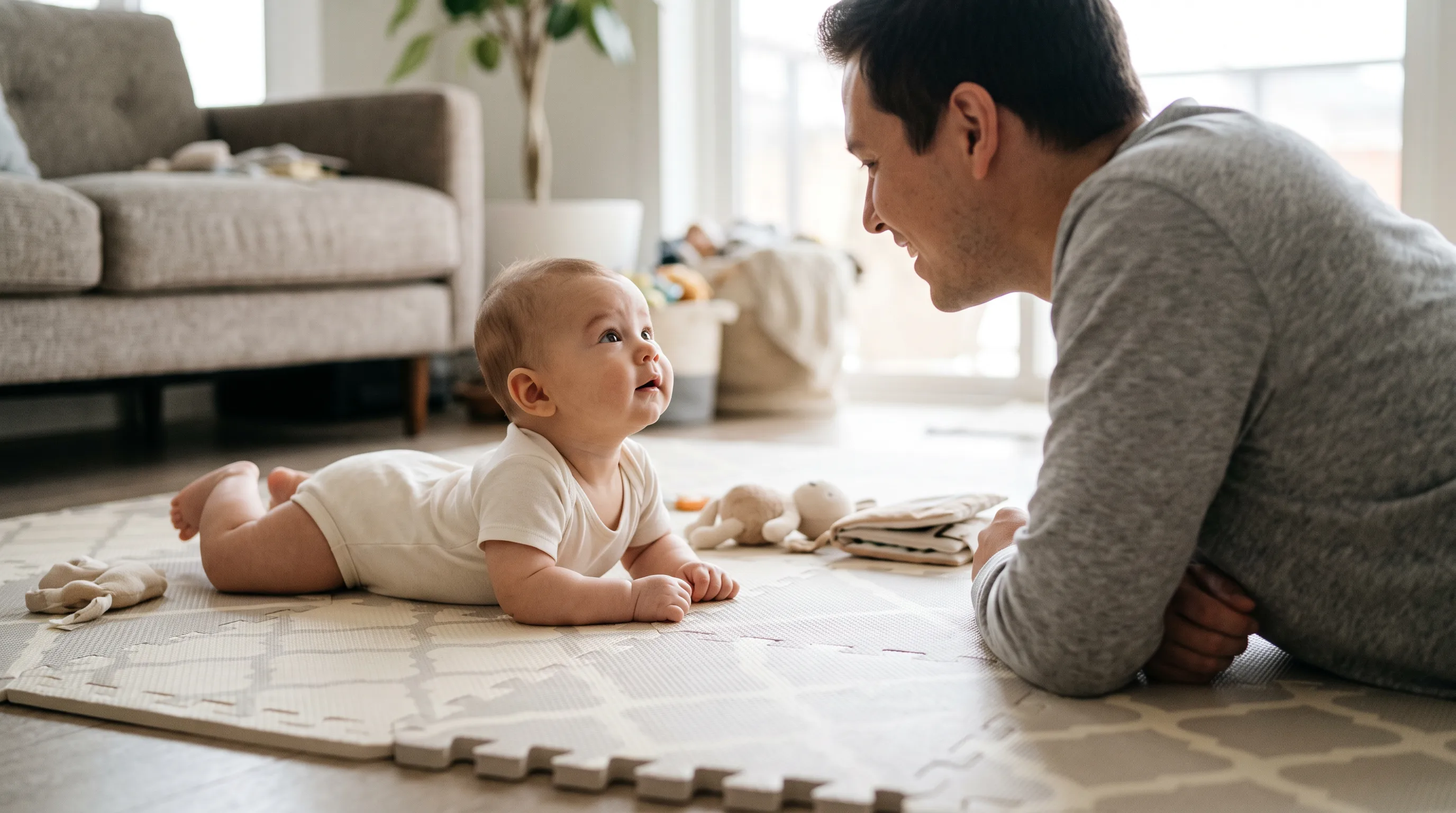
A tummy time mat is a clean, firm, flat surface on the floor where an awake baby can spend supervised time on their stomach. The American Academy of Pediatrics says tummy time can start the day your baby comes home from the hospital, beginning with 2 to 3 short sessions of 3 to 5 minutes a day and building up gradually as your baby grows stronger.
Key Takeaways
- Tummy time is supervised, awake time on the stomach; it is never for sleep.
- AAP guidance: start from the first days home, with 2 to 3 sessions of 3 to 5 minutes daily, and work up to 15 to 30 minutes a day by about 7 weeks.
- The CDC lists “holds head up when on tummy” as a 2-month milestone and “pushes up onto elbows/forearms” as a 4-month milestone.
- The best tummy time surface is on the floor, firm enough to push against, flat, clean and non-slip, with nothing soft or loose near the baby’s face.
- A parent’s chest, a blanket on a clear floor, or a firm foam play mat all work; the habit matters more than the gear.
What Is Tummy Time and Why Does It Matter?
Tummy time is the practice of placing a baby on their stomach while they are awake and an adult is watching. It exists because babies sleep on their backs. The AAP’s “back to sleep, tummy to play” message pairs safe sleep with daytime floor play, and the National Institute of Child Health and Human Development (NICHD) notes that tummy time does not directly reduce the risk of SIDS but supports growth and development in other ways.
The benefits that health agencies describe are practical and physical. According to the AAP, tummy time helps babies build strong muscles and the skills they need to reach developmental milestones, and it prepares them to slide on their bellies and crawl. NICHD adds that it builds neck, shoulder and arm strength, improves motor skills, and helps prevent flat spots on the back of the head. Those are the tummy time benefits worth knowing; be wary of products that promise more.
When to Start Tummy Time
Earlier than many parents expect. The AAP says you can start tummy time the day your baby gets home from the hospital, and NICHD says most babies can begin a day or two after birth. For a newborn, that does not mean long sessions on the floor. It can be as simple as a minute or two lying tummy-down across your lap or on your chest while you are reclined and awake.
A few timing tips from the AAP and NICHD make the first weeks easier. Try tummy time after a diaper change or when your baby wakes from a nap. Keep sessions short and stop when your baby is clearly done. If your baby gets sleepy, the CDC’s advice is to lay them on their back on a firm, bare sleep surface.
Tummy time for a newborn
Tummy time for a newborn is mostly about getting used to the position. Chest-to-chest time counts. So does holding your baby upright against your shoulder, which NICHD calls “cuddle time” and lists among ways to reduce flat spots. Many newborns fuss at first; the AAP notes that some babies do not like the position at first and suggests getting down where they can see you.

How Long Should Tummy Time Be at Each Age?
Start small and build. The AAP recommends 2 to 3 sessions a day of 3 to 5 minutes at the beginning, increasing gradually as your baby shows they enjoy it, and working up to 15 to 30 minutes total per day by 7 weeks. NICHD gives a similar target of 15 to 30 minutes daily by about 2 months, with longer sessions as the baby grows. After that, tummy time naturally blends into general floor play.
The table below combines AAP and NICHD time guidance with CDC milestone checklists. Milestones describe what most babies do by a given age; every baby develops on their own timeline, and your pediatrician is the right person to ask about your child’s progress.
| Age | Tummy time guidance | What you may see (CDC milestones) | Ideas to try |
|---|---|---|---|
| First days home | 2–3 sessions a day of 3–5 minutes (AAP, NICHD) | Early practice (CDC checklists begin at 2 months) | Tummy-down on your chest or lap; face-to-face talking |
| By about 7 weeks to 2 months | Work up to 15–30 minutes total per day (AAP, NICHD) | Holds head up when on tummy; moves both arms and legs | Toys at eye level in front of baby; floor time on a clear, firm surface |
| By 4 months | Longer sessions as baby grows and enjoys it | Pushes up onto elbows or forearms when on tummy; swings at toys | Toys arranged in a circle so baby reaches in different directions |
| By 6 months | Tummy time merges into daily floor play | Rolls from tummy to back; pushes up with straight arms | Toys just beyond reach to encourage rolling and pivoting |
If your baby cries every time, shorten the sessions rather than skipping them. Several short sessions spread through the day add up.
Tummy Time Activities That Actually Help
You do not need special toys. The ideas below come straight from AAP, NICHD and CDC guidance, with a few practical notes from our side on setting up the space.
- Get face to face. Lie on the floor in front of your baby. NICHD suggests a trusted adult sit in front of the baby to encourage interaction.
- Use your chest. The AAP suggests lying on your back with your baby on your chest so they lift their head and push up with their arms to see your face.
- Put toys at eye level, then just out of reach. The CDC suggests toys at eye level for young babies; the AAP suggests placing yourself or a toy just out of reach to encourage reaching.
- Make a circle of toys. The AAP recommends arranging toys in a circle so your baby reaches in different directions, building muscles used for rolling, scooting and crawling.
- Try a rolled towel. NICHD describes placing a rolled towel under the baby’s arms for a little support. Stay right there and remove it when you finish.
- Bring in a sibling. With adult supervision, the AAP says an older child can play with the baby during tummy time.
What Makes a Good Tummy Time Mat?
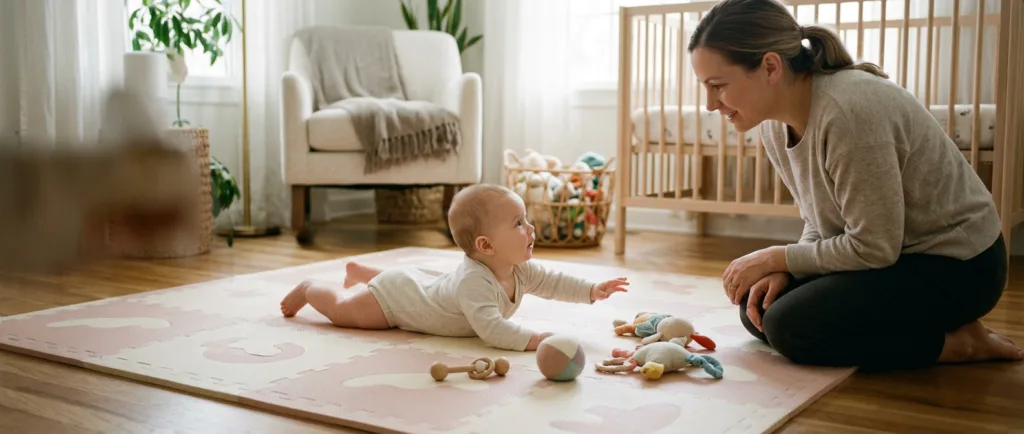
A good tummy time mat is less about features and more about the surface. Babies need something they can push against with their forearms and hands. A surface that is too soft makes pushing up harder and puts loose material near the face; a surface that is too hard or cold is uncomfortable for longer sessions. Here is what to look for:
- Firm and flat. The surface should not sink deeply under your baby’s arms. Thin cushioning that springs back is better than plush padding.
- On the floor. Tummy time belongs at floor level, never on a bed, sofa or table where a baby can slide or roll off.
- Clean and wipeable. Babies drool, spit up and put their faces on the surface. A mat you can wipe with mild soap and water is easier to keep clean than fabric that needs a full wash.
- Non-slip. The mat should stay put when an adult kneels on it and when your baby pushes and kicks.
- Big enough for two. Tummy time works best when an adult can lie alongside the baby with a few toys in a circle. Choose a size that fits that setup with clear floor space around it, away from furniture edges, cords and pet bowls. Interlocking tiles make it easy to start small in a living room corner and add tiles later as your baby starts to roll and pivot.
- Nothing loose near the face. Skip pillows, quilts and plush toys around the baby’s head during tummy time.
- Tested materials. Look for mats tested to children’s product chemical limits. Our non-toxic play mat guide explains what to ask for.
The table below compares common surfaces families use for tummy time.
| Surface | Firm and flat? | Easy to clean? | Stays in place? | Notes |
|---|---|---|---|---|
| Parent’s chest or lap | Varies | Not applicable | Yes, with hands on baby | Ideal for newborns; adult must stay awake and alert |
| Blanket on a clear floor | Depends on floor beneath | Machine wash | Can bunch or slide on hard floors | NICHD suggests this; keep it smooth and flat |
| Firm EVA foam play mat | Yes | Wipe clean | Yes, interlocking tiles grip the floor | Cushions hard floors; grows into a crawling and play area |
| Thick plush rug | Often too soft | Harder to clean | Usually | Loose fibers near the face; harder to push up from |
| Bed, sofa or changing table | No | Varies | No | Not recommended: risk of rolling or sliding off |
An interlocking foam mat has an extra advantage: it does not get retired after the tummy time months. The same surface becomes the crawling zone and then the play area, which is covered in our guide to choosing a baby crawling mat. For mat styles, thickness and room sizes, see our EVA foam puzzle mat buyer’s guide.
Keeping the tummy time area clean
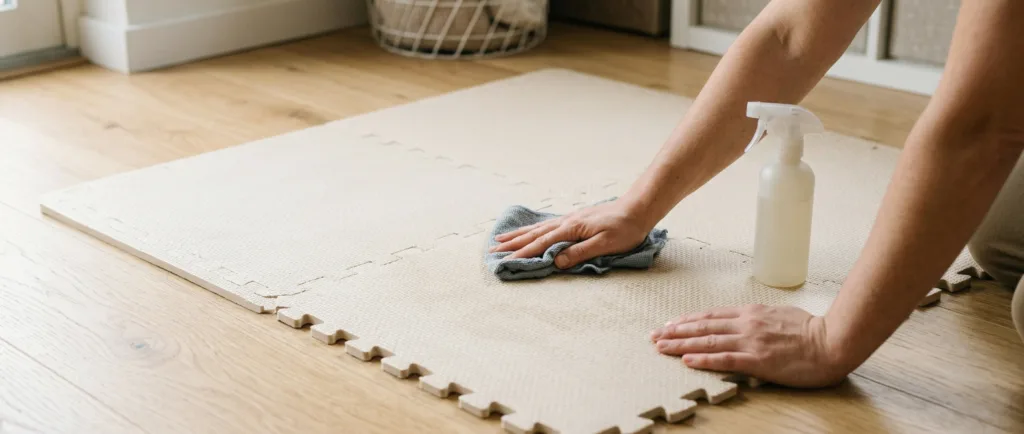
Wipe the mat with a damp cloth and mild soap, then let it dry before the next session. Avoid harsh solvents, which can damage printed surfaces. Check interlocking edges now and then for crumbs and lint, and keep the area clear of small objects that could end up in your baby’s mouth.
Common Tummy Time Questions From Parents
Most worries fall into a few patterns. If your baby hates tummy time, keep sessions very short and get on the floor with them; the AAP notes that babies eventually come to enjoy it. If your baby falls asleep on their tummy, turn them onto their back on a firm, bare sleep surface, per CDC guidance. If you notice a flat spot developing, NICHD suggests more tummy time, more upright cuddle time and less time with the head resting in car seats, bouncers and swings, and you should mention it to your pediatrician.
For retailers and brands who sell to new parents, the baby play area is one of the first rooms a family sets up, and tummy time is usually the reason they start shopping for a mat.
Frequently Asked Questions
When should I start tummy time with my newborn?
The AAP says you can start the day your baby comes home from the hospital, and NICHD says most babies can begin a day or two after birth. In the first weeks, short sessions of 3 to 5 minutes, two or three times a day, are enough. Chest-to-chest time while you are reclined and awake counts as tummy time too.
How much tummy time does a baby need each day?
Start with 2 to 3 short sessions a day and build gradually. The AAP suggests working up to 15 to 30 minutes total per day by about 7 weeks, and NICHD gives a similar target by about 2 months. After that, sessions get longer as your baby grows and enjoys floor play more.
Do I need a special tummy time mat?
No. A blanket on a clear floor or your own chest works. A dedicated mat helps when floors are hard, cold or hard to keep clean. Look for a firm, flat, wipeable, non-slip surface that sits on the floor, and avoid plush padding or pillows near your baby’s face.
Can my baby sleep on the tummy time mat?
No. Tummy time is only for when your baby is awake and supervised. If your baby falls asleep, move them onto their back on a firm, bare sleep surface such as a crib, bassinet or play yard that meets safety standards. A play mat is not a sleep product.
What if my baby cries during tummy time?
That is common. Shorten the sessions, try after a nap or diaper change, and get down at eye level with a toy or your face. Chest-to-chest tummy time is often easier to accept. If you have concerns about head control or development, talk with your pediatrician.
If you sell to new parents, a tummy time mat that also works for crawling and play is an easy product story to tell. Browse our private-label play mat designs or contact our team to discuss a line built for the first year and beyond.