
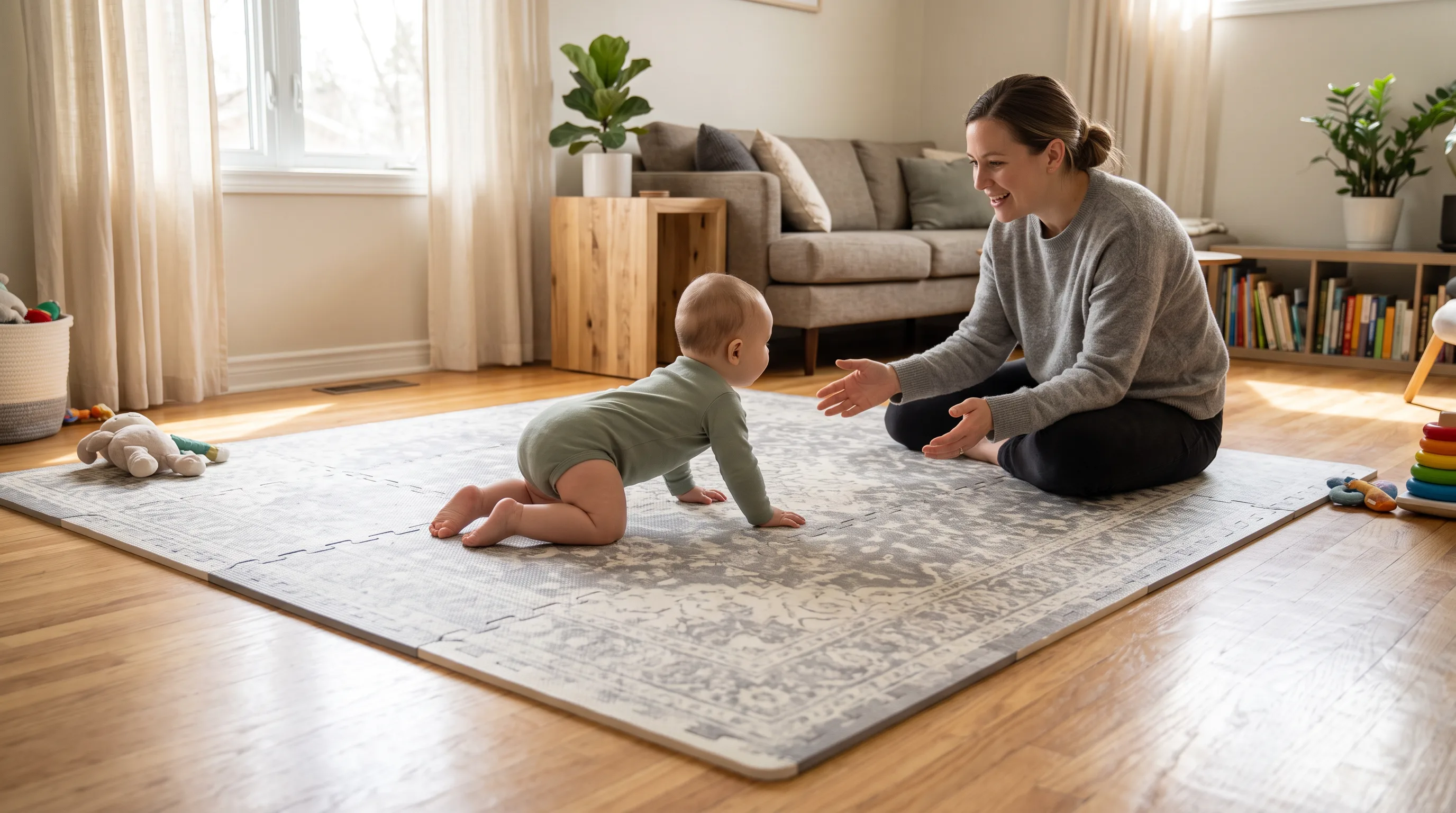
A baby crawling mat is a cushioned, grippy, wipe-clean floor covering that gives a newly mobile baby a safer, more comfortable surface than bare hardwood, tile or laminate. For hard floors, the best choice is usually a firm foam mat around 1/2 inch thick, sized to the room, with tight seams and a surface you can clean in seconds.
Key Takeaways
- The AAP describes crawling as a skill usually mastered between seven and ten months, and notes that a few children never crawl at all.
- A crawling mat for baby use should balance cushion with firmness: too soft makes crawling and pulling up harder, too thin does little for knees and tumbles.
- About 1/2 inch is a common, practical thickness for EVA foam on hard floors; it is Komat’s standard thickness.
- Plan size around the room and the baby’s range, with clear floor around the mat rather than edges tucked under furniture.
- Seams, grip on the floor below and how easy the surface is to wipe matter as much as the pattern on top.
What Does a Crawling Baby Need From the Floor?
Crawling changes how a baby uses the floor. During the tummy time months, the floor is something to push against. Once a baby starts crawling, it becomes a surface they cover quickly on hands and knees, roll across, sit up on, and later use to pull up and take tumbles. According to the AAP’s HealthyChildren.org, babies often start by rocking on hands and knees or pushing backward, since their arms are frequently stronger than their legs, and some scoot on their bottoms or slither on their stomachs instead of crawling in the classic way.
That variety tells you what the floor should do. A good baby floor mat for the crawling stage provides four things: modest cushion for knees and falls, grip so the mat and the baby do not slide, a cleanable surface, and seams that stay flat and closed.
- Cushion. Hard floors are unforgiving on knees and for the inevitable sit-down falls. Foam that compresses a little and springs back is more comfortable than a thin rug.
- Grip. Two kinds matter: the mat gripping the floor, and the baby’s hands and knees gripping the mat. A slick surface or a sliding mat makes early crawling frustrating.
- Wipeability. Crawling babies drool, snack and mouth everything. A surface that wipes clean with mild soap and water keeps up with daily life.
- Seams. On interlocking mats, the joints should sit flat and tight so small fingers cannot pry them apart and crumbs do not collect.
The CDC’s 9-month milestone checklist does not list crawling as a milestone, but it suggests placing toys slightly out of reach so a baby will crawl, scoot or roll to get them. That is exactly the kind of play a crawling mat is for. If your baby is still in the earlier stage, our tummy time mat guide covers surfaces for younger babies.
How Thick Should a Baby Crawling Mat Be?
Thickness is one of the first questions brands ask when planning a crawling mat line, and the honest answer is that thicker is not automatically better. Thickness changes how the mat feels underfoot, how it handles furniture and doors, and how stable a baby feels when pulling up.
| Thickness (approx.) | Feel for a crawling baby | Practical trade-offs | Typical use |
|---|---|---|---|
| Under 3/8 in | Light cushion; firm and stable | Easy to store and move, but limited softness on tile or concrete | Travel mats, layering over carpet |
| About 1/2 in | Noticeable cushion that still feels firm for crawling and pulling up | Good balance of comfort, stability and storage; low enough to sit near doors and furniture | Everyday living room and nursery mats on hard floors |
| About 5/8 to 3/4 in | Softer, more forgiving underfoot | Bulkier to store; taller edge; can feel less stable for first steps | Dedicated play rooms |
| 1 in and above | Very soft | Taller trip edge for adults; heavier and harder to store; may be too soft for early walkers | Gym-style or tumbling areas |
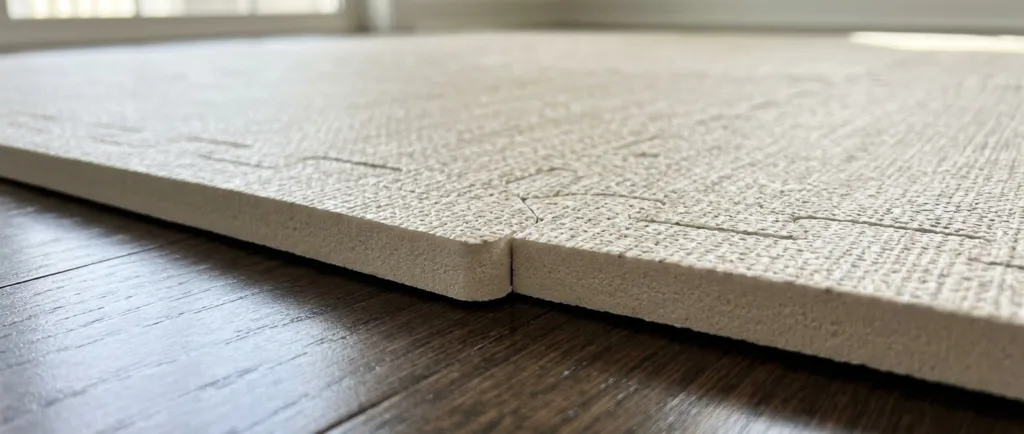
For a crawling stage on hardwood, laminate or vinyl plank, around 1/2 inch is a practical sweet spot. That is the standard thickness Komat uses for its EVA puzzle play mats, because it gives real cushion while staying firm enough for a baby who is about to start pulling up on the sofa. If you want a softer feel, density and formula matter as much as raw thickness, so ask about both.
Choosing a Baby Crawling Mat for Hard Floors
Hard floors are where crawling mats earn their keep. A baby crawling mat for hard floors needs a few extra checks beyond softness:
- Slip resistance underneath. The mat should stay put on smooth floors when someone kneels or walks on it. Interlocking tiles help because the joined area adds weight and friction; one-piece thin mats may need an approved rug pad.
- Floor protection. Check your flooring maker’s guidance on mats and rugs, especially for vinyl and finished hardwood. Lift and wipe under the mat from time to time to clear moisture and grit.
- Edge pieces. Straight border strips create a tidy, lower-profile edge and reduce the puzzle-piece look along walkways.
- Heated floors. If you have radiant heating, confirm with your flooring installer what floor coverings they recommend.
- Surface texture. A slightly textured surface gives hands and knees more grip than a glossy one.
On carpet, a foam mat mostly adds a cleanable, flatter surface. On hard floors, it adds real cushion, which is why most parents start shopping for one once their baby starts to move.
Size Planning: How Big Should a Crawling Mat Be?
Crawling babies move fast and in every direction, so size matters. A mat that is too small mostly becomes a starting point. A practical approach is to measure the open area you can dedicate to play, then leave a clear walkway around it rather than tucking edges under sofas or cabinets. Interlocking tiles let you resize as the baby grows or as you move house.
| Space | Suggested approach | Size planning notes |
|---|---|---|
| Nursery corner | Compact mat beside the crib or reading chair | Room for baby, a few toys and an adult sitting alongside; keep clear of cords and window blinds |
| Living room zone | Larger rectangular mat as the main crawling area | Size to the open floor between sofa and shelving; keep a walkway around it |
| Open-plan family room | Large mat or tiles defining a play zone | Use border pieces for a finished look; place away from kitchen traffic |
| Dedicated playroom | Wall-to-wall or near wall-to-wall tiles | Trim edge pieces to fit; plan for furniture like low shelves and a play table |
| Inside a playpen | Mat cut or assembled to the playpen footprint | Measure the inside floor area; see our playpen mat guide |
Crawling Mat Materials Compared
Most crawling mats fall into a few material families. Each can work; the right one depends on floor type, how much cushion you want and how the room needs to look.
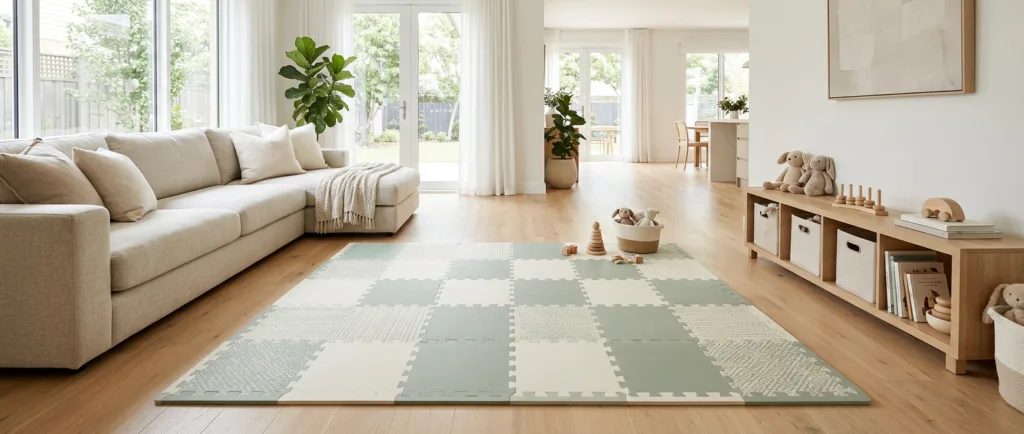
- EVA foam (interlocking tiles or large panels). EVA is a closed-cell foam that is light, cushioned and water-resistant. Rug-look printed tiles fit into living rooms without looking like a nursery, and tiles can be replaced individually if one gets damaged.
- PE / XPE roll-out mats. One-piece mats with no seams, often reversible. They are easy to wipe but harder to resize and can be bulky to store.
- PVC or PU-coated foam. Smooth, wipeable surfaces. Ask about plasticizers and phthalate testing on the surface layer.
- Fabric and cotton mats. Soft and washable, but usually thinner, harder to spot-clean and more likely to slide on hard floors.
Whatever the material, ask for third-party test reports for children’s product chemical limits. Our non-toxic play mat guide explains which reports matter. For EVA specifically, look for controls on residual formamide; Komat’s non-toxic EVA formulation keeps formamide under 2 ppm, and our patented non-continuous print lamination is designed so the printed film does not peel under crawling knees and curious fingers.
Crawling Mat or Area Rug: Which Works Better?
Plenty of families already have an area rug and wonder whether it is enough. A rug and a crawling mat solve different problems. A low-pile rug adds warmth and style but little cushion, and on hard floors it usually needs a separate pad to stop it sliding. It also tends to hold crumbs and spills, which matters once a baby is eating finger foods and crawling through the same room. A foam crawling mat gives more cushion for knees and tumbles, wipes clean in seconds and grips the floor on its own weight.
The old trade-off was looks: foam mats meant bright primary colors. Rug-look printing has largely closed that gap. A printed EVA mat with a neutral, rug-inspired pattern can sit in a living room as the main floor covering for the crawling and toddler years, then move to a playroom or basement later. Some families layer both, with a rug in the seating area and a foam mat marking the play zone. If you do layer, keep the mat on top of the hard floor rather than on top of a rug, so it lies flat and stays stable.
Setting Up and Caring for a Crawling Mat
Setup takes a few minutes and makes a real difference to how the mat performs:
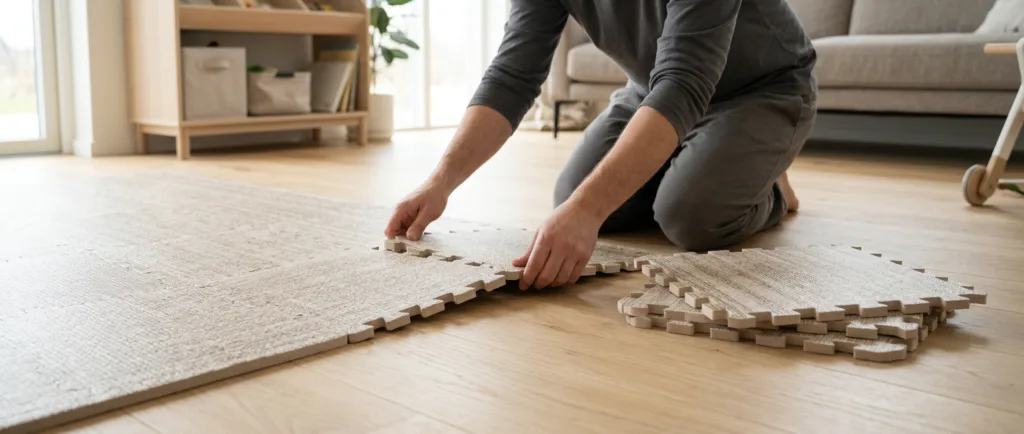
- Clean and dry the floor before laying the mat.
- Start tiles from a straight wall or the center of the area so the pattern lines up.
- Press each joint fully closed; run your hand along the seams to find any raised edges.
- Add border strips along exposed edges and walkways.
- Keep the mat clear of stairs, fireplaces, heaters and cords; the AAP recommends sturdy gates at the top and bottom of staircases once a baby is mobile.
- Wipe spills with a damp cloth and mild soap, and lift tiles periodically to clean underneath.
A mat is not a substitute for supervision. The AAP is clear that a mobile baby should never be left unsupervised, and that small items such as button batteries and coins should be kept off the floor and out of reach.
For more on how printed mats fit into family rooms, see our living spaces applications page, and for an overview of puzzle mat styles, our EVA foam puzzle mat buyer’s guide.
Frequently Asked Questions
When do babies need a crawling mat?
Many families set one up during the tummy time months and keep using it as their baby starts to move. The AAP says crawling is usually mastered between seven and ten months, though some babies scoot or skip crawling. Having a cushioned area ready before your baby is fully mobile makes the transition easier on hard floors.
Is 1/2 inch thick enough for a baby crawling mat?
For most homes with hard floors, about 1/2 inch is a practical choice. It adds noticeable cushion while staying firm and stable enough for crawling and pulling up. Thicker mats feel softer but are bulkier, have taller edges and can feel less stable for early walkers.
Do foam crawling mats damage hardwood floors?
Any floor covering can trap moisture or grit if it is never lifted. Check your flooring manufacturer’s guidance, keep the floor clean and dry before laying the mat, and lift and wipe underneath from time to time. If you have radiant heat or a specialty finish, ask your installer which coverings they recommend.
Are puzzle tiles or one-piece mats better for crawling?
Puzzle tiles can be sized to any room, replaced individually and carried in pieces; one-piece mats have no seams to clean. If you choose tiles, look for tight, flat joints and border pieces. If you choose a one-piece mat, make sure it lies flat and does not slide on your floor.
How do I clean a baby floor mat?
Wipe it with a damp cloth and mild soap, then let it dry. Avoid harsh solvents, which can damage printed surfaces. With interlocking tiles, separate them now and then to clean the joints and the floor beneath.
For brands and retailers, a crawling mat that looks like a rug and performs like foam is a strong addition to a baby range. Explore our ready private-label designs or contact Komat to talk through thickness, materials and pattern options for your customers.