
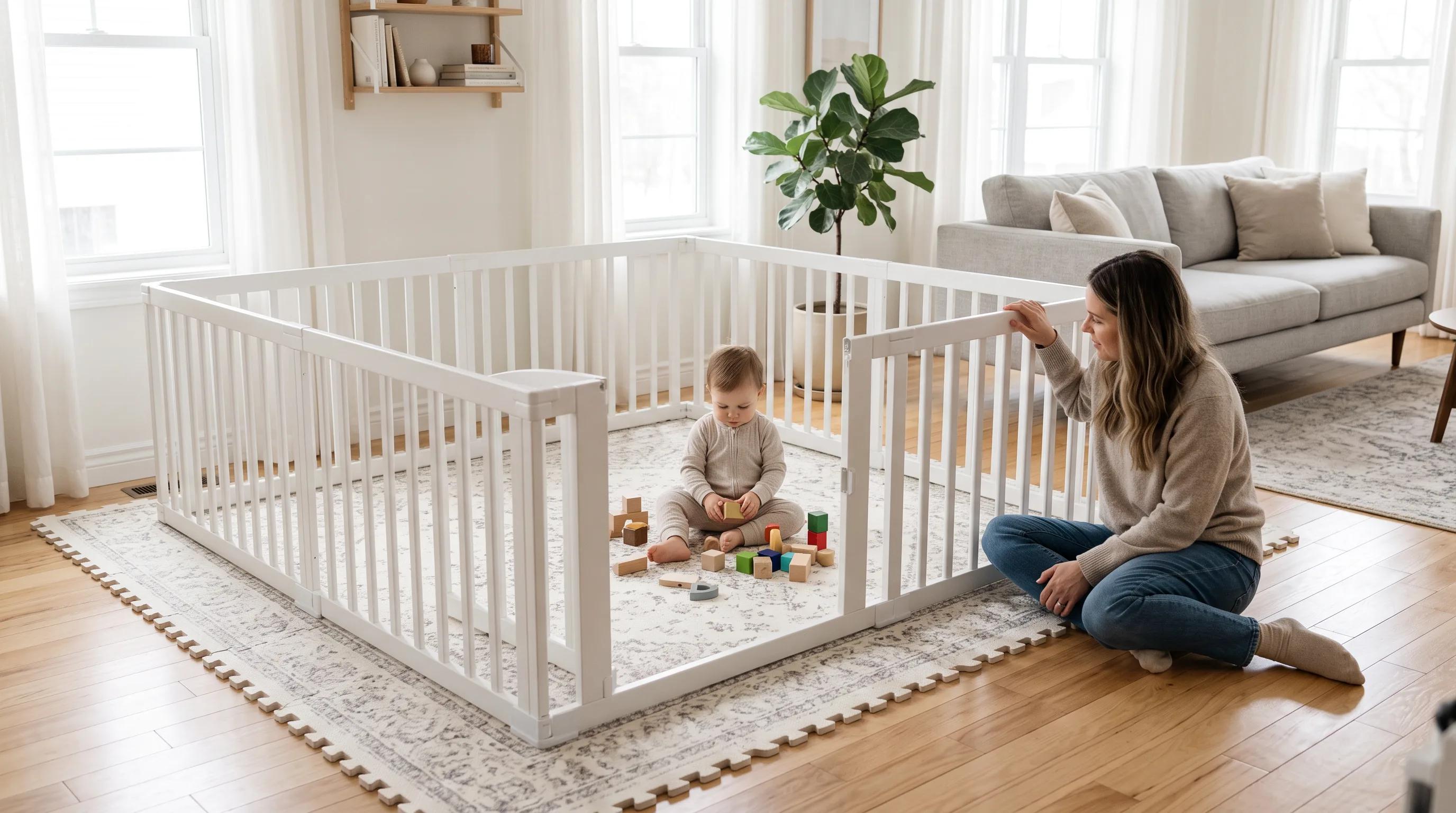
A playpen mat is a cushioned, wipe-clean floor covering that goes inside or under a freestanding playpen on hard floors, so a baby has a comfortable, grippy surface for awake, supervised play. The right playpen mat matches the playpen’s footprint, lies flat with tight seams, and is never used as extra padding inside a play yard where a baby sleeps.
Key Takeaways
- Panel-style playpens usually have no floor of their own, so on hardwood, tile or vinyl, a foam mat for playpen use adds cushion and grip.
- Measure the inside footprint of the playpen and plan the mat to cover it fully, with a clear decision on whether the panels stand on the mat or on the bare floor.
- Interlocking foam tiles can be shaped to rectangles and larger configurations; one-piece mats suit standard sizes and have no seams.
- The AAP says a baby’s sleep space should contain only a fitted sheet, with nothing else in the crib or play yard, so do not add foam mats or padding to a play yard used for sleep.
- Check the playpen maker’s instructions for how panels should stand, and keep supervising: a playpen is a play space, not a babysitter.
Playpen vs Play Yard: Why the Difference Matters
The words get used interchangeably in stores, but they describe two different products, and the difference decides whether a mat belongs inside.
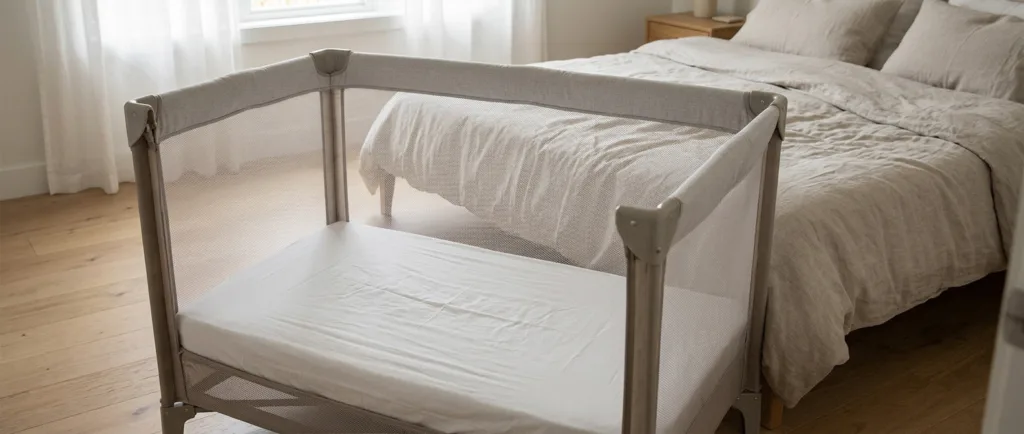
A play yard is a framed enclosure with a floor and mesh or fabric sides, intended for sleeping and playing, and regulated in the US under 16 CFR part 1221. CPSC’s business guidance describes play yards this way, notes that the rule incorporates ASTM F406 with modifications, and lists the mattress among the product’s general requirements. In other words, the floor pad is part of the tested product.
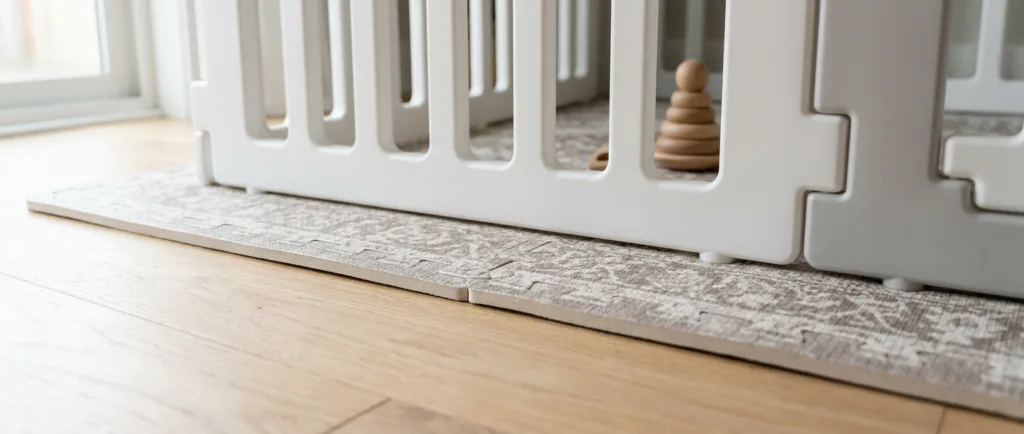
A panel playpen (sometimes called a play fence or baby play yard fence) is a set of connected panels that stand directly on your floor to enclose a play area. It usually has no floor at all. On hard floors, that leaves the baby crawling and sitting on bare hardwood or tile, which is exactly where a playpen floor mat helps.
The safety rule follows from that distinction. The AAP’s safe sleep guidance says to place a baby in a crib, bassinet, portable crib or play yard that meets safety standards, to use a fitted sheet only with nothing else in the sleep space, and not to use products for sleep that are not specifically marketed for infant sleep. It lists mattress toppers among the soft items that can increase the risk of entrapment, suffocation or strangulation. So a foam play mat is for awake play inside a panel playpen; it is never an add-on for a play yard used for naps or overnight sleep.
Why Does a Playpen Need a Mat on Hard Floors?
Babies spend playpen time doing the things that are hardest on bare floors: tummy time, sitting and toppling over, crawling, and later pulling up on the panels. A good baby playpen mat solves several problems at once:
- Cushion. Knees, elbows and sit-down falls land on foam instead of hardwood or tile.
- Grip. A slightly textured surface helps hands and knees grip during crawling.
- Warmth. Foam is noticeably warmer to sit on than tile or concrete.
- Cleanup. Spit-up, drool and snack crumbs wipe off a foam surface quickly.
- Floor protection. Toys banging on the floor and panel feet moving during play are less likely to mark the floor.
For the stages playpen time usually covers, see our guides to the tummy time mat and the baby crawling mat.
How Do You Measure for a Playpen Mat?
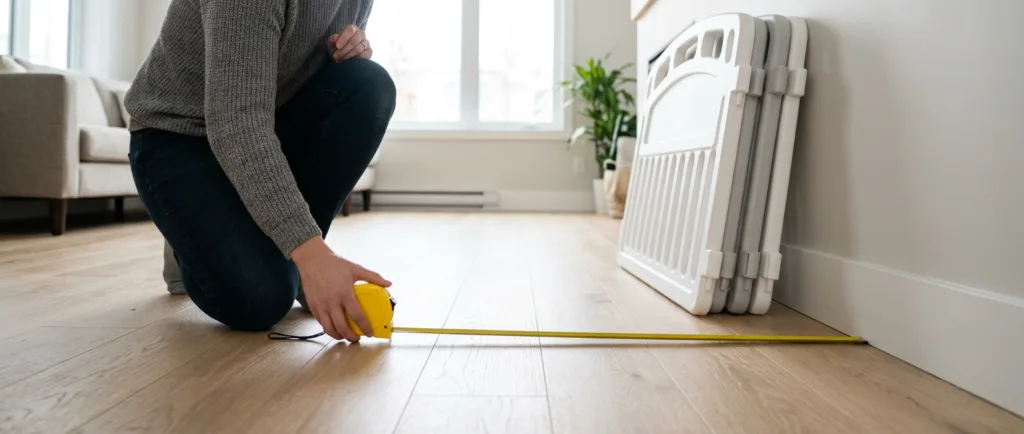
Most sizing problems come from measuring the box size instead of the real footprint. Panel playpens can be set up in different shapes, and the assembled inside area is often different from the listed size. Measure what you will actually use:
- Assemble the playpen in the shape and spot you plan to use.
- Measure the inside floor area wall to wall, at floor level, in both directions.
- Measure the outside footprint including the panel feet.
- Decide where the panels stand. Some playpens rely on rubber feet or suction pads gripping the floor. Check the manufacturer’s instructions; if the panels should stand on the bare floor, size the mat to the inside area. If the panels can stand on the mat, size it to the outside footprint.
- Allow for gates and doors so the opening can swing freely over or past the mat edge.
- Note the shape. Square and rectangular layouts are simple with tiles. Hexagonal or octagonal layouts may need a rectangle that covers the inside fully, with the corners extending under the panels or trimmed.
| Playpen setup | Mat strategy | Watch for |
|---|---|---|
| Square or rectangle, panels on bare floor | Mat sized to inside footprint, edges close to panels | Gaps along the edge where toys or fingers can slip under |
| Square or rectangle, panels on the mat | Mat slightly larger than outside footprint | Panel stability on foam; follow the playpen maker’s guidance |
| Hexagon or octagon | Rectangle that fully covers the inside area | Corners outside the panels can become a trip point for adults |
| Extended or L-shaped configuration | Interlocking tiles assembled to the shape | Seams at inside corners; add border pieces on exposed edges |
| Mesh play yard used for play only | Mat underneath to protect the floor, not inside | Never add a mat or padding inside if the play yard is also used for sleep |
Puzzle Tiles vs One-Piece Mats for a Playpen
Both formats can work well. The choice depends on your playpen shape, your floor and how much you value flexibility versus a seamless surface.
| Feature | Interlocking foam tiles | One-piece mat |
|---|---|---|
| Fit to playpen size | Assemble to almost any rectangle or extended shape | Fixed sizes; best when it matches a standard playpen |
| Seams | Yes; quality depends on tight, flat joints | No seams |
| Replacing a damaged area | Swap a single tile | Replace the whole mat |
| Storage and moving | Stacks flat; carries in pieces | Rolls or folds; can be bulky |
| Cleaning | Wipe surface; lift tiles to clean joints and floor | Wipe surface; lift whole mat to clean beneath |
| Look | Rug-look prints and pattern matching across tiles are possible | Often solid or reversible prints |
If you go with tiles, look for designs where the pattern continues across tiles so the floor reads as one surface. Komat’s pattern-matched designs and borderless puzzle design patent are aimed at exactly that, and our patented non-continuous print lamination is designed so the printed film does not peel along the seams where babies pick at edges.
Materials and Safety Checks
A playpen mat sits right where babies mouth, drool and press their faces, so materials deserve the same scrutiny as toys. Ask for third-party test reports covering children’s product chemical limits, such as lead and phthalates, and for foam, residual formamide. Our non-toxic play mat guide explains what to ask for. Komat’s EVA formulation keeps formamide under 2 ppm, and our mats are tested to ASTM F963, CPSIA, CA Prop 65, EN 71 and REACH requirements, with reports available on request.
Thickness matters too. About 1/2 inch is a practical choice inside a playpen: enough cushion for falls, firm enough for pulling up on the panels, and low enough that the edge does not become a step for climbing.
Selling playpen and play area mats?
Rug-look floors that stay put inside a playpen
Our interlocking EVA tiles come in printed designs with patterns matched across tiles, so a playpen floor looks like one continuous rug.
Cleaning and Caring for a Playpen Mat
A playpen concentrates a lot of activity in a small area, so the mat inside gets more spills and wear per square foot than a mat in an open room. A simple routine keeps it in good shape. Wipe the surface daily, or after snacks, with a damp cloth and a little mild soap, then let it air-dry before your baby goes back in. Avoid bleach, solvents and abrasive pads, which can dull or damage printed surfaces. Once a week or so, lift the mat or separate the tiles to clean the joints and the floor underneath; crumbs and moisture tend to collect along the panel line.
Check the mat as you clean. Look for raised seams, chewed edges, or any spot where a surface layer is lifting. On tile mats, a damaged piece can be swapped out on its own. Store spare tiles flat and away from direct heat so they keep their shape.
What Happens After the Playpen Stage?
Most families use a playpen for a limited window. Once a child can climb or open the gate, the enclosure is usually packed away. The mat does not have to go with it. A foam playpen mat can move straight into a toddler play corner, a playroom floor or a basement activity area, and interlocking tiles can be expanded with extra pieces to cover a larger space.
That longer life is worth considering when you choose a design. A bright pattern that suits a nursery corner may look out of place in a living room for the next two or three years, while a neutral rug-look print blends into the room long after the playpen is gone. For brands and retailers, that longer use is also a selling point: a mat that starts inside a playpen and ends up as the family room play area gives parents more value from one purchase.
Playpen Setup Tips
- Choose a spot away from stairs, windows with cords, heaters and furniture a child could reach over the panels.
- Clean and dry the floor before laying the mat.
- Lay the mat, press all seams closed and add border pieces where edges are exposed.
- Set up the playpen according to its manufacturer’s instructions, and check that panels and gates lock securely.
- Keep toys inside simple. Avoid large stuffed items or boxes a child could use to climb out.
- Supervise. The AAP’s guidance for mobile babies is never to leave them unsupervised, and to keep small items like coins and button batteries off the floor.
- Wipe the mat regularly with mild soap and water, and lift it now and then to clean underneath.
For brands building nursery and play-area collections, our baby play areas page shows how mats fit into the wider room, and our EVA foam puzzle mat buyer’s guide covers sizes and styles in more depth.
For baby brands
Add a playpen mat to your baby range
Choose from 50+ ready designs or bring your own artwork. We produce private label EVA play mats tested to ASTM F963, CPSIA and EN 71.
Frequently Asked Questions
Can I put a foam mat inside a play yard for my baby to sleep on?
No. The AAP’s safe sleep guidance says to use only a fitted sheet in the sleep space, with nothing else added, and not to use products for sleep that are not specifically marketed for infant sleep. A play yard’s own pad is part of the tested product. Foam play mats are for awake, supervised play only.
What size playpen mat do I need?
Measure your assembled playpen. If the panels must stand on the bare floor, size the mat to the inside area. If the maker allows panels to stand on a mat, size it to the outside footprint. For hexagonal or extended layouts, interlocking tiles make it easier to cover the shape.
Should the playpen panels stand on the mat or on the floor?
Follow the playpen manufacturer’s instructions. Some panels rely on rubber feet or pads gripping the floor for stability, and foam underneath can change how they hold. If in doubt, keep the panels on the bare floor and fit the mat snugly inside.
Is a playpen floor mat needed on carpet?
It is less critical for cushioning, but a mat still gives a flatter, wipeable surface that is easier to keep clean than carpet. On hard floors like hardwood, tile or vinyl, a mat makes a much bigger difference to comfort and grip.
How thick should a playpen mat be?
Around 1/2 inch is a practical thickness for most playpens on hard floors. It adds real cushion without making the surface so soft that babies struggle to pull up, and it keeps the edge low so it does not become a step for climbing over the panels.
If you sell playpens, nursery furniture or baby floor products, a matched playpen mat is an easy add-on for your customers. Browse our private-label mat designs or get in touch with Komat to discuss sizes and patterns that fit your range.