
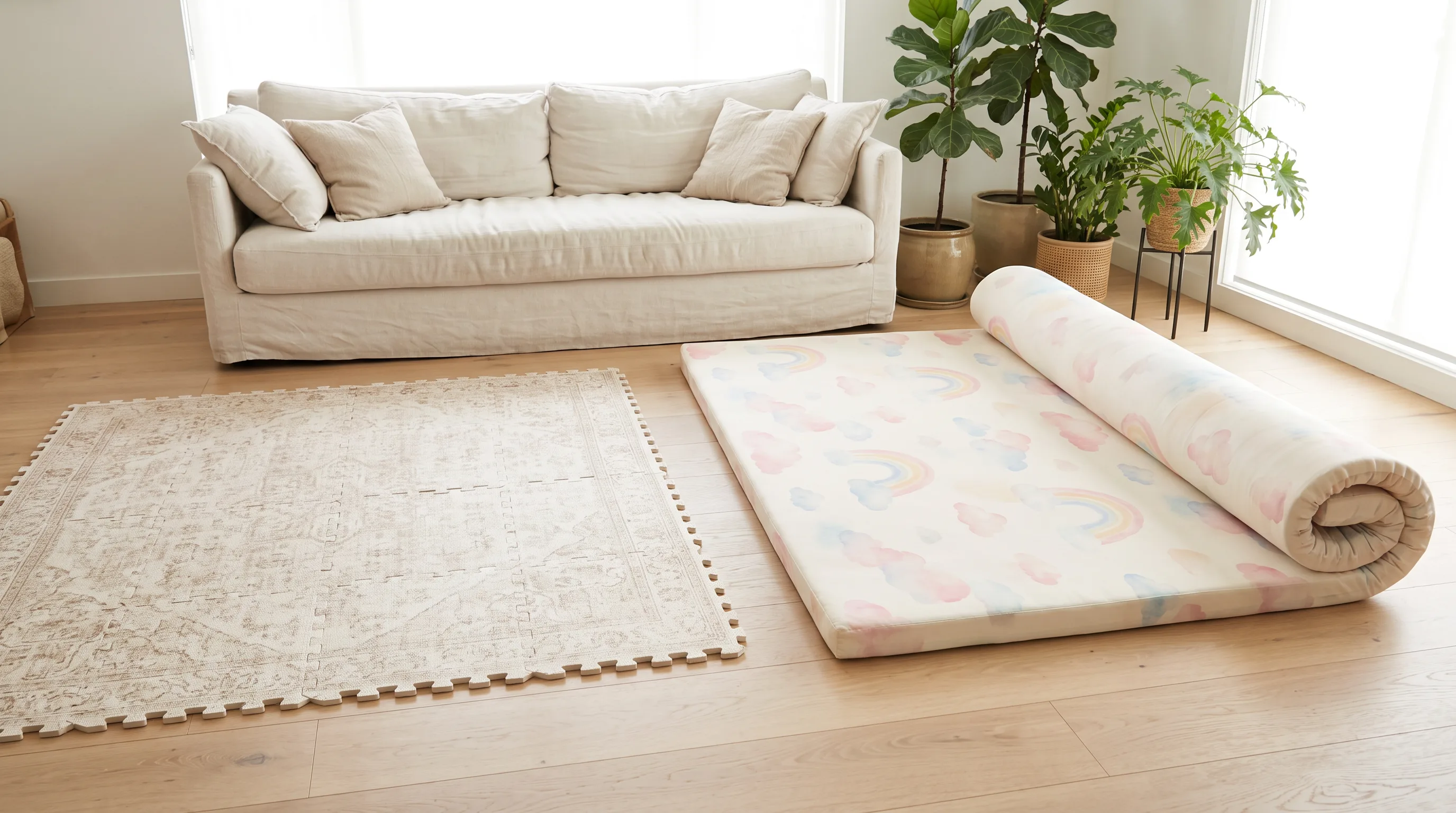
Polyethylene foam (PE foam) and EVA foam are both lightweight, closed-cell foams, but they suit different play mats. Crosslinked polyethylene foams, sold as XPE and IXPE, are firm, smooth and common in thin roll-out mats. EVA foam is softer and more rubbery, which is why it dominates interlocking puzzle tiles. The right choice depends on format, cushioning and how the mat will be printed and used.
Key Takeaways
- Polyethylene foam is a durable, chemically stable, closed-cell foam; it comes in non-crosslinked (often called EPE) and crosslinked grades.
- XPE is chemically crosslinked polyethylene foam, usually with peroxide; IXPE is crosslinked by irradiation, typically with an electron beam.
- EVA adds vinyl acetate to the polyethylene chain, which makes the foam softer, more flexible and more rubber-like than PE foam of similar weight.
- PE is on the CPSC’s list of plastics determined not to exceed phthalate limits (with specified additives); EVA is not, so EVA components are normally phthalate-tested.
- For thick, modular, cushioned tiles, EVA is the usual choice; for thin, continuous roll-out mats, crosslinked PE is common.
What Is Polyethylene Foam?
Polyethylene foam is a closed-cell foam made by expanding polyethylene resin with gas so that it fills with small sealed cells. Museum conservators, who need materials that stay stable for decades, describe it as durable, tough, chemically resistant, unaffected by water and not prone to off-gassing, which is why it is used for packaging, storage, sports equipment, flotation and sound insulation.
In the play mat market you will see three names, and they describe how the foam is made:
- PE foam (often called EPE): non-crosslinked polyethylene foam. It is light and inexpensive to produce, and familiar as protective packaging. Its cells are relatively coarse and it can lose thickness under repeated load.
- XPE foam: chemically crosslinked polyethylene foam. A crosslinking agent, commonly a peroxide, links the polymer chains while the foam expands, giving finer cells and better recovery than non-crosslinked PE.
- IXPE foam: irradiation-crosslinked polyethylene foam. The polymer sheet is crosslinked with high-energy radiation, typically an electron beam, and then foamed in an oven.
Chemical vs irradiation crosslinking
Crosslinking links neighboring polymer chains so the foam cells are stabilized as they grow. Without it, gas escapes and cells can collapse. In peroxide crosslinking, the peroxide decomposes into radicals that remove hydrogen atoms from the polymer chain, allowing chains to bond together. In electron-beam crosslinking, a radiation source does the same job below the polymer’s melting point. One known limitation of irradiation is penetration depth: the interior of thick sections can be left less crosslinked, which is one reason irradiation-crosslinked foams are usually made as thinner sheets.
Crosslinked polyethylene foams tend to have ultra-fine cells and a soft, smooth, skin-like surface. That fine, even surface is part of why XPE and IXPE are popular for printed roll-out mats and underlayments.
How Is EVA Foam Different From PE Foam?
EVA is ethylene vinyl acetate, a copolymer in which vinyl acetate units are built into the polyethylene chain. Those vinyl acetate units break up the crystalline structure of polyethylene, so EVA is softer, more flexible and more rubber-like. At low vinyl acetate content, EVA processes much like low-density polyethylene; at medium content it behaves as a thermoplastic elastomer. If you want the full chemistry, see our guide to EVA material and its properties.
In foam form, EVA is usually compounded with a blowing agent and a crosslinker, then expanded in a heated press. The result is a closed-cell foam that compresses under a knee or a fall and springs back. Both foams are closed-cell, which is why both shed spills instead of soaking them up; our explainer on closed-cell foam goes into why that matters.
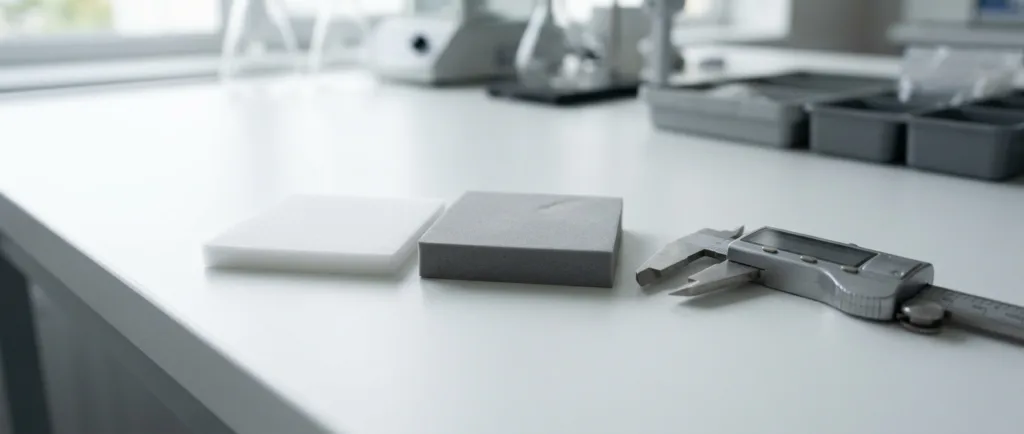
EVA vs PE Foam: Side-by-Side Comparison
The comparison below is general. Actual performance depends on grade, density, thickness and crosslinking, so always compare real products and their test data before deciding.
| Attribute | EVA foam | PE foam (EPE, non-crosslinked) | XPE (chemically crosslinked PE) | IXPE (irradiation crosslinked PE) |
|---|---|---|---|---|
| Cell structure | Closed-cell, fine to medium cells | Closed-cell, relatively coarse cells | Closed-cell, fine cells | Closed-cell, very fine cells, smooth skin |
| Feel | Soft, rubbery, grippy | Light, somewhat stiff | Firmer, smooth | Firm, smooth, uniform |
| Resilience (recovery after pressing) | Good when well crosslinked | Lower; can stay compressed | Good | Good |
| Typical thickness range in mats | Thick tiles, such as 1/2 inch | Packaging and budget underlays | Roll-out and folding mats | Thinner sheets and roll-outs |
| Printability | Laminated printed films; textures | Limited | Laminated printed films | Laminated printed films |
| Water behavior | Sheds water; closed cells | Unaffected by water | Sheds water | Sheds water |
| Common products | Interlocking puzzle tiles, footwear, padding | Protective packaging | Roll-out play mats, underlayment | Roll-out mats, underlayment |
| Relative cost tier | Mid | Low | Mid | Mid to higher |
Cost tiers are relative and shift with grade, density and order structure, so treat them as a rough orientation rather than a quote basis.
Which Is Better for Play Mats: EVA or Polyethylene Foam?
Neither is better in every situation. The format of the mat usually decides the material.
When EVA foam makes sense
- Modular, expandable floors. EVA cuts cleanly with dies, so interlocking edges are precise and tiles can be added or removed to fit a room.
- Thicker cushioning. At 1/2 inch, EVA tiles give noticeable softness on hardwood or tile, useful for crawling and early walking.
- Rug-look designs. EVA bonds well with decorative films, so a mat can look like a woven rug while staying wipeable.
- Replaceable pieces. If one tile is damaged or stained, you replace a tile, not the whole mat.
When PE foam (XPE or IXPE) makes sense
- Continuous surfaces. Roll-out and folding mats avoid seams, so crumbs and liquids have fewer places to go.
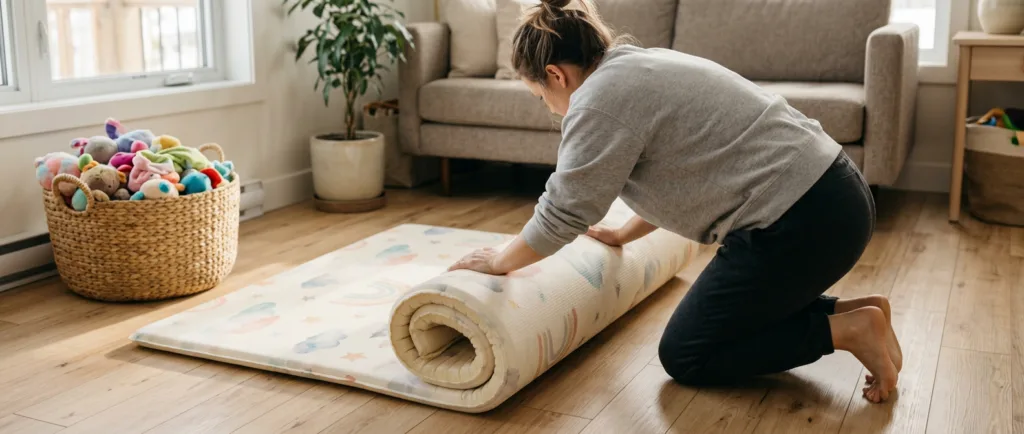
- Portability. A thin roll-out mat can be stored behind a sofa or taken to a grandparent’s house.
- Underlayment and packaging. Thin crosslinked PE is common under flooring and in protective packaging.
What About Safety and Compliance?
Both materials can be made into compliant children’s products, and both can be made badly. The polymer name is only the start; residues, pigments and surface films matter just as much.
One regulatory detail differs. Under 16 CFR 1308.2, the CPSC has determined that certain plastics, including polyethylene and polypropylene with specified additives, do not exceed U.S. phthalate content limits with a high degree of assurance. EVA is not listed as a standalone plastic there; it appears only as a permitted additive in polyethylene. So an EVA play mat’s foam is normally included in third-party phthalate testing, while a PE foam may qualify for the determination if its additives match the list. Printed films, inks and coatings on either type still need their own evaluation, and the underlying limits always apply. Confirm the approach with your testing lab.
| Compliance question | EVA foam mats | PE foam mats (EPE, XPE, IXPE) |
|---|---|---|
| Covered by CPSIA lead limits (children’s products)? | Yes | Yes |
| On the CPSC phthalate determination list (16 CFR 1308.2)? | No (only as an additive in PE) | PE listed, with specified additives |
| Formamide relevance | Often tested; foam toy materials are covered by EU limits | Covered by the same EU foam toy limits if sold as toys |
| Printed or laminated surface | Test inks and films as accessible components | Test inks and films as accessible components |
For a deeper look at residues, odor and test reports, read Is EVA Foam Toxic? If you are also weighing PVC or leather-look surfaces, our EVA vs PVC vs PU play mat comparison covers those materials.
Durability and Everyday Use
Several practical factors decide how a mat holds up at home:
- Compression recovery. Well-crosslinked EVA and crosslinked PE both recover after kneeling or sitting. Non-crosslinked PE can keep dents.
- Edge wear. Interlocking EVA edges flex every time tiles are joined, so stress-crack resistance and a clean die cut matter.
- Surface film. On printed mats of either material, poor lamination shows up as peeling or bubbling. Komat’s patented non-continuous print lamination is designed so the film does not peel.
- Heat and sunlight. Keep any foam mat away from heaters and long direct sun exposure, which can distort or fade it.

How Should Brands Choose Between EVA and PE Foam?
For a brand or importer building a range, the material decision is really a product-format decision. Start with how your customer will use the mat, then work back to the foam. These questions usually settle it:
- Will the mat stay in one place or move around? Mats that live permanently in a playroom or nursery suit interlocking EVA tiles. Mats that are packed away daily or taken on trips suit a roll-out or folding PE format.
- How much cushioning do you want to promise? If thickness and softness are part of the pitch, EVA at 1/2 inch gives you a clear story. Thin PE mats compete more on portability and a seamless surface.
- Does the room size vary? Modular tiles let one SKU cover small apartments and large basements. A single roll-out size can be easier to merchandise but less flexible for buyers.
- How important is design? Both materials can carry laminated prints. With EVA, the challenge is matching a pattern across tile joints; Komat’s borderless puzzle design patent and pattern-matched designs address exactly that.
- What test plan will you run? Budget for CPSIA lead and phthalate testing on EVA foam, and for every printed or laminated layer on either material.
Many brands end up offering both formats for different shoppers. If EVA tiles are part of your plan, our EVA puzzle play mat collection shows the rug-look styles that sell to design-conscious parents.
Frequently Asked Questions
Is XPE foam the same as EVA foam?
No. XPE is crosslinked polyethylene foam, made from polyethylene alone. EVA foam is made from ethylene vinyl acetate, a copolymer that includes vinyl acetate in the chain. Both are closed-cell foams, but EVA is generally softer and more rubbery, while XPE is firmer with a smoother surface. Both can be printed with laminated films.
What is the difference between XPE and IXPE?
Both are crosslinked polyethylene foams. XPE is crosslinked chemically, typically with a peroxide added to the compound. IXPE is crosslinked by irradiation, usually an electron beam, before the sheet is foamed. IXPE generally has very fine, uniform cells and a smooth surface, and it tends to be produced in thinner sheets because radiation penetration limits thickness.
Is polyethylene foam safe for babies?
Polyethylene foam is chemically stable and widely used, and PE appears on the CPSC’s list of plastics determined not to exceed phthalate limits when made with specified additives. As with any play mat, safety depends on the finished product, including inks and films. Look for CPSIA testing on the whole mat and supervise babies during floor play.
Which is softer, EVA or PE foam?
At similar thickness, EVA foam usually feels softer and more cushioned, with a rubbery rebound. PE foams, especially crosslinked XPE and IXPE, tend to feel firmer and smoother. Softness also depends on density and thickness, so compare products in hand rather than relying on material names alone.
Why are most puzzle play mats made from EVA?
EVA cuts cleanly into interlocking shapes, holds its edges after repeated joining, gives soft cushioning at thicknesses such as 1/2 inch, and bonds well with decorative films. Those properties fit modular tiles. Thin crosslinked PE is better suited to continuous roll-out or folding mats where seams are not needed.
Is EVA or polyethylene foam easier to recycle?
Non-crosslinked polyethylene foam is generally the easiest of these to recycle where facilities accept it. Crosslinking, used in XPE, IXPE and most EVA foam, makes the material much harder to remelt; conservation references note that crosslinked PE foams are not recyclable in the way non-crosslinked ones are. Durable designs and bio-based content are other routes to a lower footprint.
If you are planning a play mat line and deciding between modular tiles and other formats, Komat can show you how rug-look EVA tiles perform in real homes. Browse our private-label designs or explore the baby play area applications to see where EVA fits best.