

Landed cost is the total cost of getting an imported product to your warehouse, ready to sell: the purchase cost plus freight, insurance, customs duties, government fees, broker charges and destination handling. Calculating landed cost per unit, rather than looking only at the supplier’s quote, shows your real margin and lets you compare suppliers and shipping terms on equal footing.
Key Takeaways
- Landed cost equals product cost plus every cost incurred to move, clear and receive the goods at your door.
- US customs duty is generally calculated on the customs value of the goods, which under the transaction value rule excludes international freight and insurance.
- Formal US entries also carry a Merchandise Processing Fee of 0.3464 percent of value (within an annually adjusted minimum and maximum), and ocean imports carry a Harbor Maintenance Fee of 0.125 percent.
- For bulky, lightweight goods such as foam play mats, freight is driven mainly by volume, so packaging and container loading have a large effect on landed cost per unit.
- Duty rates and additional tariffs change, so confirm classification and current rates with a licensed customs broker before you finalize a cost model.
What Is Landed Cost?
Landed cost is the sum of all costs to purchase a product and deliver it to the buyer’s receiving location. The phrase “landed cost meaning” trips up many first-time importers because suppliers quote only part of it. A supplier’s quotation covers the goods and, depending on the Incoterm, some transport. Everything after that point (ocean freight, insurance, customs, brokerage, port charges, trucking and receiving) still has to be paid by someone, and usually that someone is you.
Knowing your landed cost lets you set retail and wholesale pricing with confidence, compare an offer from one supplier quoted Ex Works against another quoted FOB, and spot which cost lines are worth negotiating. Our guide to FOB vs EXW and other Incoterms explains how those terms shift costs between buyer and seller.
The Landed Cost Formula
The landed cost formula is simple to write down:
Landed cost = Product cost + Transportation + Insurance + Customs duties + Government fees + Brokerage and handling + Other destination costs
To get landed cost per unit, divide the total by the number of sellable units in the shipment. If a shipment contains several products, allocate shared costs (freight, fees, handling) by a sensible key: by volume for freight, by customs value for value-based fees and duty, and by unit count for per-unit handling.
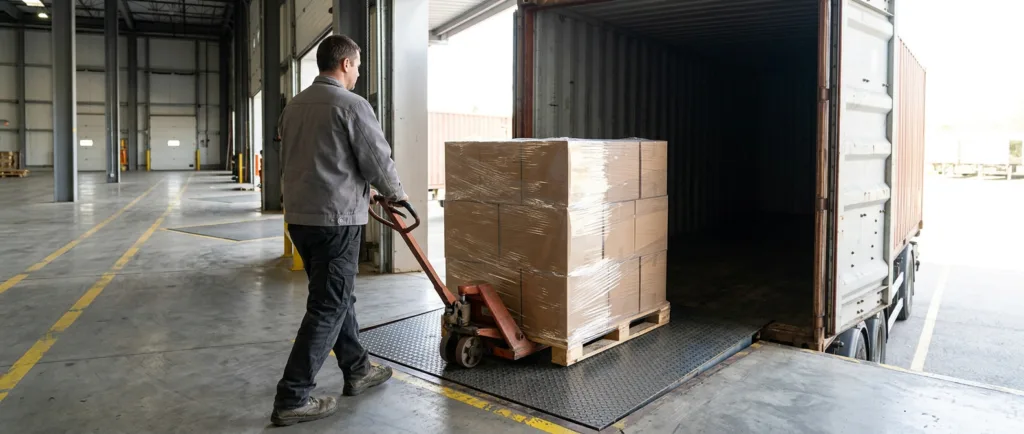
Every Component of Landed Cost
The table below lists the cost lines most importers of play mats and similar consumer goods should model. Not every line applies to every shipment, and who pays each one first depends on the Incoterm in your contract.
| Component | What it covers | Notes |
|---|---|---|
| Product cost | The goods as quoted, including retail packaging and inserts | Check what the quote includes: packaging, carton marks, labels |
| Origin charges | Inland trucking to port, export clearance, origin terminal handling | Included in an FOB quote; paid by the buyer under EXW |
| Main freight | Ocean or air transport to the destination port | For foam mats, usually driven by volume rather than weight |
| Cargo insurance | Coverage for loss or damage in transit | Under CIF the seller buys minimum cover; many buyers add their own |
| Customs duty | Duty rate from the Harmonized Tariff Schedule applied to customs value | Plus any additional tariffs in force; confirm with your broker |
| Merchandise Processing Fee (MPF) | CBP fee on formal entries: 0.3464% of value | Subject to a minimum and maximum that CBP adjusts each fiscal year |
| Harbor Maintenance Fee (HMF) | Port use fee on ocean cargo: 0.125% of value | Applies to shipments through covered ports |
| Customs broker and bond | Entry filing, compliance checks, bond coverage | Often a per-entry fee plus an annual or single-entry bond |
| Destination charges | Terminal handling, container fees, drayage to your warehouse | Delays can add storage and equipment charges |
| Warehousing and receiving | Unloading, palletizing, storage, labeling | Third-party logistics providers usually charge per pallet or carton |
| Marketplace fees | Fulfillment and referral fees if you sell through a marketplace such as Amazon | Not part of import cost strictly, but essential for margin |
| Compliance costs | Third-party testing, certificate preparation and eFiling | Spread across the units the testing supports |
How customs value works
Customs value is the value on which duty and several fees are calculated. In the US, the primary basis is transaction value, the “price actually paid or payable” for the goods, which the statute defines exclusive of costs for international transportation, insurance and related services. Certain amounts are added if they are not already in the invoice, including packing costs paid by the buyer, selling commissions, assists (items or services the buyer supplies free or at reduced cost for production), certain royalties and license fees, and resale proceeds that flow back to the seller. If you buy on CIF terms, the international freight and insurance included in the invoice are generally deducted to reach US customs value. Your broker will confirm the exact calculation.
Duty rates and classification
The duty rate depends on the product’s classification in the Harmonized Tariff Schedule of the United States, which you can search on the USITC website. Classification of foam play mats depends on material and design, and additional tariffs may apply on top of the base rate depending on country of origin and current trade actions. As of 2026 these measures have changed frequently. We do not state a definitive code or rate here; our article on HTS codes for foam play mats explains how importers approach the question, and a licensed customs broker should confirm it for your product.
MPF and HMF
Under 19 CFR 24.23, formally entered merchandise is subject to a Merchandise Processing Fee of 0.3464 percent ad valorem. The regulation sets base-year minimum and maximum amounts that CBP adjusts for inflation each fiscal year and publishes, so check the current figures before you finalize a model. Under 19 CFR 24.24, ocean cargo through covered ports pays a Harbor Maintenance Fee of 0.125 percent, based on the same appraised value used for duty.
How to Calculate Landed Cost: A Worked Example
The example below uses round, hypothetical numbers purely to show the arithmetic. It is not a quotation, does not reflect Komat pricing, and the duty rate is a placeholder, not the actual rate for any play mat. Replace every line with your own quotes and your broker’s figures.
Assume a sea shipment of 4,000 play mat sets with an invoice value of $40,000 on FOB terms, a placeholder duty rate of 5 percent, and illustrative logistics quotes.
| Line (illustration only) | Basis | Amount |
|---|---|---|
| Product cost (FOB) | Supplier invoice | $40,000.00 |
| Ocean freight | Hypothetical forwarder quote | $4,000.00 |
| Cargo insurance | Hypothetical premium | $200.00 |
| Customs duty | Placeholder 5% × $40,000 customs value | $2,000.00 |
| MPF | 0.3464% × $40,000 (assumes result is between current min and max) | $138.56 |
| HMF | 0.125% × $40,000 | $50.00 |
| Customs broker and bond | Hypothetical | $400.00 |
| Destination port charges and drayage | Hypothetical | $1,200.00 |
| Warehouse receiving | Hypothetical | $500.00 |
| Total landed cost | $48,488.56 | |
| Landed cost per set | $48,488.56 ÷ 4,000 | about $12.12 |
In this illustration, the invoice works out to $10.00 per set, but each set actually costs about $12.12 once it reaches the warehouse, roughly 21 percent more. If you then sell through a marketplace, fulfillment and referral fees come on top. The lesson is not the specific numbers but the gap: margins built on invoice cost alone are overstated.
Where landed cost estimates usually go wrong
The most common errors are not arithmetic mistakes but missing lines. Importers often forget destination charges that only appear on the final invoice from the port or trucker, such as container demurrage or detention when pickup is delayed. Others model duty on the wrong value, or use an outdated duty rate after additional tariffs change. A third frequent gap is allocating freight by unit count when products differ greatly in size, which makes compact items look expensive and bulky ones look cheap. Finally, many first models ignore the cost of defects and returns. Build in a small contingency line, update the model with actual invoices after each shipment, and compare forecast against actual so the next estimate is better.

Building a Landed Cost Calculator
A landed cost calculator does not need special software. A spreadsheet with clear inputs works well and is easy to update when quotes change. Include:
- Shipment inputs: units, cartons, carton dimensions, total volume and weight.
- Commercial inputs: invoice value, currency, Incoterm and named place.
- Freight inputs: origin charges (if not in the quote), main freight, insurance.
- Customs inputs: customs value, duty rate and any additional tariffs (from your broker), MPF rate with current min and max, HMF rate.
- Destination inputs: broker, bond, port, drayage, receiving and storage.
- Sales channel inputs: marketplace or distributor fees, if you want margin by channel.
- Outputs: total landed cost, cost per unit, and landed cost as a percentage of invoice value.
Keep a version for each supplier and Incoterm you are comparing. Seeing the per-unit result side by side is often more revealing than comparing the supplier quotes themselves.
How to Reduce Landed Cost on Play Mats
Some landed cost lines are fixed by regulation, but many respond to good planning:
- Design packaging for the container. Foam mats are light and bulky, so freight cost per unit depends heavily on how many sets fit in a container. Carton dimensions that stack efficiently can lower per-unit freight noticeably. Our packaging and logistics team plans carton sizes with container loading in mind.
- Compare Incoterms honestly. A lower EXW quote can end up costing more once you pay for origin trucking, export clearance and loading yourself.
- Get classification and valuation right the first time. Errors lead to corrections, delays and storage charges. Work with a broker and keep documentation consistent.
- Avoid hidden quality costs. Defects, returns and re-inspection add cost after landing. Buying from a supplier with in-process inspection at every station, and agreeing final inspection terms (see our guide to AQL sampling), protects your margin. Komat’s 99.7 percent or higher shipping yield and 1:1 replacement for defective units on delivery are designed to keep this line small.
- Plan compliance early. Testing and certificate work spread over a larger production run cost less per unit, and late surprises cost more.
- Consolidate where it makes sense. Fewer, fuller shipments spread per-entry broker fees and the MPF minimum over more units.
Frequently Asked Questions
What is included in landed cost?
Landed cost includes the product cost plus everything needed to get the goods to your receiving location: origin charges, main freight, insurance, customs duty and any additional tariffs, the Merchandise Processing Fee, the Harbor Maintenance Fee for ocean cargo, broker and bond fees, destination port charges, drayage and warehouse receiving. Many brands also add compliance and marketplace costs for a full margin view.
How do you calculate landed cost per unit?
Add every cost line for the shipment to get total landed cost, then divide by the number of sellable units. When a shipment contains several products, allocate freight by volume, duty and value-based fees by customs value, and handling by units or cartons. Recalculate whenever freight quotes, duty rates or order sizes change, because each one moves the result.
Is freight included in customs value for US duty?
Generally no. Under the US transaction value rule, the price actually paid or payable excludes costs for international transportation, insurance and related services. That means duty is usually calculated on a value close to the FOB value of the goods. Certain items, such as buyer-paid packing costs and assists, are added. Confirm the calculation for your shipment with a licensed customs broker.
What is the Merchandise Processing Fee?
The Merchandise Processing Fee is a CBP user fee on formal entries, charged at 0.3464 percent of the value of the goods under 19 CFR 24.23. It has a minimum and maximum per entry, which CBP adjusts each fiscal year for inflation and publishes. Check the current figures on CBP’s website or with your broker before using them in a cost model.
Does the Incoterm change my landed cost?
The Incoterm changes who pays each cost line first and where risk transfers, but the costs themselves still exist. An EXW quote looks lower because origin trucking, export clearance and loading are left to you. An FOB or CIF quote includes more of those costs. Compare suppliers on landed cost per unit, not on the headline quote.
Building a cost model for a new play mat line? Our team can help you plan carton sizes and shipping terms that keep landed cost under control. Explore Komat’s ready private-label designs or contact us to talk through a program for your market.