

An HTS code is the 10-digit number U.S. Customs and Border Protection (CBP) uses to classify every imported product, and for foam play mats it is rarely obvious. The same EVA tiles can look like floor coverings, plastic sheets or toys depending on design and marketing, so importers should treat classification as a documented decision made with a licensed customs broker, not a quick lookup.
Key Takeaways
- The Harmonized Tariff Schedule of the United States (HTSUS) is published by the U.S. International Trade Commission, while CBP interprets and enforces it.
- The first six digits follow the international Harmonized System; digits seven to ten are U.S.-specific rate and statistical lines.
- Classification is decided by heading terms, section and chapter notes, and the General Rules of Interpretation (GRIs), applied in order.
- Foam play mats can plausibly be argued under several headings, so this article names no single code or duty rate.
- A CBP binding ruling, requested before import under 19 CFR Part 177, is the strongest way to get certainty for a new product.
What Is an HTS Code?
An HTS code is a product classification number from the Harmonized Tariff Schedule of the United States. It tells CBP what the goods are, which duty rate column applies, whether any trade remedies or special programs are relevant, and how the shipment is counted in U.S. trade statistics. Every line on an entry needs one.
According to the U.S. International Trade Commission, the HTSUS was enacted by Congress and took effect on January 1, 1989, and it is built on the international Harmonized System administered by the World Customs Organization (WCO). The USITC explains that the 8-digit level holds the U.S. rate lines, while the 10-digit level holds statistical reporting categories. CBP, not the USITC, is responsible for interpreting and enforcing the schedule. As of 2026, the USITC publishes the schedule as “Revision 22 (2026)” on its HTS site, and the schedule is revised during the year, so always check the current edition.
HTS code vs. HS code
An HS code is the six-digit international code that every WCO member uses. The WCO describes the Harmonized System as covering more than 5,000 commodity groups, each identified by a six-digit code, and used by over 200 countries and economies. An HTS code is the U.S. extension of that six-digit base. Your supplier’s export declaration in Asia and your U.S. import entry usually share the first six digits, but the last four belong to the importing country, and the two sides do not always agree even at six digits.
How Does Tariff Classification Work?
Tariff classification is the legal process of matching a product to the one heading and subheading that best describes it. It is not a keyword search. The HTSUS opens with the General Rules of Interpretation, and they must be applied in sequence: you only move to the next rule if the previous one does not settle the question.
| Rule | What it says (summarized) | Why it matters for foam mats |
|---|---|---|
| GRI 1 | Classification is decided by the terms of the headings and any section or chapter notes. Titles are for reference only. | Chapter notes can exclude a product from a whole chapter before you compare headings. |
| GRI 2(a) | An incomplete or unassembled article is classified as the finished article if it has its essential character. | A kit of loose tiles and border strips shipped flat is still treated as the assembled mat. |
| GRI 2(b) | A reference to a material includes mixtures and combinations; goods of more than one material go to GRI 3. | Laminated print film on foam, or foam with a textile face, can trigger the composite-goods analysis. |
| GRI 3(a) | The most specific heading is preferred over a more general one. | A heading naming floor coverings may be more specific than one naming plastic sheets in general. |
| GRI 3(b) | Composite goods and retail sets are classified by the component that gives the essential character. | Mat-plus-toy bundles need a decision on which item drives the set. |
| GRI 3(c) | If still tied, use the heading that occurs last in numerical order. | A tiebreaker of last resort. |
| GRI 4-6 | Most-akin goods, cases and packing, and the rule that subheadings are compared only at the same level. | GRI 6 governs the step from heading to 8- and 10-digit lines. |
The full text of the GRIs sits in the general notes of the schedule on the USITC site. Reading it once, in the original wording, is worth the ten minutes, because brokers and CBP rulings will cite these rules by number.
Why Is the HTS Code for Foam Play Mats Hard to Pin Down?
Foam play mats sit at the border between several product families. A rug-look EVA puzzle mat for a nursery floor, a plain foam sheet, and an EVA foam tumbling shape are made from similar material, yet the tariff schedule can treat them very differently. Three questions usually drive the analysis.
1. Is it a floor covering, a plastic sheet, or another plastic article?
Chapter 39 of the HTSUS covers plastics and articles of plastics. In the 2026 schedule, heading 3918 reads “Floor coverings of plastics, whether or not self-adhesive, in rolls or in the form of tiles,” heading 3921 covers “Other plates, sheets, film, foil and strip, of plastics,” with separate subheadings for cellular (foam) materials, and heading 3926 covers “Other articles of plastics.” Interlocking tiles sold to cover a floor raise the floor-covering question; plain foam sheet stock raises the sheet question; a finished foam object that is neither may fall to the basket heading. Which applies depends on the product’s form, use and the chapter notes, not on how the supplier labels it.
2. Is it a toy?
Chapter 39’s notes exclude articles of Chapter 95, which the note describes as toys, games and sports equipment. Heading 9503 covers “other toys” and also “puzzles of all kinds.” That wording is a common source of confusion: calling a product a “puzzle mat” in marketing does not make it a puzzle in the tariff sense, but a mat with removable play pieces, printed games, or features designed mainly for amusement may be argued toward Chapter 95. The 9503 statistical lines in the 2026 schedule are also split by whether the item is a “children’s product” and by labeled age group, so your age grading and your classification should be consistent with each other.
3. Is it a set or a composite?
Many private-label launches bundle a mat with border strips, a storage bag, or soft play pieces. Under GRI 3(b), the importer has to decide which item gives the set its essential character, and be able to explain that choice. Bundles are where classification disagreements most often start.
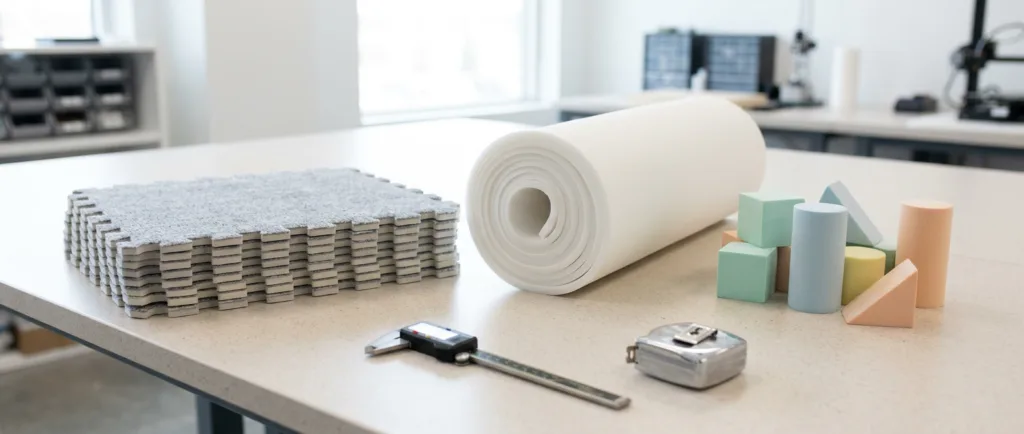
| Product variant | Headings a broker may discuss (examples only) | Facts that tend to move the decision |
|---|---|---|
| Rug-look interlocking EVA floor tiles | 3918 (floor coverings of plastics); 3921 (cellular plastic sheets) | Tile form, intended floor use, surface print or laminate, how it is marketed |
| Plain foam sheet or roll stock | 3921 (other plates and sheets, cellular) | Whether it is cut to a finished shape or sold as material |
| Mat with removable shapes or printed games | 9503 (toys, puzzles) vs. Chapter 39 headings | Whether play value dominates; age grading; GRI 3(b) for sets |
| Foam tumbling shapes for soft play | 9503 or 9506 vs. 3926 | Toy vs. gym or exercise use; age range; design |
| Vegan leather splat mat | Depends on material build-up and use | Plastic vs. coated fabric construction; floor vs. table use |
The table is a conversation starter, not a classification. It names no subheading and no duty rate on purpose. Rates and additional duties change, and a heading that looks right on paper can be wrong once the chapter notes and rulings are read in full.
How Do You Use an HTS Code Lookup Without Getting It Wrong?
An HTS code lookup on the USITC search tool is the right starting point, as long as you use it to build a shortlist rather than to pick a final answer. A disciplined process looks like this:
- Describe the product precisely. Material (for example EVA foam, Bio EVA or another foam), thickness, tile size, surface treatment, what is in the box, and who it is marketed to.
- Search by function and material, not by marketing name. Try “floor coverings,” “cellular plastics,” “toys” and “articles of plastics,” then read the full heading and its chapter notes.
- Read the section and chapter notes first. Under GRI 1, an exclusion note can rule out a chapter immediately.
- Search CBP’s Customs Rulings Online Search System (CROSS) for published rulings on similar foam mats, play mats and soft play items. Note the facts each ruling relied on.
- Write down your reasoning and the documents you relied on. If CBP asks later, a written rationale shows reasonable care.
- Confirm with a licensed customs broker before the first shipment, and consider a binding ruling for a new product line.
Two habits cause most mistakes: copying the six-digit code from a supplier’s commercial invoice, and reusing a code from a “similar” product without checking whether one design change (a textile top, a removable toy piece) changed the analysis.
What Is a CBP Binding Ruling and When Should You Request One?
A binding ruling is a written decision from CBP that applies customs law to a specific, described transaction. Under 19 CFR Part 177, rulings are generally issued for prospective transactions, meaning goods that have not yet arrived or been entered. The request should give a complete description of the facts and, where possible, include photos, drawings and a physical sample. A ruling letter represents CBP’s official position on that transaction and binds CBP personnel until it is modified or revoked, but only if the actual goods match the facts you described.
The regulation also cautions that rulings addressed to other companies should not be relied on as if they were your own. Published rulings are excellent research, but your product’s details may differ in ways that matter.
A ruling request makes the most sense when:
- You are launching a new mat format, material or bundle and expect steady volume.
- Your broker sees two defensible headings and the duty difference is meaningful.
- Your product combines materials (foam plus film, foam plus textile, mat plus toys).
- Retail or marketplace partners ask for documented classification.
Classification Is Connected to Your Other Compliance Files
The facts that drive classification also drive product safety obligations, so keep them consistent. If your mat is designed and marketed for children 12 and under, it is a children’s product for CPSC purposes, which brings third-party testing and a Children’s Product Certificate; our CPSIA compliance guide explains those steps. The same age grading appears in the 9503 statistical lines. When your marketing, labeling, test reports and entry data all describe the product the same way, both customs and safety reviews go faster.
Classification also feeds your cost model. The duty rate tied to the code is one input to landed cost, and the shipping terms you negotiate determine who handles export formalities on the origin side; see FOB vs EXW and other Incoterms for how responsibilities split.

What Your Manufacturing Partner Can Provide
Your supplier should not choose your HTS code, because the legal responsibility sits with the importer of record. A good manufacturing partner can, however, make your broker’s job much easier by providing:
- A material breakdown by layer (foam type, print film or laminate, backing) and approximate weight share.
- Tile dimensions, thickness and the number of pieces and accessories per retail set.
- Photos and drawings of the product and packaging, plus the intended age range and use.
- Test reports and certificates that describe the product consistently with the commercial invoice.
- Country of origin details and the production location for each component.
At Komat, we prepare this product data pack as part of every importer and distributor program, and our packaging and logistics team keeps carton marks and documents aligned with the specification.
Frequently Asked Questions
What is the HTS code for foam play mats?
There is no single answer that fits every foam play mat. Depending on form, use and marketing, brokers may consider floor-covering, plastic-sheet, other-plastic-article or toy headings. Because the right line depends on your exact product and current rulings, confirm the code with a licensed customs broker, and consider requesting a CBP binding ruling for a new design.
Is an HTS code the same as an HS code?
Not exactly. The HS code is the six-digit international code maintained by the World Customs Organization. The U.S. HTS code adds four more digits: the 8-digit level sets the U.S. duty rate line, and the 10-digit level is a statistical category. Other countries add their own national digits, so codes match at most to six digits.
Can I use the HTS code my supplier puts on the invoice?
Use it as a clue, not an answer. The supplier’s export code reflects the exporting country’s tariff, and the importer of record is responsible for the U.S. classification. Check the supplier’s code against the HTSUS headings, chapter notes and CBP rulings, then confirm with your broker before the goods ship.
How long does a CBP binding ruling take?
Timing varies with CBP workload and the complexity of the request, so plan for it well before your first shipment rather than relying on a fixed turnaround. A complete request with clear photos, a full material breakdown and a physical sample helps avoid follow-up questions that add time. Your broker or customs counsel can advise on current processing expectations.
Does the HTS code affect product safety testing?
Not directly, but the same facts drive both. Age grading, intended use and whether the item is a toy influence classification and also determine which CPSC rules apply. Keeping product descriptions consistent across marketing, labels, test reports and customs entries reduces questions from both agencies.
If you are planning a private-label mat line and want a manufacturing partner that hands your broker clean, consistent product data, contact the Komat team or browse our ready private-label designs to start your specification.