

A children’s product certificate (CPC) is the written statement in which a U.S. importer or domestic manufacturer certifies, based on passing tests at a CPSC-accepted third-party lab, that a children’s product meets every applicable CPSC safety rule. For imported play mats, the importer issues the CPC, and as of July 8, 2026 its data is eFiled with CBP at entry.
Key Takeaways
- A CPC is required for children’s products, meaning products designed or intended primarily for children 12 years of age or younger.
- For imported products, the importer is the certifier; for domestic products, the U.S. manufacturer is, with a private-labeler rule for privately labeled domestic goods.
- Under 16 CFR 1110.11, a certificate must identify the product, cite each applicable rule, identify the certifier, records custodian, place of manufacture and testing parties, and include a prescribed attestation.
- The CPC rests on third-party test reports; a General Certificate of Conformity (GCC) covers non-children’s products and does not generally require third-party testing.
- Certifiers must keep certificate records for at least five years from the certificate creation date.
What Is a Children’s Product Certificate?
A Children’s Product Certificate is a certificate of compliance required by section 14 of the Consumer Product Safety Act for children’s products subject to CPSC rules. It connects three things: a specific product, the list of rules that apply to it, and the third-party test results showing that the product passed. People also call it a “CPC certificate” or a “CPSC certificate,” but CPSC’s own term is Children’s Product Certificate.
The CPC does not replace testing; it summarizes and attests to it. If the underlying test reports are missing, outdated or for a different product, the certificate does not hold up. That is why we think of the CPC as the cover page of a compliance file rather than a standalone form. For the wider framework of limits and tests behind it, see our plain-English CPSIA guide.
Who Issues a Children’s Product Certificate?
Under 16 CFR 1110.7, the party that certifies depends on where the product is made:
- Imported products: the importer issues the finished product certificate.
- Domestic products: the U.S. manufacturer certifies. For privately labeled domestic products, the private labeler certifies unless the manufacturer issues the certificate.
For a brand that imports play mats from an overseas manufacturing partner, this means the brand (or whichever company acts as importer) owns the CPC. The manufacturer can supply test reports, material data and production details, but cannot carry the importer’s legal responsibility. Brands that sell through a separate importer of record should agree in writing who certifies, who keeps records and who responds to CPSC questions.

What Must a Children’s Product Certificate Include?
Since the amended rule took effect on July 8, 2026, the required content is set out in 16 CFR 1110.11. Some older guidance pages still describe the earlier seven-element format, so check the current eCFR text when you build your template.
| Element | What 16 CFR 1110.11 requires | Play mat example (illustrative) |
|---|---|---|
| 1. Product identification | At least one unique identifier (such as GTIN, UPC, model number or SKU) plus a description sufficient to match the product to the certificate | Model and SKU for a 16-tile rug-look EVA mat set, size, thickness and print name |
| 2. Applicable rules | Each applicable rule, ban, standard or regulation, listed separately | Lead content, lead in surface coatings (16 CFR 1303), phthalates (16 CFR 1307), toy standard (16 CFR 1250, ASTM F963-23) if applicable |
| 3. Certifier | Name, street address, city, state or province, country, email and telephone | The U.S. importer of record |
| 4. Records custodian | Person (or always-staffed position) maintaining the records, with full contact details | Compliance manager at the importer |
| 5. Date and place of manufacture | At least month and year; manufacturer name, address, email and telephone | Production month and the manufacturer’s site details |
| 6. Testing | Most recent test date and place, and full details of each third-party lab relied on | Lab name, address and report dates |
| 7. Attestation | Prescribed attestation text on paper and electronic certificates; built into eFiling for imports | Signed attestation by the certifier |
The rule also lets a certificate include a URL or other electronic means of reaching the underlying records. If a firm claims a testing exclusion, the certificate still lists all applicable rules and identifies the exclusion instead of a test date. Under 16 CFR 1110.9, eFiled certificates must be in English, and other certificates must be in English and may also include other languages.
How to Issue a Children’s Product Certificate, Step by Step
- Confirm the product is a children’s product. Review age grading, packaging and marketing against the factors in 16 CFR 1200.2. A rug-look mat sold for nurseries is a typical example.
- List every applicable rule with your lab. For a foam play mat this commonly includes total lead content, lead in surface coatings and phthalates, plus the toy standard if the mat is treated as a toy; our ASTM F963 overview explains when that happens.
- Lock the specification. Agree on the foam, print film, inks, backing, accessories and packaging with your manufacturer, and record them in a bill of materials.
- Test production-representative samples at a laboratory the CPSC has accepted for each rule you cite.
- Draft the certificate with all elements from 16 CFR 1110.11 and have the responsible person sign the attestation.
- File and distribute. eFile certificate data at entry for imports, give the certificate to distributors and retailers, and store the full record set.
- Plan retesting. Set periodic test dates and a change-control rule so that material or design changes trigger new tests and a new certificate.
Children’s Product Certificate Template: How to Structure One
The CPSC does not require a specific design, so a children’s product certificate template is really a checklist laid out as a page. A practical layout for play mat brands follows the order of 16 CFR 1110.11: a header with the product identifiers and a short description; a numbered list of each rule; a contact block for the certifier and records custodian; manufacturing date and place; a testing block that lists each lab and report date next to the rule it supports; and the attestation with signature and date.
Two habits make the template more useful. First, add your internal report numbers next to each rule so anyone can find the evidence quickly. Second, version the certificate by production lot or date range, so a later material change triggers a new certificate rather than an edit to an old one. Because certificates for imports are now eFiled, many importers keep the template as their internal master record and enter the same data through their broker or CPSC’s Product Registry.
CPC vs. GCC: What Is the Difference?
A General Certificate of Conformity (GCC) is the certificate used for general-use, non-children’s products that are subject to a CPSC rule. CPSC guidance explains that GCCs are issued by domestic manufacturers and importers, must be based on testing or a reasonable testing program, and do not require third-party testing. The table compares the two.
| Point | Children’s Product Certificate (CPC) | General Certificate of Conformity (GCC) |
|---|---|---|
| Products covered | Children’s products (primarily for ages 12 and under) subject to CPSC rules | General-use products subject to a CPSC rule |
| Testing basis | Third-party testing at a CPSC-accepted lab | A test of the product or a reasonable testing program; third-party not required |
| Who certifies | Importer (imports) or U.S. manufacturer (domestic) | Importer (imports) or U.S. manufacturer (domestic) |
| Ongoing testing | Periodic and material-change testing under 16 CFR 1107 | Per the firm’s reasonable testing program |
| Filing for imports (as of 2026) | eFiled with CBP | eFiled with CBP for most regulated products |
| Foam mat example | Rug-look puzzle mat marketed for baby play areas | Interlocking foam tiles for adult home gyms, if a CPSC rule applies |
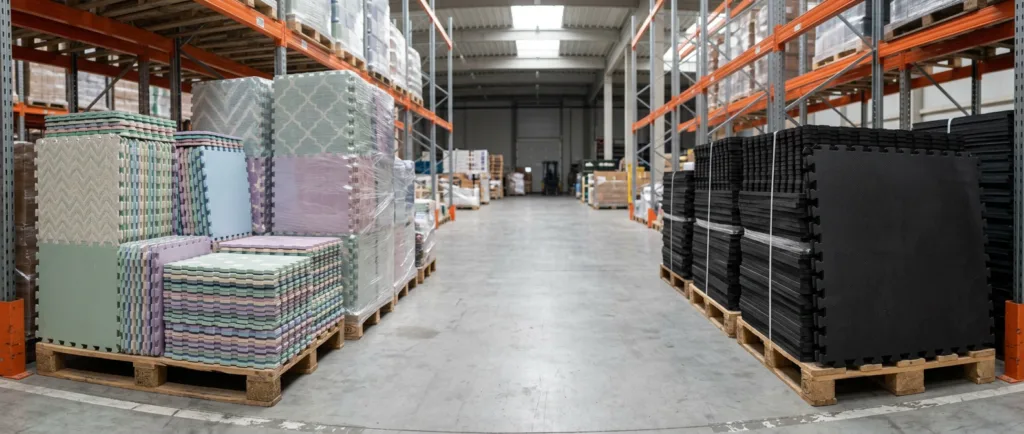
Not every general-use product needs a GCC, because a GCC is only required when a CPSC rule applies. Foam flooring sold for home fitness spaces may not be subject to the same rules as a children’s play mat, so ask your lab or counsel which, if any, apply.
Where Do You Keep the Certificate, and Who Gets a Copy?
Under 16 CFR 1110.13, a certificate must accompany each finished product or shipment, and each certificate covers a single product. For imports, the certifier eFiles the certificate data in CBP’s ACE system at entry; products imported by mail go into CPSC’s Product Registry before arrival. The certifier must furnish the certificate to each distributor and retailer, and certificates must be available for inspection within 24 hours of a CPSC or CBP request. Electronic certificates are allowed if a unique identifier appears on the product, carton or invoice and the certificate can be reached electronically.
Under 16 CFR 1110.17, certifiers must keep the supporting records, including test results, for at least five years from the certificate creation date. A shared folder per product and lot, with the certificate, test reports, bill of materials and change log together, makes audits and retailer requests far easier.

Retailers and online marketplaces add a practical layer on top of the regulation. Many ask suppliers to upload the certificate and supporting test reports before a listing goes live, and some re-request them when a product is reordered or a complaint arrives. If your certificate, test reports and product listing all use the same identifiers, model names and photos, those reviews are quick. If they do not match, approvals stall while someone reconciles the documents, which is avoidable with one master record per product.
Common Mistakes With Children’s Product Certificates
- Letting the supplier issue it. For imports, the importer is the certifier. A manufacturer-issued “CPC” for an importer’s product does not meet the rule.
- Vague product identification. “Foam play mat” is not enough. Use unique identifiers and a description that distinguishes sizes, prints and materials.
- Missing rules. Listing only lead and forgetting surface coatings, phthalates or the toy standard where they apply.
- Test reports that do not match. Reports for a different print, thickness or material version do not support the certificate.
- No update after changes. A new film supplier or ink change can require retesting and a new certificate.
- Weak record keeping. If you cannot produce the supporting records quickly, the certificate loses its value.
Good manufacturing partners reduce these risks by keeping materials stable and documenting every change. At Komat, test reports to ASTM F963, CPSIA, CA Prop 65, EN 71 and REACH are available on request, and our quality control system uses 100% in-process inspection at every station. Our importer program provides the material lists and production data your certificate needs.
Frequently Asked Questions
Who issues a children’s product certificate for imported products?
The importer. Under 16 CFR 1110.7, the importer certifies imported finished products, while the U.S. manufacturer certifies products made domestically. An overseas manufacturer can provide test reports and production details, but the importer’s name and contact details go on the certificate and the eFiled data.
Does a CPC have to be on official CPSC letterhead or a government form?
No. CPSC does not prescribe a particular template or letterhead. The certificate must contain every element in 16 CFR 1110.11, including the attestation, and be in English. For imported products, the same data is eFiled with CBP through the importer’s broker or CPSC’s Product Registry.
Can I use one CPC for several play mat designs?
Each certificate covers one product under 16 CFR 1110.13. If designs differ in material, print, thickness or accessories, they generally need their own product identification and supporting tests. Your lab can advise when a test result legitimately covers more than one version.
How long must I keep CPC records?
At least five years from the certificate creation date, under 16 CFR 1110.17. That includes the test results and other supporting records. Keeping the certificate, reports, bill of materials and change history in one place per product makes it easy to respond to CPSC, CBP or retailer requests.
What is the difference between a CPC and a test report?
A test report is the lab’s record of what was tested and the results. A CPC is the importer’s or manufacturer’s certification that the product complies with all applicable rules, based on those reports. You need both: the reports as evidence, and the certificate as the formal statement.
If you are planning a children’s play mat line and want a manufacturing partner that keeps your compliance file clean, browse our private-label designs or contact Komat to discuss specifications and documentation.