

Soft play equipment is foam-based play gear, such as climbers, ramps, steps, tumbling animals, blocks and mats, designed for young children to crawl, climb, balance and tumble on safely. For homes, daycares and indoor play spaces, the best soft play equipment is low to the ground, made from firm, wipe-clean foam, sized for the children using it and set on cushioned flooring with adult supervision.
Key Takeaways
- Soft play covers four main families: foam climbers and shape sets, tumbling animals, soft play blocks and the mats beneath them.
- Most pieces are either vinyl-covered foam shapes or solid molded EVA foam; each has different cleaning and durability trade-offs.
- CPSC’s public playground handbook recommends toddler climbing equipment no higher than 32 inches and says carpet and mats are inappropriate surfacing under equipment unless tested to ASTM F1292.
- Falls were the most common hazard pattern in CPSC’s review of playground incidents, so height and surfacing matter even indoors.
- Brands and retailers should match each product to its intended age and use, and confirm the applicable standards with their testing lab.
What Is Soft Play Equipment?
Soft play is a style of active play in which children move over, through and around padded foam shapes rather than rigid structures. Soft play equipment ranges from a single foam ramp in a family room to large modular sets in daycares and indoor play centers. Its purpose is gross motor development, the large movements of crawling, climbing, balancing, rolling and jumping, in an environment where bumps are softer than on wood, metal or plastic.
The appeal is easy to see. The American Academy of Pediatrics notes that physical play builds motor skills and supports healthy weight while also teaching empathy and teamwork. Soft play brings that kind of movement indoors, which is especially useful in winter, in small homes and in childcare settings where outdoor time is limited.
Types of Soft Play Equipment
Foam Climbers and Shape Sets
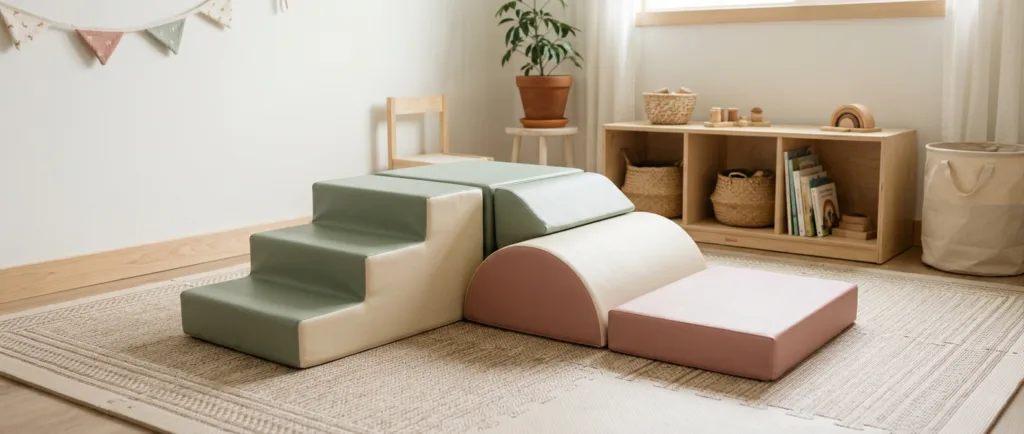
Foam climbers are modular shapes, typically steps, ramps, wedges, cylinders, half-cylinders, arches and cubes, that can be arranged into crawling and climbing courses. They are the core of most indoor soft play equipment. Sets designed for babies and young toddlers are low and wide; sets for preschoolers may include taller steps and tunnels.
Tumbling Animals and Rockers
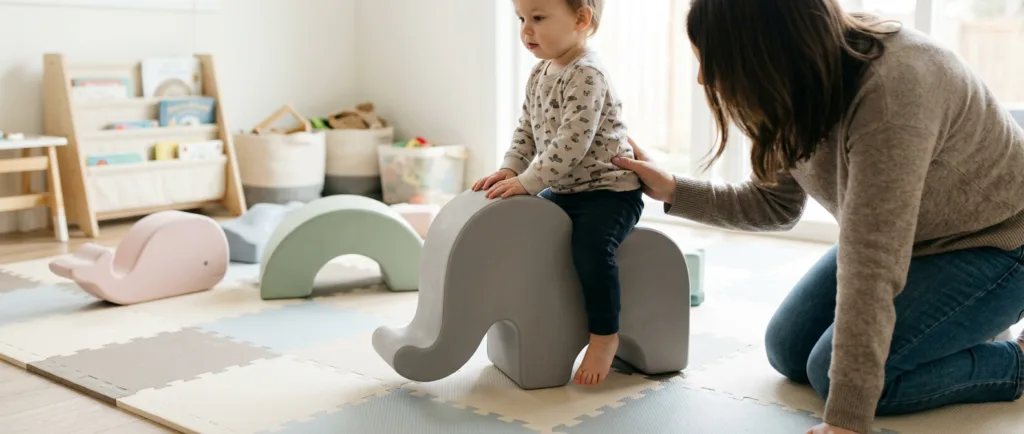
Tumbling animals are solid foam shapes in simple animal forms that children can sit on, straddle, climb over and rock. Because they are lightweight, children can push and drag them, which adds strength and coordination play. They are popular in both homes and toddler rooms because they double as seating and pretend-play props.
Soft Play Blocks
Soft play blocks are large, light foam blocks for building towers, walls and forts. Unlike climbers, they are meant to be moved, stacked and knocked down. They support problem-solving and cooperative play as well as movement.
Mats and Floor Tiles
Mats are the base layer: interlocking foam tiles or folding panel mats that cover the floor of the play area. They make crawling and sitting comfortable and soften everyday tumbles. As we explain below, though, ordinary play mats are not the same as tested impact-attenuating surfacing for climbing equipment.
| Type | Typical forms | Main skills | Common setting | Key safety point |
|---|---|---|---|---|
| Foam climbers | Steps, ramps, wedges, cylinders, arches | Crawling, climbing, balance | Homes, daycares, play centers | Keep height low for the age group |
| Tumbling animals | Solid foam animal shapes, rockers | Sitting balance, climbing, pretend play | Homes, toddler rooms | Stable base; supervise rocking |
| Soft play blocks | Large light cubes and bricks | Building, lifting, cooperation | Classrooms, playrooms | Avoid stacking into climbing towers |
| Mats and floor tiles | Interlocking tiles, folding panels | Crawling, floor play, tumbling | Everywhere | Comfort layer, not tested fall surfacing |
| Contained play structures | Multi-level padded play systems | Climbing, sliding, crawling | Commercial play centers | Specialist design and standards apply |
Materials and Covers
Most soft play equipment falls into two construction types.
Covered foam shapes have a foam core, often polyurethane or polyethylene foam, inside a sewn cover of coated fabric such as PVC-coated polyester (commonly called vinyl). Covers come in many colors, wipe clean and can sometimes be replaced. The trade-offs are seams and zippers: seams can split with heavy use, and any zipper should be hidden or child-resistant so children cannot open the cover and reach the foam.
Solid molded foam pieces, often EVA, are made from foam throughout with no separate cover. EVA (ethylene vinyl acetate) is a lightweight closed-cell foam, meaning its cells are sealed, so the surface resists absorbing liquids. Molded EVA pieces have no seams or zippers to fail and can be wiped clean directly. They are typically lighter than covered shapes of the same size, which suits tumbling animals and pieces children move themselves.
| Factor | Vinyl-covered foam shapes | Solid molded EVA foam |
|---|---|---|
| Construction | Foam core in a sewn coated-fabric cover | Foam throughout, no cover |
| Cleaning | Wipe cover; seams can trap dirt | Wipe surface directly; no seams |
| Failure points | Seams, zippers, cover tears | Surface dents or nicks with heavy use |
| Weight | Heavier for the size, more stable | Lighter; easy for children to move |
| Sizes and shapes | Very flexible; large pieces possible | Best for compact shapes and animals |
| Best fit | Climbers, ramps and large modular sets | Tumbling animals, small shapes, home use |
Soft Play Safety: Heights, Surfacing and Supervision
Soft does not mean risk-free. Children can still fall from foam climbers, and how far they fall and what they land on matters. The best-known U.S. guidance on fall heights is the Consumer Product Safety Commission’s Public Playground Safety Handbook. It is written for public playgrounds, not for home soft play, but its principles are a useful reference for any climbing equipment.
Fall height is the vertical distance from the highest designated play surface down to the surfacing below. Critical height is the fall height below which a life-threatening head injury would not be expected, and surfacing is rated by this value. In the handbook, CPSC:
- Recommends that toddler climbing equipment and platforms be no more than 32 inches high, with guardrails or barriers on elevated toddler surfaces above 18 inches.
- Says concrete, asphalt and other hard surfaces should never be directly under equipment.
- Lists carpet and mats as inappropriate surfacing unless they are tested to ASTM F1292, the impact attenuation standard for playground surfacing.
- Reports more than 200,000 playground injuries a year treated in emergency rooms, and found in a review of incidents from 2001 to 2008 that falls were the most common hazard pattern, at 44% of injuries.
A separate CPSC test report on surfacing for indoor play areas (2005) noted that an earlier study found carpet and safety floor tiles provided virtually no fall protection, and that among the materials tested, critical height generally increased with material thickness. The practical lesson for parents, teachers and product teams is clear: a play mat makes floor play comfortable, but it is not a substitute for tested surfacing under elevated climbing equipment.
For commercial indoor play centers, ASTM F1918 is the safety performance specification for soft contained play equipment, covering users from 2 to 12 years old. It explicitly excludes home playground equipment and toys and juvenile products, so the standards that apply to a product depend on what it is and who it is for. As of 2026, brands should confirm applicable requirements with their testing lab or compliance counsel.
Practical safety habits for any setting:
- Choose equipment sized for the youngest children who will use it, and keep climbing heights low.
- Place soft play on continuous cushioned flooring, away from walls, furniture edges, windows and hard floors.
- Leave clear space around climbers so children are not landing on other equipment.
- Do not stack blocks or shapes into improvised towers for climbing.
- Supervise actively; foam reduces bumps but does not prevent falls.
- Inspect regularly for split seams, exposed foam, loose zippers or chunks bitten off, and retire damaged pieces.
Cleaning Soft Play Equipment
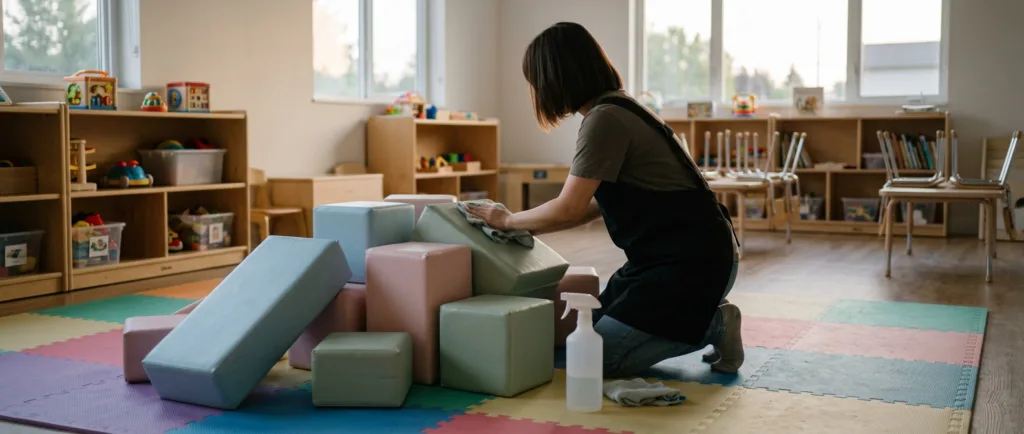
Soft play gets touched, sat on, drooled on and sneezed on, so cleaning should be routine. For homes, wipe surfaces with a damp cloth and mild soap, then dry. For daycares and commercial spaces, follow your licensing agency’s cleaning and sanitizing requirements and the equipment manufacturer’s instructions on which products are safe for the covers or foam. General tips:
- Wipe high-touch surfaces daily in group settings, more often during illness outbreaks.
- Avoid soaking foam or forcing liquid into seams and zippers.
- Let pieces dry fully before stacking or storing.
- Check undersides and the floor beneath for crumbs and moisture.
Soft Play at Home vs in Daycares and Play Spaces
At home, soft play usually means a few low pieces, such as a ramp, steps and a tumbling animal, on a rug-look foam mat in the playroom or living room. The priorities are low height, easy cleaning and a look that fits the room. Our playroom ideas guide shows how to zone an active play corner, and our guide to a safe toddler play area covers the surrounding setup.
In daycares and indoor play spaces, equipment sees far heavier use by many children of different ages. Durability, cleanability, age-appropriate zoning, local licensing rules and documentation of testing all become central. Our daycare and commercial page outlines how foam floors and soft play pieces fit those environments.
How Brands and Retailers Source Soft Play
For brands and retailers, sourcing indoor soft play equipment comes down to a few decisions:
- Define the user and setting. Home toddler use, daycare rooms and commercial play centers carry different expectations and standards.
- Choose construction. Covered foam suits large climbers; solid EVA suits tumbling animals and compact pieces.
- Plan testing early. Agree with your lab which standards apply to each SKU and build that into development.
- Coordinate the floor. Selling soft play alongside matching foam mats gives customers a complete, coordinated play area.
- Check quality systems. Ask how your production partner inspects pieces during production, not just at the end.
At Komat, our soft play range focuses on EVA foam tumbling animals, designed to sit alongside our rug-look EVA puzzle mats so brands can offer a coordinated play space. Our production line runs 100% in-process inspection at every station, with a shipping yield of 99.7% or higher and 1:1 replacement for defective units on delivery. Our products are designed to meet ASTM F963, CPSIA, CA Prop 65, EN 71 and REACH requirements, with test reports available on request. See the range on our soft play page, or learn how we support private-label programs on our brand owners page.
Frequently Asked Questions
What age is soft play equipment for?
Soft play equipment is made for a wide range of ages, from low crawling shapes for babies to larger climbers for preschoolers and contained play structures for older children. Always follow the age labeling on each product. For toddlers, CPSC’s playground handbook recommends climbing equipment no higher than 32 inches, which is a useful reference for indoor pieces too.
Is a foam play mat enough under soft play climbers?
A foam play mat makes floor play comfortable and softens everyday bumps, but it is not the same as tested impact-attenuating surfacing. CPSC lists carpet and mats as inappropriate surfacing under equipment unless they are tested to ASTM F1292. Keep climbers low, leave clear space around them and supervise closely.
What is the difference between soft play blocks and foam climbing blocks?
Soft play blocks are light foam pieces meant to be stacked, carried and knocked down for building play. Foam climbing blocks, such as steps, ramps and wedges, are firmer and designed to be climbed and crawled over. Do not stack building blocks into towers for climbing, as they are not designed to stay stable under a child’s weight.
How do you clean soft play equipment?
Wipe surfaces with a damp cloth and mild soap, then dry. Avoid soaking foam or pushing liquid into seams and zippers. In daycares, follow your licensing agency’s cleaning and sanitizing rules and the manufacturer’s guidance on suitable products. Inspect pieces regularly and retire any with split covers or exposed foam.
Is EVA foam good for soft play equipment?
EVA is a lightweight closed-cell foam that resists absorbing liquids and can be molded into seamless shapes, which makes it well suited to tumbling animals and compact soft play pieces. Larger climbers are often made from foam cores in vinyl covers instead. Whatever the material, choose products tested to the standards that apply to their intended age and use.
If you are a brand, distributor or retailer building a soft play and play mat range, browse Komat’s coordinated patterns on our designs page, or contact our team to discuss your program.