
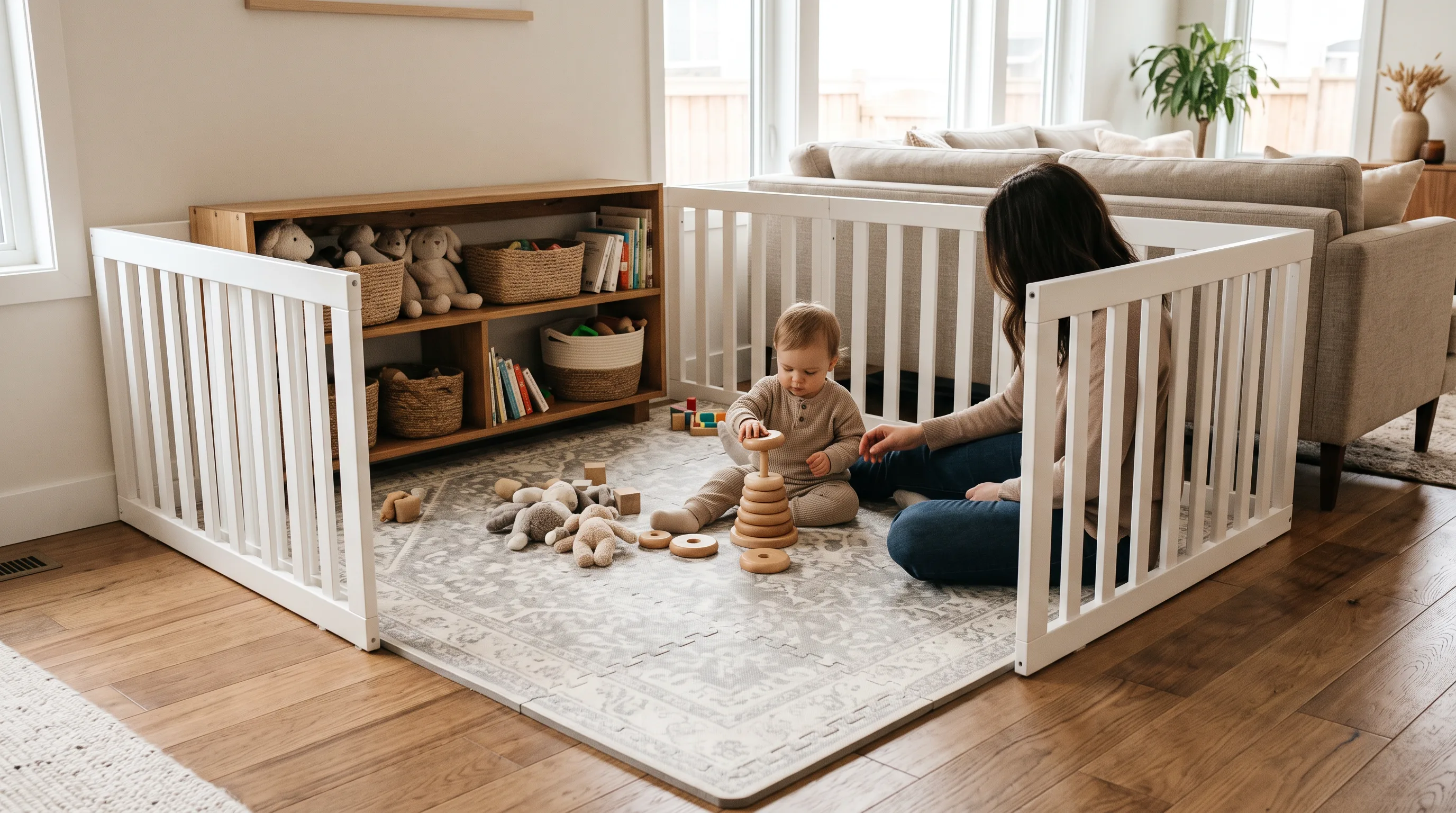
A safe toddler play area is a defined, baby-proofed space on a soft floor, within sight of an adult, with anchored furniture, gates where needed and only age-appropriate toys. To set one up, choose a spot you can supervise, clear and secure hazards, lay down cushioned flooring, add boundaries and storage, then keep it clean with a simple routine.
Key Takeaways
- The best toddler play area is one an adult can see from where they usually sit, cook or work.
- CPSC advises anchoring TVs, bookcases and dressers to the wall; tip-overs injure thousands of children every year.
- Hardware-mounted gates are recommended at the top of stairs; pressure-mounted gates are not secure enough there.
- Soft, continuous flooring such as interlocking EVA foam tiles cushions everyday falls and makes floor play more comfortable.
- Choose toys whose parts are larger than your child’s mouth, and keep cords, button batteries and small magnets out of reach.
What Is a Toddler Play Area?
A toddler play area is a dedicated part of the home where a child roughly one to three years old can move, explore and play on their own while an adult stays close by. It is not a locked-away room or a substitute for supervision. It is a space prepared in advance so that most of what a toddler can reach is safe to touch, climb on, drop or put in their mouth.
Toddlers are a specific design challenge. They walk but still fall often, they climb before they understand height, and they test everything by mouthing it. An indoor play area for toddlers works when it accounts for all three: soft ground, nothing tempting to climb, and nothing small enough to swallow. The steps below follow the order we recommend to parents and to the brands who build products for them.
Step 1: Choose the Right Spot
Location matters more than size. Toddlers play longer and more independently when they can see and hear a familiar adult, so a corner of the living room, the edge of an open kitchen or a family room usually beats a separate room down the hall. When you choose a spot, look for:
- Line of sight from the places adults spend the most time.
- Distance from stairs, the front door and the kitchen work zone (stove, oven, knife drawer).
- Distance from windows and window covering cords. CPSC advises moving cribs, beds, furniture and toys away from windows and cords, and recommends cordless window coverings wherever children may be present.
- A flat, level floor without floor vents, heaters or loose transition strips inside the play footprint.
- Natural light and airflow, which make the space pleasant for everyone.
Step 2: Baby-Proof Before You Furnish
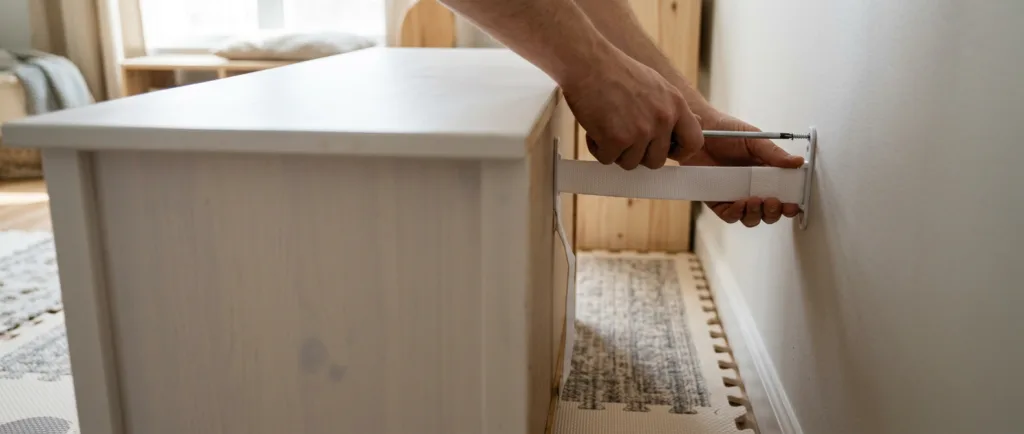
Baby-proofing is the process of removing or securing household hazards a young child can reach. Do it at a toddler’s eye level: get down on your knees and look for what is within reach, what could be pulled down and what could be climbed.
Furniture tip-overs deserve top priority. The U.S. Consumer Product Safety Commission reports an estimated 17,800 emergency department-treated injuries per year from TV, furniture and appliance tip-overs (2020 to 2022), with children under 18 accounting for 44% of injuries, and 217 reported deaths from 2013 through July 2023, 55% of which involved children aged 1 to 3. CPSC’s advice is simple: anchor TVs and furniture such as bookcases and dressers securely to the wall, put heavier items on lower shelves and do not store toys or remotes where kids may be tempted to climb.
Then work through the rest of the room:
- Cover unused outlets and route electrical cords behind furniture.
- Add soft corner guards to low tables and hearths near the play area.
- Lock cabinets that hold cleaning products, medicines or batteries.
- Remove houseplants, candles and decorative objects from low surfaces.
- Check the floor for coins, small toy pieces, pet food and loose batteries.
Step 3: Lay Down Soft, Continuous Flooring
Toddlers fall constantly while learning to walk, squat and climb, and they spend hours sitting and kneeling. A hard floor is cold and unforgiving; a thin rug can slide. Soft flooring for a toddler play area should be cushioned, stable under foot, continuous with no gaps between pieces and easy to clean.
Interlocking EVA foam tiles are a popular solution because they let you build exactly the footprint you need, add border pieces for clean edges and replace one tile instead of the whole floor. EVA (ethylene vinyl acetate) is a lightweight closed-cell foam, which means its cells are sealed and spills sit on the surface rather than soaking in. If you are comparing options for crawling babies as well as toddlers, see our guide to choosing a baby crawling mat for hard floors, and our non-toxic play mat guide for what to ask about materials and testing.
A soft floor reduces bumps and bruises from everyday falls, but it is not engineered surfacing for climbing equipment. Keep climbing structures low and supervised.
Step 4: Add Boundaries and Gates
Boundaries tell a toddler where play happens and keep them away from hazards you cannot remove, such as stairs or the kitchen. Options include room-divider play yard panels, baby gates across doorways and furniture arranged to create a natural enclosure.
Gates are regulated in the United States. CPSC’s mandatory rule for gates and enclosures (16 CFR part 1239) incorporates the ASTM F1004 standard and covers products intended for children 6 to 24 months; under the rule, products manufactured after January 21, 2023 must meet ASTM F1004-22. Brands sourcing gates or enclosures should confirm the current version with their testing lab, as of 2026.
For placement, Vanderbilt University Medical Center’s injury prevention program advises using hardware-mounted gates at the top of stairs, notes that pressure-mounted gates are not secure enough to prevent falls there, and recommends gates at both the top and bottom of stairs. Always follow the gate manufacturer’s instructions on where a gate may be used.
If you use a play yard or playpen inside the play area, put a mat that fits the enclosure underneath. Our playpen mat guide covers sizes and setup.
Step 5: Pick Age-Appropriate Toys and Storage
A toddler play space does not need many toys. It needs the right ones, rotated often and stored where a child can reach them safely.
- Size: The American Academy of Pediatrics advises making sure all toys and parts are larger than your child’s mouth. In the U.S., toys intended for children under 3 are subject to federal small-parts rules (16 CFR part 1501).
- Batteries and magnets: The AAP warns about button or coin batteries and high-powered magnets that can come loose.
- Strings and ribbons: Remove loose ribbons or strings from stuffed toys.
- Open-ended toys: Blocks, stacking rings, shape sorters, simple puzzles, push toys and board books support many kinds of play.
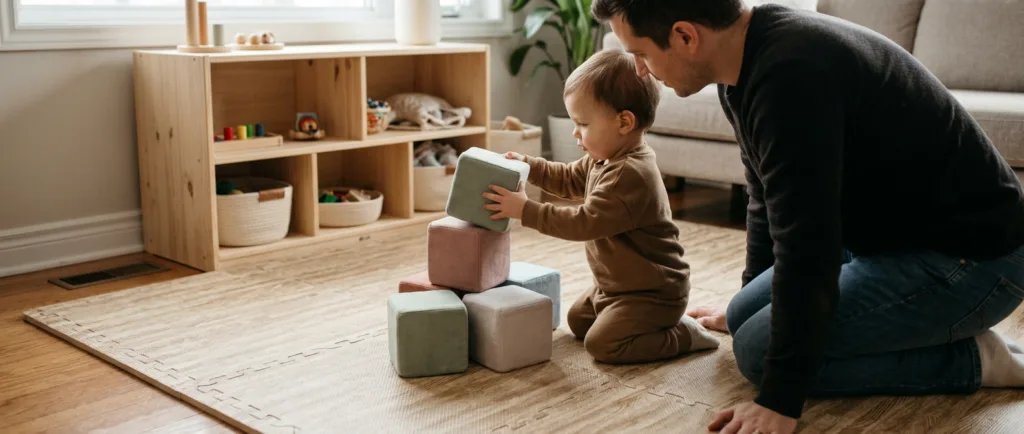
- Storage: Low, open shelves anchored to the wall, with baskets a toddler can lift. Avoid heavy lidded chests that can slam shut on fingers.
- Older siblings’ toys: Keep small-part sets on high shelves or in another room.
Toddler Play Area Setup Checklist
Use this checklist when you set up the space and again every few months as your child grows. Toddlers gain new skills quickly, and a space that was safe at 14 months may not be at 24 months.
| Area | Check | Why it matters | Done? |
|---|---|---|---|
| Location | Visible from where adults usually sit or cook | Supervision is the most important safety layer | ☐ |
| Furniture | Bookcases, dressers and TVs anchored to the wall | CPSC: tip-overs injure and kill young children | ☐ |
| Windows | Cordless coverings; furniture moved away from windows | Window cords are a strangulation hazard | ☐ |
| Electrical | Outlets covered; cords hidden or secured | Prevents pulling and mouthing cords | ☐ |
| Floor | Soft, continuous mat with edges finished, no gaps | Cushions everyday falls; stable footing | ☐ |
| Stairs | Hardware-mounted gate at top; gate at bottom | Falls are a leading cause of child injury | ☐ |
| Toys | Age-labeled; parts larger than the child’s mouth | Reduces choking risk | ☐ |
| Batteries and magnets | Battery covers secured; loose magnets removed | Swallowed batteries and magnets cause serious injury | ☐ |
| Storage | Low, open, anchored; no heavy lidded chests | Prevents climbing and pinched fingers | ☐ |
| Cleaning | Daily sweep, weekly wipe-down routine | Keeps the floor free of crumbs and small objects | ☐ |
Step 6: Set a Simple Cleaning Routine
A play area that is easy to clean gets cleaned. A practical routine looks like this:
- Daily: pick up toys, sweep or vacuum the mat and do a quick scan for small objects.
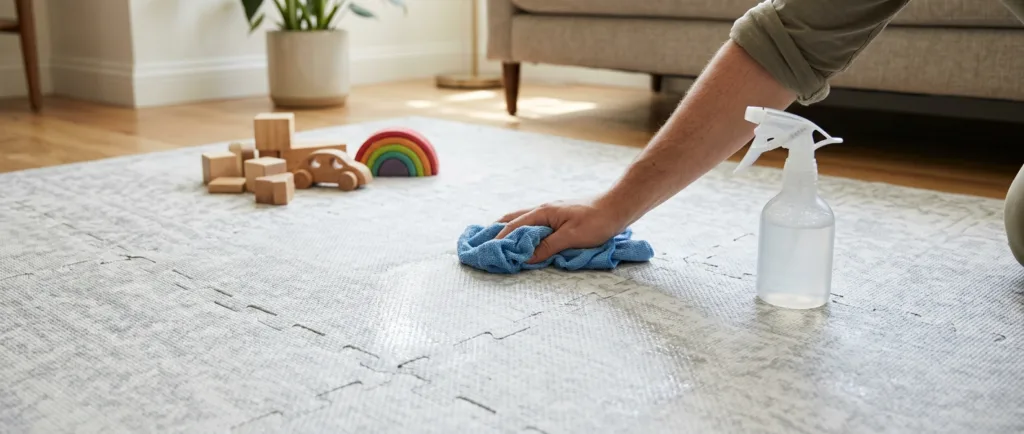
- After spills: wipe the surface promptly with a damp cloth and mild soap, then dry it.
- Weekly: wipe the whole mat and the toys that get mouthed most.
- Monthly: lift the tiles, clean underneath, check for damaged edges and reassemble.
Avoid harsh solvents and soaking foam seams. Closed-cell EVA does not absorb liquid the way carpet does, which is a big part of why parents choose it for messy toddler years.
| Flooring option | Cushioning | Stability for new walkers | Cleaning after spills | Notes |
|---|---|---|---|---|
| Bare hardwood or tile | None | Firm, can be slippery in socks | Very easy | Hard landings |
| Area rug on hard floor | Low to moderate | Can slide without a non-slip pad | Spills soak in | Needs regular deep cleaning |
| Interlocking EVA foam tiles | Good | Stable when locked together | Wipe clean | Expand or reconfigure as needed |
| Single-piece roll-out mat | Varies by thickness | Good | Wipe clean | Fixed size; harder to store |
Making the Toddler Play Space Look Good
A toddler play space often lives in the most visible room in the house, so it should fit the décor. Rug-look printed foam tiles in neutral or soft pastel patterns look like an area rug rather than a gym floor. Low wooden shelves, woven baskets and a small reading corner keep the space calm. For layout and color ideas by zone, see our playroom ideas guide, and for how Komat approaches floor-level spaces for babies and toddlers, visit our baby play areas page.
At Komat, we design rug-look EVA puzzle mats with patterns matched across tiles, a 1/2-inch standard thickness and an EVA formulation with formamide under 2 ppm. Our mats are tested to ASTM F963, CPSIA, CA Prop 65, EN 71 and REACH requirements, with reports available on request.
Frequently Asked Questions
How big should a toddler play area be?
There is no fixed size. The area should fit a child and an adult sitting side by side, plus room to crawl, walk a few steps and spread out toys. Many families start with a mat area roughly the size of a medium rug and expand with extra tiles as the child becomes more mobile. Fit the space to your room and keep it within an adult’s line of sight.
Do I need a baby gate for a toddler play area?
You need gates wherever a toddler could reach a hazard you cannot remove, especially stairs. Injury prevention experts recommend hardware-mounted gates at the top of stairs because pressure-mounted gates are not secure enough there. Inside the play area, play yard panels or furniture can create boundaries. Always follow the gate manufacturer’s instructions on approved locations.
What flooring is best for a toddler play area?
Choose a floor that is cushioned, stable and easy to clean. Interlocking EVA foam tiles are a common choice because they soften everyday falls, stay put when locked together, wipe clean after spills and can be resized. Look for products tested to children’s product safety standards, and use border pieces so edges do not become trip points.
How do I baby-proof a play area on a budget?
Focus on the highest-risk items first: anchor furniture and TVs, block stairs, move furniture away from windows and cords, and remove small objects and batteries from reach. These steps cost little but address the most serious hazards. Then add a soft floor, a few open-ended toys and low storage over time.
How often should I clean a toddler play mat?
Sweep or vacuum daily and wipe spills right away with a damp cloth and mild soap. Give the whole mat a wipe-down weekly, and lift interlocking tiles once a month to clean underneath and check for damage. Avoid harsh solvents and soaking the seams.
If your brand or store sells to parents setting up toddler play spaces, explore Komat’s rug-look patterns on our designs page, or contact us to discuss a private-label program.
Sources
- CPSC: Reminder to Tackle the Deadly Hazard of TV and Furniture Tip-Overs (2024)
- CPSC Business Guidance: Gates and Enclosures
- Vanderbilt University Medical Center: Stair Safety Tips
- HealthyChildren.org (AAP): How to Buy Safe Toys
- eCFR: 16 CFR Part 1501, Small Parts for Children Under 3
- CPSC: Go Cordless With Window Coverings (2023)