
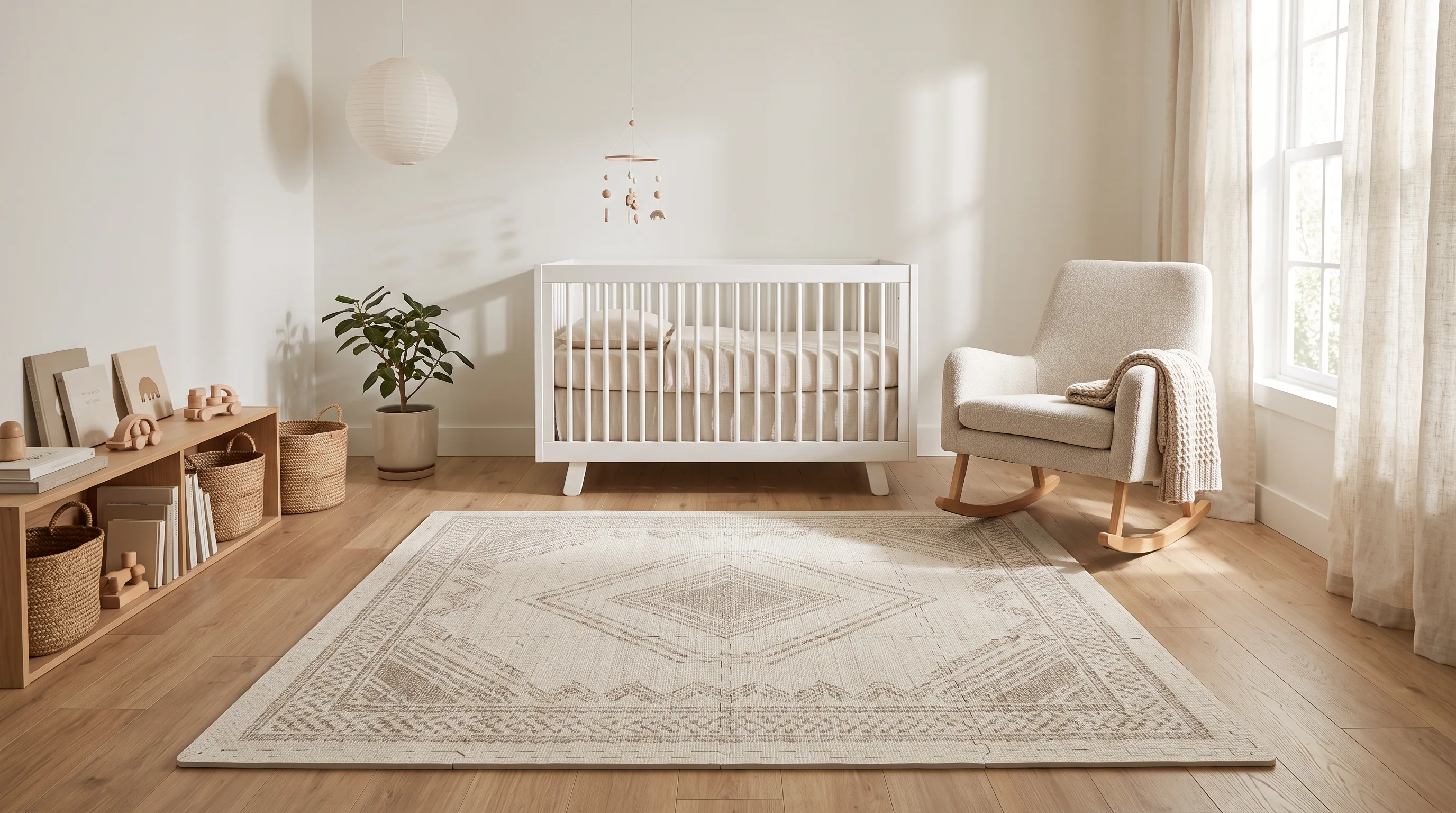
A nursery rug adds warmth, texture and style to a baby’s room, while a foam play mat adds cushioning and wipe-clean protection where a baby actually plays. For most families, a rug-look foam mat works better in the main play zone because it handles spills, tummy time and early falls, and a traditional nursery rug works best under a glider or along walking paths.
Key Takeaways
- Traditional nursery rugs win on texture and classic style; foam play mats win on cushioning and easy cleanup.
- Closed-cell EVA foam does not absorb spills the way rug fibers do, which matters during the spit-up and first-foods months.
- The Asthma and Allergy Foundation of America recommends washable throw rugs washed weekly in hot water of at least 130°F to control dust mites.
- Any rug on a hard floor should have a non-slip backing or pad; CDC injury researchers have documented adult fall injuries involving rugs and carpets.
- Neither a rug nor a play mat is a sleep surface: the AAP says babies should sleep on their backs on a firm, flat surface in their own crib or bassinet.
What Is a Nursery Rug, and What Is a Foam Play Mat?
A nursery rug is a textile floor covering, usually woven, tufted or knitted from wool, cotton or synthetic fibers, placed in a baby’s room for warmth, sound softening and style. A foam play mat is a cushioned floor covering made of foam, often EVA (ethylene vinyl acetate) puzzle tiles or a single roll-out piece, designed for babies and toddlers to lie, crawl and play on.
The two used to look very different. Rugs were the décor choice and foam mats were the bright, practical choice that parents tolerated. That gap has closed. Rug-look foam mats now carry printed patterns, from distressed medallions to soft geometrics, that read as an area rug from across the room. So the question for many parents is no longer “pretty or practical?” but “which surface suits each part of the nursery?”
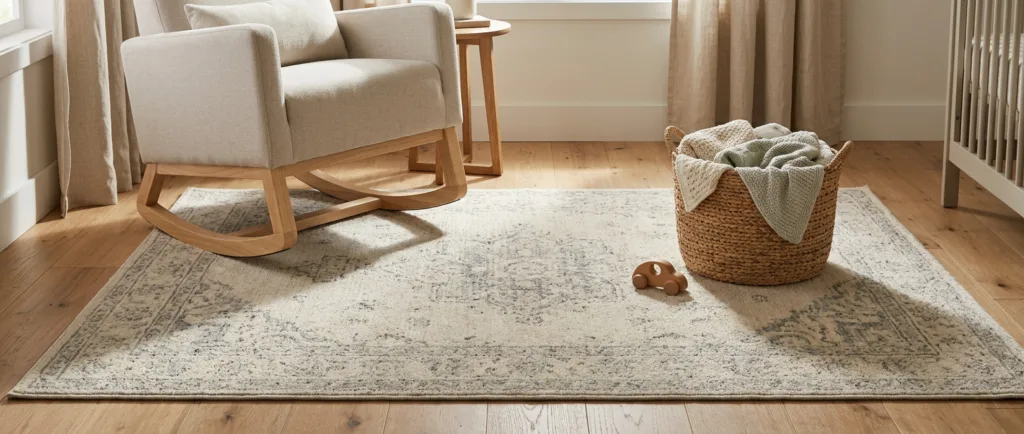
Nursery Rug vs Play Mat: Side-by-Side Comparison
The table below compares a typical woven or tufted nursery rug with an interlocking rug-look EVA foam play mat across the factors parents ask us about most. Actual performance depends on the specific product, its thickness, pile height and backing, so read product details carefully.
| Factor | Traditional nursery rug | Rug-look foam play mat |
|---|---|---|
| Cushioning | Low to moderate; depends on pile and rug pad | Good; foam compresses under knees, elbows and bumps |
| Spills and spit-up | Liquids soak into fibers and backing | Liquids sit on the closed-cell surface; wipe away |
| Washing | Spot clean, professional clean, or machine wash if labeled washable | Wipe with damp cloth and mild soap; lift tiles to clean underneath |
| Dust mites and allergens | Fibers can hold dust; regular hot washing or HEPA vacuuming needed | Smooth surface is easy to wipe; dust collects at seams and underneath |
| Slip on hard floors | Needs a non-slip pad or backing | Foam grips most hard floors; keep tiles locked together |
| Warmth and texture | Soft, warm, tactile; classic look | Warm underfoot; smooth printed surface |
| Style | Wide range of weaves, piles and colors | Printed rug-look patterns; best when pattern matches across tiles |
| Flexibility | Fixed size and shape | Add, remove or reshape tiles as the baby grows |
| Longevity | Can last many years with care | Replace individual damaged tiles; lifespan depends on use |
Cushioning: Where Foam Has the Clear Edge
Cushioning is the floor’s ability to compress and soften contact when a baby lies, rolls, kneels or topples over. A thin, flat-weave nursery rug offers little of it; a plush rug on a thick pad offers more, but plush piles can be harder for a new crawler to move across and harder to keep clean. A foam mat gives consistent cushioning across its whole surface, which is why it suits the main play zone where babies spend most of their floor time.
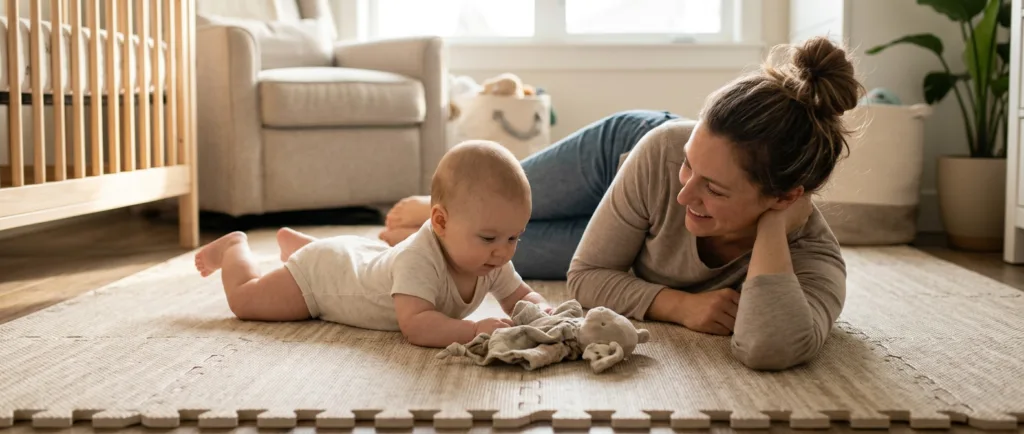
The AAP stresses that babies need a safe space to crawl and explore, with toys within reach and supervised tummy time. A cushioned, flat and stable surface makes that floor time more comfortable for both baby and parent. Our tummy time mat guide covers when to start and what surface works best.
Spills, Washing and Hygiene
The first year is messy. Spit-up, leaking diapers, milk bottles and, later, first foods all end up on the nursery floor. This is the factor where the two options differ most.
Rug fibers and backing absorb liquid. Many spills can be spot cleaned, but repeated milk spills can leave odor and staining that only a deep clean removes. Washable nursery rugs are a useful middle ground: thinner rugs designed to go in a home washing machine. If you choose one, check the care label for size limits and drying instructions before you buy.
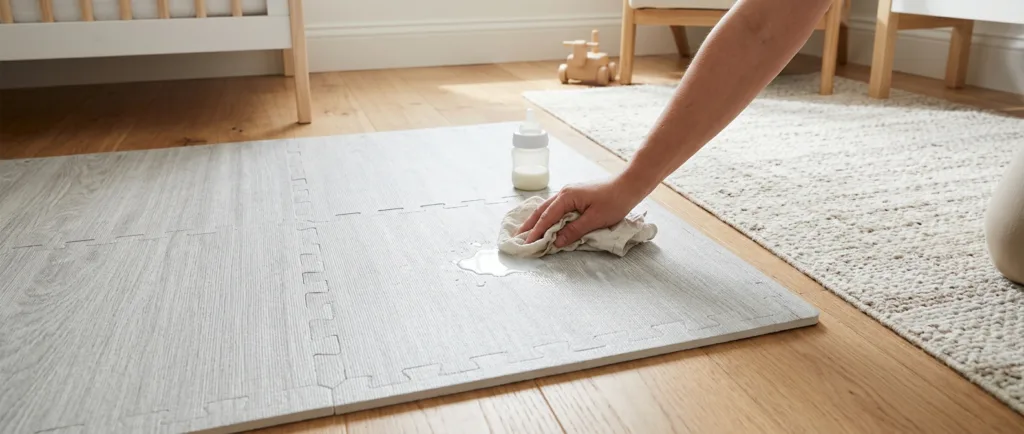
A closed-cell foam is a foam whose cells are sealed from each other, so liquid stays on the surface instead of soaking into the material. That means a spill on an EVA mat can usually be wiped away with a damp cloth and mild soap. Dust and crumbs do collect at seams and underneath tiles, so lift the mat periodically to clean the floor below.
Allergens and Dust Mites
Dust mites are microscopic creatures that live in household dust and feed on shed skin; their waste is a common indoor allergen. The Asthma and Allergy Foundation of America (AAFA) notes that dust mites thrive in wall-to-wall carpeting, curtains and fabric-covered furniture, and suggests choosing solid-surface flooring and washable throw rugs where possible. AAFA recommends washing bedding and throw rugs weekly in hot water of at least 130°F, using a vacuum with a HEPA filter, and keeping indoor humidity between 30% and 50%. It also cautions that vacuuming alone is not enough to remove all dust mites and their waste.
For families managing allergies, that points toward two practical choices: a small washable nursery rug that can go through a hot wash, and a smooth, wipeable play mat in the main play zone. If your child has diagnosed allergies or asthma, ask your pediatrician or allergist which flooring setup suits your home.
Slip, Trips and Safe Movement
A baby room rug can slide on hardwood or tile, which is a risk for an adult carrying a baby at night as much as for a toddler learning to walk. A 2013 study by researchers at the CDC’s National Center for Injury Prevention and Control, published in the Journal of Injury and Violence Research, examined fall injuries in adults associated with rugs and carpets. The authors suggested securing rugs with adhesive tape or non-skid backing and repairing curled carpet edges, and flagged transitions between carpeted and non-carpeted areas as particularly hazardous.
In practice: put a non-slip pad under every nursery rug on a hard floor, keep edges flat, and avoid placing a rug edge right where you walk from the door to the crib. Interlocking foam tiles generally grip hard floors well; use border pieces so the mat has a beveled, finished edge rather than a puzzle edge that can catch toes.
Rugs, Mats and Safe Sleep
One point is not a matter of preference. Neither a rug nor a play mat is a place for a baby to sleep. The American Academy of Pediatrics recommends that babies sleep on their backs on a firm, flat surface in their own crib or bassinet with only a fitted sheet, and that if a baby falls asleep somewhere else, they be moved to a firm sleep surface as soon as possible. Play mats are for awake, supervised time.
Style: Making Both Look Intentional
Style is where rugs traditionally win, and where rug-look foam mats have caught up. A few principles help either option look deliberate:
- Size to the furniture. A rug should anchor the glider and side table; a play mat should cover the open floor where play happens.
- Pick a calm base color. Ivory, oatmeal, soft grey and muted pastels hide everyday marks and let toys and art add color.
- Look for pattern continuity. On foam mats, a pattern that lines up across tiles reads as one rug; mismatched tiles look like a gym floor.
- Layer textures. A woven rug, a printed foam mat, linen curtains and wood furniture together create a warm, finished room.
When to Use Both
Many nurseries end up with both, each doing what it does best. A common layout:
- Glider zone: a low-pile, washable nursery rug with a non-slip pad under the chair and side table.
- Play zone: a rug-look foam mat in the open center of the room for tummy time, rolling, crawling and early walking.
- Walking path: bare floor or a flat, secured runner between door and crib.
| Nursery zone | Best surface | Why |
|---|---|---|
| Under glider or rocking chair | Low-pile washable rug on non-slip pad | Warm, quiet underfoot; low traffic from baby |
| Open play area | Rug-look foam play mat | Cushioning and wipe-clean surface for floor time |
| Door-to-crib walking path | Bare floor or secured flat runner | Reduces trip risk for adults carrying a baby |
| Changing table area | Wipe-clean surface or washable mat | Accidents happen; easy to clean |
| Inside the crib | Firm mattress with fitted sheet only | AAP safe sleep guidance |
If you are wondering about what foam play mats are made of, our article Is EVA Foam Toxic? explains what parents and brands should know about EVA, and our EVA foam puzzle mat buyer’s guide walks through thickness, edges and print quality.
What Komat Builds for Nursery Floors
At Komat, we design rug-look printed EVA puzzle mats for brands that sell into nurseries and family rooms. Our patented non-continuous print lamination is designed so the printed film does not peel, our borderless puzzle design hides seams, and our patterns are matched across tiles so the floor reads as a single rug. Our standard thickness is 1/2 inch, our EVA formulation keeps formamide under 2 ppm, and our mats are tested to ASTM F963, CPSIA, CA Prop 65, EN 71 and REACH requirements, with reports available on request. Learn more on our baby play areas page.
Frequently Asked Questions
Is a nursery rug or a play mat better for tummy time?
A foam play mat is usually the better tummy time surface. It is cushioned, flat and stable, and it wipes clean after spit-up. A low-pile rug can work if it is clean and secured, but deep plush piles are less stable and harder to clean. Whatever the surface, tummy time should always be supervised and done while the baby is awake.
Can I put a foam play mat on top of a nursery rug?
You can place a foam mat over a low-pile, flat rug, but avoid laying one over a thick or plush rug, which can make the mat uneven and unstable. On hard floors, foam tiles usually grip well on their own. If you layer, check that the mat stays flat and locked together and does not shift when your baby moves.
Are washable nursery rugs worth it?
Washable nursery rugs are worth considering, especially for families managing allergies or frequent spills. They let you wash away dust and odors at home. Check the care label for washer size and drying instructions. Allergy experts recommend washing throw rugs weekly in hot water of at least 130°F to control dust mites.
What size nursery rug do I need?
Size the rug to the furniture it anchors. Under a glider, choose a rug large enough for the chair’s front legs or the whole chair to sit on it, with a non-slip pad underneath. For the open play area, many parents prefer a foam play mat sized to the free floor space, since tiles can be added later.
Can my baby nap on a play mat or rug?
No. The AAP recommends that babies sleep on their backs on a firm, flat surface in their own crib or bassinet with only a fitted sheet. If your baby falls asleep on a play mat, rug or in your arms, move them to their crib or bassinet as soon as possible.
If you are a brand or retailer building a nursery flooring line, browse Komat’s rug-look patterns on our designs page or contact our team about private-label options.